
Ghiyath al-Din Muhammad
Sultan of Ghurid Empire
About Ghiyath al-Din Muhammad
Lived 1139 – 1202 (aged 62–63).
Ghiyath al-Din Muhammad , also known as Ghiyath al-Din Ghori or Ghiyassuddin Ghori ( – 13 March 1203), was the Sultan of the Ghurid dynasty from 1163 until his death in 1203. During the diarchy of Ghiyath and his younger brother Muhammad of Ghor, who governed the eastern realm of the Ghurid Empire, the Ghurids emerged as one of the greatest powers of the eastern Islamic world.
During his early reign, he defeated the Ghurid claimants to the throne and fought with the Khwarazmian Empire over the lordship of Khorasan. He occupied Ghazna and Herat by 1175 and went on to establish control over most of what is now Afghanistan and the surrounding areas by 1200, and as far west as Bastam and Gurgan. His brother, Mu'izz al-Din, helped manage and expand the eastern part of the empire (as far as Bengal) and served Ghiyath with utmost loyalty and deference. Ghiyath died in 1203 and was succeeded by Mu'izz al-Din.
Early life Ghiyath was born in 1140, as the son of Baha al-Din Sam I, who briefly reigned as king of the Ghurid dynasty in 1149. According to the Tabaqat-i-Nasiri by Minhaj al-Siraj, his birth name like his younger sibling Muhammad of Ghor was "Muhammad". During the tender years of Ghiyath al-Din, his mother used to call him "Habshi" due to his dark complexion. His title as a prince was "Shamsuddin" and after ascending the throne, he styled himself as "Ghiyasuddin or "Ghiyath al-Din.
During his early life, Ghiyath along with Mu'izz al-Din were imprisoned by their uncle Ala al-Din Husayn but were later released by the latter's son Sayf al-Din Muhammad. When Sayf died in 1163, the Ghurid nobles supported Ghiyath, and helped him ascend the throne.
In 1173, Ghiyath invaded Ghazni and defeated the Oghuz Turks, who had taken the city from the Ghaznavids. He then installed his brother Mu'izz al-Din as the ruler of Ghazni.
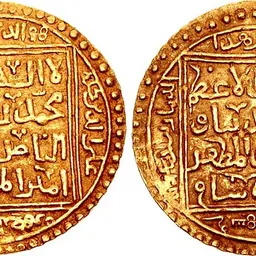
Coinage of Ghiyath al-Din Muhammad (AH 558-599 AD 1163–1203). Baldat Herat mint. Dated AH 599 (1202-3 CE). During the same period, the Khwarazmian prince Sultan Shah, who had been expelled from Khwarezm by his brother Tekish, took refuge in Ghor and requested military aid from Ghiyath. Ghiyath, however, did not help the latter. Instead, Sultan Shah managed to get help from the Kara-Khitan Khanate, and began plundering the northern Ghurid domains. In 1186, Ghiyath, along with Mu'izz al-Din, dissolved the Turkic Ghaznavid dynasty after having captured Lahore, where they had the last Ghaznavid ruler Khusrau-Malik executed. With the aid of the rulers of Bamiyan, Sistan, and his brother Mu'izz al-Din, Ghiyath then defeated the forces of Sultan Shah at Marw al-Rudh in 1190. He also annexed most of the latter's territories in Khorasan. Shortly after war broke out between the Khwarazmian Shahs and the Ghurids; Tekish attacked Herat while the Kara-Khitans invaded Guzgan. Both, were, however, defeated by Ghiyath.
In 1200, Tekish died and was succeeded by Muhammad Khan (who took the honorific name 'Ala' al-Din). Among the first to hear of this were Ghiyath and Mu'izz al-Din. Within weeks the two brothers had already moved their armies westwards into Khorasan. Once they had captured Nishapur, Mu'izz al-Din was sent on an expedition towards Ray, but he let his troops get out of control and got little further than Gurgan, earning criticism from Ghiyath which led to the only reported quarrel between the brothers. Ghiyath appointed the son of Fakhr al-Din Masud, Taj al-Din Zangi, as the governor of Sarakhs, while another Ghurid named Nasir al-Din Muhammad Kharnak was appointed as governor of Merv.
Death Ghiyath al-Din Muhammad was buried in the Great Mosque of Herat. Brick iwan with remains of Ghurid inscriptions (1200–1201), close to the former Ghiyath al-Din mausoleum, which was destroyed in 1940s. Ghiyath died on 13 March 1203 in Herat. He was succeeded by his brother Mu'izz al-Din, who had quickly returned to Ghor from India and obtained the support of Ghurid nobles. They crowned him as Sultan of the Ghurid Empire at Firuzkuh.
Ghiyath al-Din Muhammad was buried in the Great Mosque of Herat, where a mausoleum was established in his name, at the northern gate of the mosque.
Don’t just read it —
keep it.
Full-length biographies made to live with: read them, listen on the way to work, watch them tonight.
- E-book
- Audio
- Video
Instant download · yours to keep · every purchase keeps this site free
Important facts
Family & relationships
People in Ghiyath al-Din Muhammad's life
Named in this biography and alive at the same time
Contemporaries
People whose lives overlapped Ghiyath al-Din Muhammad's




Frequently asked questions
Who was Ghiyath al-Din Muhammad?
Sultan of Ghurid Empire
When was Ghiyath al-Din Muhammad born?
Ghiyath al-Din Muhammad was born in 1139 in Ghor Province.
When did Ghiyath al-Din Muhammad die?
Ghiyath al-Din Muhammad died in 1202 in Herat.
Sources & further reading
· Wikipedia: Ghiyath al-Din Muhammad
· DBpedia: Ghiyath al-Din Muhammad
Cite this page
APA: Biography.guide. (2026). Ghiyath al-Din Muhammad. https://biography.guide/ghiyath-al-din-muhammad/
MLA: "Ghiyath al-Din Muhammad." Biography.guide, https://biography.guide/ghiyath-al-din-muhammad/.
Chicago: "Ghiyath al-Din Muhammad." Biography.guide. https://biography.guide/ghiyath-al-din-muhammad/.
Data last updated: 2026-09-26 · Spot an error? Report a correction.
Page generated 2026-09-27 05:14 UTC