
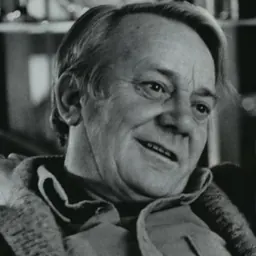
Gervase Farjeon
English theatre producer, director, manager and designer
About Gervase Farjeon
Lived 1920 – 2001 (aged 80).
Early life Farjeon was born in Bucklebury, Berkshire, England on 23 October 1920. He was the third child and only son of Herbert Farjeon (1887-1945), a presenter of revues, lyricist, playwright and theatre manager, whose father had been a novelist and playwright and a friend of Charles Dickens and whose mother was descended from the Jefferson acting dynasty of the United States.
Farjeon's wider family was almost exclusively artistic: an uncle, Harry Farjeon, was a composer, another uncle, Joseph Jefferson Farjeon, was a novelist and playwright, and his aunt, Eleanor Farjeon, was an author of children's stories and plays, poetry, biography, history and satire.
Farjeon grew up surrounded by musicians, actors, artists and writers and listened to stories and gossip about many of the artistic figures of the late 19th and early 20th centuries. He was entranced by the theatre. His father often took him to first nights and encouraged him from an early age to criticise shows and their performances and staging. Farjeon longed to be an actor. Outside the artistic milieu of his family, in early childhood he also developed a love of animals. Bedales School at Petersfield in Hampshire, England where he was put in charge of the school's theatre. From Bedales, even though he still harboured ambitions to be an actor and had an intensifying interest in the theatre, he started training as an architect at the Architectural Association School of Architecture in Bedford Square, London. and when called up under the National Service (Armed Forces) Act 1939 he declared himself to be a conscientious objector. Expecting a prison sentence, he faced a tribunal chaired by a judge, but being able to prove a lifelong pacifism he was granted exemption and began work on the home front with evacuees.
Sachs left the Players' in 1947 and Farjeon, now Director of Productions, was joined by the stage designer Reginald Woolley and his partner, actor-producer Don Gemmell, to form the new board of directors. By the early 1950s the Players' Theatre Club had over 3000 members and had achieved "world-wide fame".
In 1952 Farjeon and his colleagues decided to commission their own musical to take the stage at the Players' as a filler for part of the variety programme and it was Farjeon who telephoned an actor and writer of revues, Sandy Wilson, to invite him to discuss writing a musical.
In his autobiography, I Could Be Happy, Wilson recalls that at the first meeting with Farjeon and Woolley, when he suggested doing a musical in the period of the 1920s, Farjeon quickly replied: "That would be fine".
With Farjeon remaining at the production helm it ran for a then record-breaking five years and 2,048 performances, taking £650,000 at the box office and playing to 1,250,000 people.
With the money-spinning success of The Boy Friend, Farjeon and his fellow directors of the Players' Theatre nursed ambitions to produce more shows that might succeed in the West End. They set up a production company, Players' Ventures Limited, with Farjeon as Managing Director.
A considerably less successful venture followed: an "implausible Oxonian farce", Commemoration Ball by Stanley Parker. After a try-out in Worthing in September 1955 it opened at the Piccadilly Theatre in the West End in April 1956 where it ran for only six performances, the gallery booing the opening night. This show was welcomed enthusiastically by the first night audience and brought stardom for the performer Millicent Martin but it ran for only 164 performances and closed in January 1960, having lost £15,000.
Producer While at Wyndham's with The Boy Friend Farjeon had met Richard O'Donoghue, a former actor working as Wyndham's manager, and together in 1959, they set up a theatrical production partnership. They produced a number of shows during the following six years.
The first was The Doctor and the Devils, an adaptation of a screenplay by the Welsh poet and writer Dylan Thomas. It was based on the true story of William Burke and William Hare, who in 1828 in Edinburgh, Scotland, murdered at least 16 people and sold their bodies for anatomical dissection. After being first seen in Glasgow in 1961 it took to the stage at the Edinburgh Festival to some "considerable controversy" in 1962.
A children's play, New Clothes for the Emperor by Nicholas Stuart Gray, followed in 1963, and then a comedy, Domino by Marcel Achard with Denholm Elliott and Judy Campbell in the cast. There was a run of this show in Brighton and it was booked to open in the West End at the Savoy Theatre but Farjeon and O'Donoghue decided at the last minute not to bring it in to London at that stage, "because they were not satisfied that they had achieved its true potential". It toured provincial theatres while work continued on it, but its final appearance was at the Lyric Hammersmith in the summer of 1963.
Subsequently, another comedy, Every Other Evening, an adaptation of a French play with mother and daughter leads, Margaret and Julia Lockwood, toured the UK for eight weeks in 1964 before having a respectable run at the Phoenix Theatre in the West End.
April 1965 saw the opening at the New Arts Theatre in London of a first play, Kindly Monkeys, by Milton Hood Ward, to generally poor reviews.
In the six years of their producing partnership Farjeon and O'Donoghue also produced a variety of concerts and cabarets in the West End of London, in Dublin and in the English provinces.
Farjeon and O'Donoghue's final production was An Evening of Music Hall opening at the Chichester Festival Theatre in 1965, with the comedian Cyril Fletcher, the actor and musical star Jessie Matthews, and members of the Players' Theatre.
Corporate theatre Farjeon and O'Donogue's partnership ended by mutual agreement in 1965, with O'Donoghue becoming Registrar of the Royal Academy of Dramatic Art and Farjeon joining the actors John Hewer and Mike Hall in their newly-established and pioneering London production company which was set up to use the talents and techniques of show business to stage corporate conferences, product launches, cabarets, shows and films. For many years Farjeon was responsible for the design of all of Hewer-Hall's many productions throughout the UK and much of Western Europe and found himself in demand to create stage designs for other new companies entering the same field. His obituarist noted in The Independent that "his designs were ingenious, painstakingly crafted and planned, combining all he knew of art, architecture and theatre". He was remembered for "working all night to perfect models, create effects and tiny intricate details".
In 1992 Farjeon and Travers made a comprehensive study of European zoos as part of a delegation on behalf of the European Economic Community. "It was dire," reported Farjeon about one of the zoos they visited. "We gagged at the stench from the prison-like cages. Many animals were sick and undernourished. The vet with the delegation said euthanasia would be kinder for some." The Born Free Foundation holds films and photographs documenting Farjeon's and Travers' investigations abroad.
Literary archivist Farjeon's family life had brought him close to his aunt, the author and poet Eleanor Farjeon, for whose estate he became executor. As well as managing her estate and being her literary executor (a duty which took on new and unexpected responsibilities in 1972 when her hymn Morning Has Broken became an international hit when recorded by Cat Stevens) he was the curator of a large archive of her literary papers, letters and photographs and of many papers concerning her close friend the British poet Edward Thomas.
Farjeon was also the "meticulous cataloguer" They lived in a Georgian house in Gospel Oak in North London, in a country home known as "Newfoundout" with acres of garden and woodland near Horsham in West Sussex, and at a farmhouse in the French Pyrénées. There were no children.
In later life, for twenty years until his death, Farjeon shared his life with the actor, broadcaster and poetry and literary anthologist Anne Harvey, though he and his wife remained married. Both women survived him.
Harvey recorded that Farjeon was "a man of many talents who remained modestly self-effacing, never convinced he had met the successes of better-known members of his family".
Bill Travers' wife, and partner in the Born Free Foundation, Dame Virginia McKenna, described him as a "gentle, modest man" who never forced his opinions on others, and remembered him for "his kindness, his loyalty and his generosity but, above all, his friendship". He was cremated at Golders Green Crematorium in North London and his ashes were scattered at his request at his and his wife's property in West Sussex, "under the copper beech tree".
Don’t just read it —
keep it.
Full-length biographies made to live with: read them, listen on the way to work, watch them tonight.
- E-book
- Audio
- Video
Instant download · yours to keep · every purchase keeps this site free
Important facts
Family & relationships
People in Gervase Farjeon's life
Named in this biography and alive at the same time






Contemporaries
People whose lives overlapped Gervase Farjeon's






Frequently asked questions
Who was Gervase Farjeon?
English theatre producer, director, manager and designer
When was Gervase Farjeon born?
Gervase Farjeon was born on 23 October 1920 in Berkshire, Bucklebury.
When did Gervase Farjeon die?
Gervase Farjeon died on 6 August 2001.
Sources & further reading
Cite this page
APA: Biography.guide. (2026). Gervase Farjeon. https://biography.guide/gervase-farjeon/
MLA: "Gervase Farjeon." Biography.guide, https://biography.guide/gervase-farjeon/.
Chicago: "Gervase Farjeon." Biography.guide. https://biography.guide/gervase-farjeon/.
Data last updated: 2026-09-22 · Spot an error? Report a correction.
Page generated 2026-09-27 05:21 UTC