
About Gershom Scholem
Lived 1897 – 1982 (aged 84). Gershom Scholem was an Israeli and German philosopher, librarian, historian, pedagogue, writer and university teacher.
Gershom Scholem (; 5 December 1897 – 21 February 1982) was a German philosopher and historian. Widely regarded as the founder of modern academic study of the Kabbalah, Scholem was appointed the first professor of Jewish mysticism at Hebrew University of Jerusalem.
Biography
Gerhard (Gershom) Scholem was born in Berlin to Arthur Scholem and Betty Hirsch Scholem. His father was a printer. His older brother was the German Communist leader Werner Scholem. He studied Hebrew and Talmud with an Orthodox rabbi.
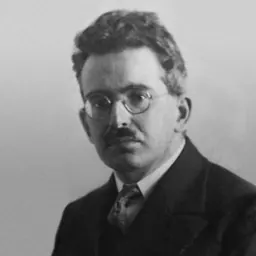
Scholem met Walter Benjamin in Munich in 1915, when the former was seventeen years old and the latter was twenty-three. They began a lifelong friendship that ended when Benjamin committed suicide in 1940 in the wake of Nazi persecution. Scholem dedicated his book Major Trends in Jewish Mysticism (Die jüdische Mystik in ihren Hauptströmungen), based on lectures 1938–1940, to Benjamin. In 1915, Scholem enrolled at the Frederick William University in Berlin (today, Humboldt University), where he studied mathematics, philosophy, and Hebrew. There he met Martin Buber, Shmuel Yosef Agnon, Hayim Nahman Bialik, Ahad Ha'am, and Zalman Shazar. He studied mathematical logic at the University of Jena under Gottlob Frege. He was in Bern in 1918 with Benjamin when he met Elsa (Escha) Burchhard, who became his first wife. Scholem returned to Germany in 1919, where he received a degree in Semitic languages at the Ludwig-Maximilians-Universität München.
Scholem wrote his doctoral thesis on the oldest known kabbalistic text, Sefer ha-Bahir. The following year it appeared in book form as "Das Buch Bahir", having been published by his father's publishing house. There Scholem became a librarian, heading the Department of Hebrew and Judaica at the National Library. In 1927, he revamped the Dewey Decimal System, making it appropriate for large Judaica collections. During the period that he was a librarian of ancient manuscripts at the library of Hebrew University, fragments of the newly discovered Dead Sea Scrolls and inventory from the Cairo Genizah moved through the collections he was overseeing. Scholem became a professor of mysticism at the Hebrew University in 1933.
Scholem's brother Werner was a member of the ultra-left "Fischer-Maslow Group" and the youngest ever member of the Reichstag, or Weimar Diet, representing the Communist Party of Germany. He was expelled from the party and later murdered by the Nazis during the Third Reich. Unlike his brother, Gershom was vehemently opposed to both Communism and Marxism. In 1936, he married his second wife, Fania Freud. Fania, who had been his student and could read Polish, was helpful in his later research, particularly in regard to Jacob Frank.
In 1946, Scholem was sent by the Hebrew University to search for Jewish books that had been plundered by the Nazis and help return them to their rightful owners. He spent much of the year in Germany and Central Europe as part of this project, known as "Otzrot HaGolah".
Academic career Scholem became a lecturer at the Hebrew University of Jerusalem. He taught the Kabbalah and mysticism from a scientific point of view and became the first professor of Jewish mysticism at the university in 1933, working in this post until his retirement in 1965, when he became an emeritus professor.
Scholem directly contrasted his historiographical approach on the study of Jewish mysticism with the approach of the 19th-century school of the Wissenschaft des Judentums ("Science of Judaism"), which sought to submit the study of Judaism to the discipline of subjects such as history, philology, and philosophy. According to Jeremy Adler, Scholem's thinking was "both recognizably Jewish and deeply German," and "changed the course of twentieth-century European thought."
At the time Scholem entered his field of study, Jewish mysticism was acknowledged as Judaism's weakest scholarly link by many of the scholars, publishers and cultural leaders of the Jewish community and gentile German scholars who sponsored Scholem's early career, including Martin Buber, Salman Schocken, Franz Rosenzweig, Robert Eisler, Philipp Bloch, Moses Marx, Clemens Baumker, Fritz Hommel and Walter Benjamin.
Scholem told the story of his early research "at the start of my path" in 1922 when he went to Berlin to visit "the only Jewish scholar who had engaged in the study of Kabbalah in the previous generation." Gesturing at the rabbi's library of documents, manuscripts and autographs written by the authors of the Kabbalah, some of which had been inscribed in early modern or medieval centuries, Scholem remarked, "How wonderful it is, Herr Professor, that you have read and learned all this!" to which "...the elderly gentleman replied: 'What! And I also have to read all this nonsense?!"
After generations of demoralization and assimilation in the European Enlightenment, the disappointment of messianic hopes, and in the midst of the catastrophe of the Final Solution in Europe from the major currents of Jewish mysticism could only be found in long block quotations in antisemitic texts, where some "nincompoop who had quoted and translated the most wonderful, the most profound things,"
It is a measure of the depth of Scholem's friendship with Benjamin that he wrote two memoirs at the end of his life: his own autobiography tends to be less read or frequently cited than his "Autobiography of a Friendship" recounting his lifelong relationship and work in partnership with Benjamin prior to the latter's death in flight from the Gestapo in 1940.
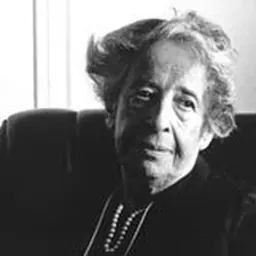
Debate with Hannah Arendt In the aftermath of the Adolf Eichmann trial in Jerusalem, Scholem sharply criticised Hannah Arendt's book, Eichmann in Jerusalem and decried her lack of solidarity with the Jewish people ( "love of one's fellow Jews", ʾahəvaṯ ʾiśrāʾēl). Arendt responded that she never loved any collective group, and that she does not love the Jewish people but was only part of them. The bitter fight, which was exchanged in various articles, led to a rift between Scholem and Arendt though they remained mutually respectful thereafter and continued to work alongside one another on various projects, particularly in their work on the literary estate of Walter Benjamin. In an apparently wrathful moment, Scholem wrote to Hans Paeschke that he "knew Hannah Arendt when she was a socialist or half-communist and... when she was a Zionist. I am astounded by her ability to pronounce upon movements in which she was once so deeply engaged, in terms of a distance measured in light years and from such sovereign heights." Differing perspectives on the appropriate penalty for Adolph Eichmann further illuminate differences between the two authors. Whereas Arendt felt that Eichmann should be executed, Scholem was opposed, fearing that his execution would serve to alleviate the Germans' collective sense of guilt.
Awards and recognition In 1958, Scholem was awarded the Israel Prize in Jewish studies. In 1968, he was elected president of the Israel Academy of Sciences and Humanities. In 1969, he received the Yakir Yerushalayim (Worthy Citizen of Jerusalem) award. In 1977, he was awarded the Bialik Prize for Jewish thought.
Literary influence
Various stories and essays of the Argentinian writer Jorge Luis Borges were inspired or influenced by Scholem's books. He has also influenced ideas of Umberto Eco, Jacques Derrida, Harold Bloom, Italian philosopher Giorgio Agamben, and George Steiner. American author Michael Chabon cites Scholem's essay, The Idea of the Golem, as having assisted him in conceiving the Pulitzer-Prize winning book The Amazing Adventures of Kavalier and Clay. The same essay influenced, and is cited by, Bruce Chatwin's Utz. Chaim Potok's The Book of Lights features a lightly disguised Scholem as "Jacob Keter."
Selected works in English Major Trends in Jewish Mysticism, 1941 Jewish Gnosticism, Merkabah Mysticism, and the Talmudic Tradition, 1960 Arendt and Scholem, "Eichmann in Jerusalem: Exchange of Letters between Gershom Scholem and Hannah Arendt", in Encounter, 22/1, 1964 On the Kabbalah and Its Symbolism, 1965 The Messianic Idea in Judaism and other Essays on Jewish Spirituality, trans. 1971 Sabbatai Sevi: The Mystical Messiah, 1973 Kabbalah, Meridian 1974, Plume Books 1987 reissue: On Jews and Judaism in Crisis: Selected Essays, 1976 From Berlin to Jerusalem: Memories of My Youth, 1977; trans. Harry Zohn, 1980. Walter Benjamin: the Story of a Friendship, trans. Harry Zohn. New York: Schocken Books, 1981. Origins of the Kabbalah, JPS, 1987 reissue: Zohar — The Book of Splendor: Basic Readings from the Kabbalah, ed., 1995 On the Mystical Shape of the Godhead: Basic Concepts in the Kabbalah, 1997 The Fullness of Time: Poems, trans. Richard Sieburth, 2003 On History and Philosophy of History, in "Naharaim: Journal for German-Jewish Literature and Cultural History", v, 1–2 (2011), pp. 1–7. On Franz Rosenzweig and his Familiarity with Kabbala Literature, in "Naharaim: Journal for German-Jewish Literature and Cultural History", vi, 1 (2012), pp. 1–6. On the Possibility of Jewish Mysticism in Our Time, 1994. From Frankism to Jacobinism, 2019
Don’t just read it —
keep it.
Full-length biographies made to live with: read them, listen on the way to work, watch them tonight.
- E-book
- Audio
- Video
Instant download · yours to keep · every purchase keeps this site free
Important facts
People in Gershom Scholem's life
Named in this biography and alive at the same time





Related people
Same field, nearest in time
Contemporaries
People whose lives overlapped Gershom Scholem's


Frequently asked questions
Who was Gershom Scholem?
German-Israeli philosopher (1897–1982)
When was Gershom Scholem born?
Gershom Scholem was born on 5 December 1897 in Berlin.
When did Gershom Scholem die?
Gershom Scholem died on 21 February 1982 in Jerusalem.
What was Gershom Scholem's occupation?
Gershom Scholem was a philosopher, librarian, historian, pedagogue, writer and university teacher.
What nationality was Gershom Scholem?
Gershom Scholem was Israeli and German.
Sources & further reading
Cite this page
APA: Biography.guide. (2026). Gershom Scholem. https://biography.guide/gershom-scholem/
MLA: "Gershom Scholem." Biography.guide, https://biography.guide/gershom-scholem/.
Chicago: "Gershom Scholem." Biography.guide. https://biography.guide/gershom-scholem/.
Data last updated: 2026-09-20 · Spot an error? Report a correction.
Page generated 2026-09-27 05:24 UTC