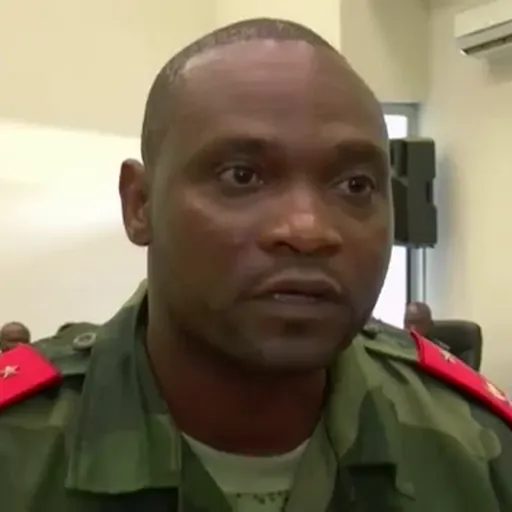
Germain Katanga
Former leader of the Patriotic Resistance Force in Ituri
About Germain Katanga
Born 1978. Germain Katanga is a Congolese politician and military personnel, known for Crime against humanity and International Criminal Court.
Germain Katanga (; born 28 April 1978), also known by his nom de guerre Simba , is a Congolese former rebel leader and the former head of the Patriotic Resistance Force in Ituri (FRPI), an armed group in the Ituri Province of the Democratic Republic of the Congo (DRC). On 17 October 2007, the Congolese authorities surrendered him to the International Criminal Court (ICC) to stand trial on six counts of war crimes and three counts of crimes against humanity. The charges include murder, sexual slavery, rape, destruction of property, pillaging, willful killing, and directing crimes against civilians.
On 7 March 2014, Katanga was convicted by the ICC on five counts of war crimes and crimes against humanity as an accessory to the February 2003 massacre in the village of Bogoro. The verdict was the second-ever conviction in the 12 years of operation of the ICC, following the 2012 conviction of Thomas Lubanga Dyilo. Katanga transferred from imprisonment in the Netherlands to imprisonment in Congo in December 2015 to complete his sentence. His ICC sentence was reduced, with the completion date set to 18 January 2016. Following the completion of his ICC sentence, he remained in prison under war crimes charges under the Congolese legal system. He was granted the specific rank of brigadier general. Katanga was succeeded as leader of the FRPI by Cobra Matata.
He was arrested by the Congolese authorities in early March 2005 He was held without charge until his transfer to the ICC in October 2007.
International Criminal Court proceedings On 2 July 2007, a Pre-Trial Chamber of the ICC found that there were reasonable grounds to believe that Katanga bore individual criminal responsibility for war crimes and crimes against humanity committed during the Bogoro attack, and issued a sealed warrant for his arrest.
In February 2008, another suspect, Mathieu Ngudjolo Chui, was surrendered to the ICC to face charges in relation to the Bogoro attack; he and Katanga were to be tried jointly. The hearing to confirm the charges against them began on 27 June 2008. and ended on 11 July 2008. On 26 September 2008, Pre-Trial Chamber I confirmed some of the charges against Katanga and Ngudjolo and committed them for trial before a Trial Chamber of the Court.
The trial began on 24 November 2009.
ICC verdict On March 7, 2014, by a 2-to-1 decision, the ICC convicted Germain Katanga on five counts of war crimes and crimes against humanity, as an accessory in the February 2003 massacre in the village of Bogoro in the DRC. The verdict was only the second time in the 12-year history of the International Criminal Court that an ICC trial resulted in a conviction. The court acquitted Katanga of directing rapes and the use of child soldiers during the massacre, citing insufficient evidence to connect Katanga to these crimes, while at the same time emphasizing that these crimes did occur. Although Katanga and Chui were originally charged together, the ICC split their trials in November 2012 to allow the prosecutors to collect more evidence regarding Katanga's involvement.
The Katanga trial verdict produced mixed reactions. Some human rights activists in the DRC expressed satisfaction with the verdict as bringing a measure of closure to the victims and their families, with one activist quoted as saying: "For those who lost their possessions, their mothers, their homes, this judgment provides some relief. Today people here see some satisfaction. In the end, everyone must answer for his actions." Some women's groups criticized the ICC for acquitting Katanga of rape and sexual slavery charges, claiming that the court appeared to demand higher level of proof for the sexual crimes than for other crimes. Phil Clark, a London-based expert on the ICC, criticized the ICC prosecutors for not devoting sufficient resources to the case: "The ICC has been doing its investigations on the cheap. It's been using a really small group of investigators who haven’t spent an enormous amount of time in Congo. The prosecution has cut corners, they’ve used local Congolese intermediaries to do a lot of their dirty work. And as a result of that these cases haven’t been systematically built." Melbourne Law School Professor Kevin Jon Heller, an expert in international criminal law, has strongly criticised the recharacterisation of the charges Katanga faced, arguing that this violates the Rome Statute of the International Criminal Court and the rights of the accused.
On 23 May 2014, Katanga was sentenced to 12 years' imprisonment. The almost seven years he spent in detention at the ICC – between 2007 and 2014 – was deducted from the sentence. On 19 December 2015, Katanga was transferred to a prison in the DRC, where he is served the balance of his sentence. Katanga's sentence was reduced by the ICC, with a completion date of 18 January 2016. Katanga remained imprisoned while the Congolese government pursued further charges for war crimes and crimes against humanity that were still ongoing as of March 2017. Opinio Juris described the Congolese charges as raising concerns about non bis in idem (double jeopardy).
Don’t just read it —
keep it.
Full-length biographies made to live with: read them, listen on the way to work, watch them tonight.
- E-book
- Audio
- Video
Instant download · yours to keep · every purchase keeps this site free
Important facts
People in Germain Katanga's life
Named in this biography and alive at the same time



Related people
Same field, nearest in time


Contemporaries
People whose lives overlapped Germain Katanga's

Frequently asked questions
Who is Germain Katanga?
former leader of the Patriotic Resistance Force in Ituri
When was Germain Katanga born?
Germain Katanga was born on 28 April 1978 in Mambasa.
What is Germain Katanga's occupation?
Germain Katanga is a politician and military personnel.
What is Germain Katanga known for?
Germain Katanga is known for Crime against humanity and International Criminal Court.
What nationality is Germain Katanga?
Germain Katanga is Congolese.
Sources & further reading
Cite this page
APA: Biography.guide. (2026). Germain Katanga. https://biography.guide/germain-katanga/
MLA: "Germain Katanga." Biography.guide, https://biography.guide/germain-katanga/.
Chicago: "Germain Katanga." Biography.guide. https://biography.guide/germain-katanga/.
Data last updated: 2026-09-21 · Spot an error? Report a correction.
Portrait: Wikimedia Commons · author & licence
Page generated 2026-09-27 05:01 UTC