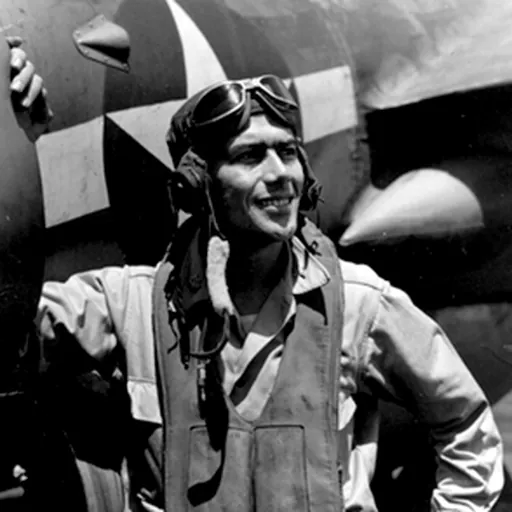
About Gerald R. Johnson
Lived 1920 – 1945 (aged 25). Gerald R. Johnson was a flying ace.
Gerald Richard Johnson (June 23, 1920 – October 7, 1945) was a World War II flying ace who flew for the United States Army Air Forces. Johnson commanded the 9th Fighter Squadron and 49th Fighter Group, and became the fourth ranking fighter ace in the Pacific during World War II. He ended his war career with 22 kills.
Early life Johnson was born in Kenmore, Ohio on June 23, 1920, one of five children born to parents Harold Victor Johnson, Sr. and Hazel Irene Johnson. He was a twin to Harold Victor Johnson, Jr. born on the same day. In 1936, the family moved to Eugene, Oregon. Johnson graduated from Eugene High School in 1938. After graduation, he worked as an attendant with the Department of Agriculture in the summer of 1940. He earned the rank of Eagle Scout in the Boy Scouts of America.
Johnson was married to Barbara Hall on June 1, 1944.
Military career In 1941, he joined the U.S. Army Aviation Cadet Program at Luke Field. He received his pilot wings in the fall of 1941 and was commissioned a second lieutenant.
World War II
Johnson was then assigned to the 57th Pursuit Squadron of the 54th Pursuit Group at Everett, Washington, from November 1941 to February 1943 and went with the group to Alaska from June to October 1942, where he flew the Bell P-39 Airacobra and Curtiss P-40 Warhawk. During the Aleutian Campaign, on 58 combat missions he scored probable two enemy aircraft kills while flying the P-39.
On October 15, 1943, while defending the allied shipping at Oro Bay, he and other aircraft from the 348th Fighter Group intercepted twenty Japanese aircraft. As they maneuvered into position, one of the aircraft in Johnson's formation could not drop its auxiliary fuel tanks, while another blew a supercharger. Unable to fight effectively, these aircraft were escorted back home, leaving Johnson and a few other aircraft alone. During the dogfight, Johnson chased an enemy aircraft off his wingman's tail and destroyed it. Johnson's aircraft was then attacked by the enemy. His heavy fire tore the wing off a Japanese fighter and sent it spiraling, in the process ripping off Johnson's port (left) tail boom assembly. Johnson managed to regain control of his aircraft and was escorted back to base by the remaining friendly planes. Johnson shot down an Oscar and two Aichi D3A "Vals", on that day and successfully managed to disperse the enemy formation and divert it from the target, making him a flying ace but at the cost of his own aircraft. who survived the subsequent crash and fire. Later, an Australian flag indicating this Boomerang was painted on Johnson's P-38 Lightning. In late 1943, the 9th Fighter Squadron received the Republic P-47 Thunderbolt, due to the losses suffered by the squadron in the aerial battles over Rabaul and Lockheed being unable to quickly ship replacement P-38s. Johnson shot down a Tony and an A6M Zero, while flying the P-47. He scored a total of 11 aerial victories before going back to the US for a three month shore leave.
Returning to the Pacific in October 1944, he was one of the first USAAF fighter pilots to arrive at Tacloban on Leyte in the Philippines, as P-38s from the 49th FG touched down on the freshly carved airstrip. The strip was under attack night and day as the Japanese tried to destroy the American foothold on Leyte. Four hours later, Johnson shot down two enemy planes, over Balikpapan, in Borneo. 13 days later, he shot down two more enemy planes, on the lead up to the Philippines campaign. During the spring of 1945, the 49th Fighter Group occupied Clark Field and were concentrating on providing ground support roles. They were particularly effective in delivering napalm bombs which devastated enemy installations and made an invasion of the Luzon unnecessary. During World War II, Johnson flew a total of 265 combat missions. He was credited with the destruction of 22 enemy aircraft in aerial combat plus 2 probables and 1 damaged, which includes 20 in P-38 Lightning and 2 in P-47 Thunderbolt.
Death and legacy A few weeks after World War II ended, Johnson was assigned as commander of Atsugi Air Base, Japan.
Awards and decorations His awards and decorations include:
USAAF Pilot BadgeDistinguished Service Crossw/ 1 bronze oak leaf clusterSilver Star Legion of MeritDistinguished Flying Crossw/ 1 silver oak leaf clusterSoldier's MedalAir Medalw/ 2 silver and 1 bronze oak leaf clustersAmerican Defense Service MedalAmerican Campaign MedalAsiatic-Pacific Campaign Medalw/ 1 silver and 4 bronze campaign starsWorld War II Victory MedalArmy of Occupation Medalw/ 'Japan' claspPhilippine Liberation Medalw/ 2 service stars
Army Presidential Unit Citationw/ 3 bronze oak leaf clusters Philippine Republic Presidential Unit Citation
Distinguished Service Cross citation (1st Award)
Johnson, Gerald R. Major (Air Corps), U.S. Army Air Forces 9th Fighter Squadron, 49th Fighter Group, 5th Air Force Date of Action: October 15, 1943
Citation:
The President of the United States of America, authorized by Act of Congress July 9, 1918, takes pleasure in presenting the Distinguished Service Cross to Major (Air Corps) Gerald Richard Johnson, United States Army Air Forces, for extraordinary heroism in connection with military operations against an armed enemy while serving as Pilot of a P-38 Fighter Airplane in the 9th Fighter Squadron, 49th Fighter Group, Fifth Air Force, in aerial combat against enemy forces on 15 October 1943, during an air mission in the Southwest Pacific Area. When a large enemy force of 18 dive bombers accompanied by 20 fighters approached the area to attack shipping at Oro Bay, Major Johnson courageously led his squadron of eight airplanes to intercept the enemy flight. Against these overwhelming odds, he unhesitatingly attacked. During the fierce engagement which followed, Major Johnson shot down two enemy bombers and one enemy fighter. By this daring strike, he dispersed the enemy formation and diverted it from the target. Supporting squadrons of allied fighters then entered the combat and turned back the enemy force with no damage to our shipping or installations. In addition to destroying three enemy aircraft on this occasion, Major Johnson, by his heroism, diverted the enemy attack and saved much valuable cargo. Major Johnson's unquestionable valor in aerial combat is in keeping with the highest traditions of the military service and reflects great credit upon himself, the 5th Air Force, and the United States Army Air Forces.
Distinguished Service Cross citation (2nd Award)
Johnson, Gerald R. Lieutenant Colonel (Air Corps), U.S. Army Air Forces 9th Fighter Squadron, 49th Fighter Group, 5th Air Force Date of Action: December 7, 1944
Citation:
The President of the United States of America, authorized by Act of Congress July 9, 1918, takes pleasure in presenting a Bronze Oak Leaf Cluster in lieu of a Second Award of the Distinguished Service Cross to Lieutenant Colonel (Air Corps) Gerald Richard Johnson, United States Army Air Forces, for extraordinary heroism in connection with military operations against an armed enemy while serving as Pilot of a P-38 Fighter Airplane in the 9th Fighter Squadron, 49th Fighter Group, Fifth Air Force, in aerial combat against enemy forces on 7 December 1944, during an air mission in the Southwest Pacific Area. On this date Major Johnson shot down four enemy aircraft in a single engagement. Major Johnson's unquestionable valor in aerial combat is in keeping with the highest traditions of the military service and reflects great credit upon himself, the 5th Air Force, and the United States Army Air Forces.
Aerial victory credits SOURCES: Air Force Historical Study 85: USAF Credits for the Destruction of Enemy Aircraft, World War II
Don’t just read it —
keep it.
Full-length biographies made to live with: read them, listen on the way to work, watch them tonight.
- E-book
- Audio
- Video
Instant download · yours to keep · every purchase keeps this site free
Important facts
People in Gerald R. Johnson's life
Named in this biography and alive at the same time


Related people
Same field, nearest in time
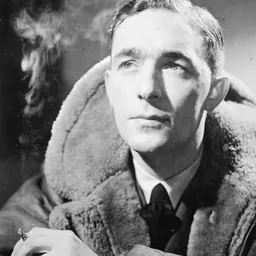
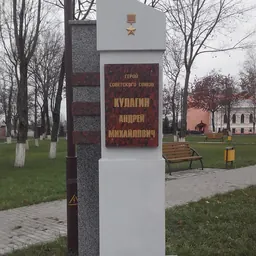
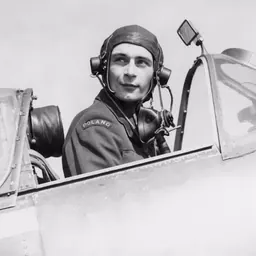

Contemporaries
People whose lives overlapped Gerald R. Johnson's



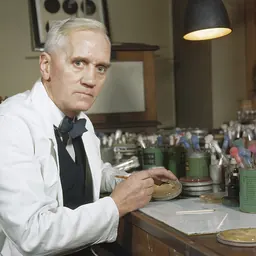

Frequently asked questions
Who was Gerald R. Johnson?
American World War II flying ace
When was Gerald R. Johnson born?
Gerald R. Johnson was born on 23 June 1920.
When did Gerald R. Johnson die?
Gerald R. Johnson died on 7 October 1945.
What was Gerald R. Johnson's occupation?
Gerald R. Johnson was a flying ace.
Sources & further reading
· Wikipedia: Gerald R. Johnson
Cite this page
APA: Biography.guide. (2026). Gerald R. Johnson. https://biography.guide/gerald-r-johnson/
MLA: "Gerald R. Johnson." Biography.guide, https://biography.guide/gerald-r-johnson/.
Chicago: "Gerald R. Johnson." Biography.guide. https://biography.guide/gerald-r-johnson/.
Data last updated: 2026-09-20 · Spot an error? Report a correction.
Portrait: Wikimedia Commons · author & licence
Page generated 2026-09-27 04:57 UTC