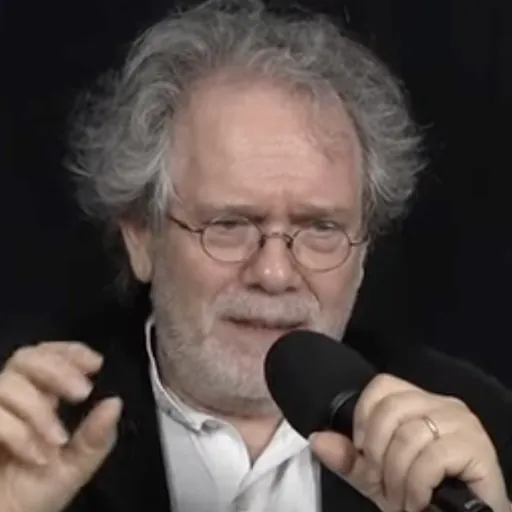
Georges Didi-Huberman
French philosopher and art historian (born 1953)
About Georges Didi-Huberman
Born 1953. Georges Didi-Huberman is a French philosopher, art historian, university teacher and art theorist.
Georges Didi-Huberman FBA (born 13 June 1953) is a French philosopher and art historian.
Biography
Georges Didi-Huberman was born on 13 June 1953 in Saint-Étienne, into a Sephardic family from Tunisia on his father's side and Ashkenazi Polish heritage on his mother's side. His sister is the actress Évelyne Didi. He was a scholar at the French Academy in Rome (Villa Medici) and resident in the Berenson Foundation of Villa I Tatti in Florence. He teaches at the School for Advanced Studies in the Social Sciences, where he has been a lecturer since 1990.
Honours He is the 2015 recipient of the Adorno Prize.
In July 2017, Didi-Huberman was elected a Corresponding Fellow of the British Academy (FBA), the United Kingdom's national academy for the humanities and social sciences.
Other awards and distinctions 2019: Prix de la Principauté de Monaco, a lifetime achievement award granted jointly by Les Rencontres Philosophiques de Monaco and the Prince Pierre Foundation. 2025: Pour le Mérite for Sciences and Arts
Published work Invention de l’hystérie. Charcot et l’Iconographie photographique de la Salpêtrière, sur l'École de la Salpêtrière, Macula, 1982 (translated into English as Invention of Hysteria: Charcot and the Photographic Iconography of the Salpêtrière, MIT Press, 2004). Mémorandum de la peste. Le fléau d’imaginer, Christian Bourgois, 1983. La Peinture incarnée followed by Chef-d'œuvre inconnu de Balzac, Minuit, 1985. Fra Angelico. Dissemblance et figuration, Flammarion, 1990 (translated into English as Fra Angelico: Dissemblance and Figuration, Univ. of Chicago Press, 1995). Devant l’image. Questions posées aux fins d'une histoire de l'art, Minuit, 1990 (translated into English as Confronting Images: Questioning the Ends of a Certain History of Art, Penn State Univ. Press, 2004). Ce que nous voyons, ce qui nous regarde, Minuit, 1992. Le Cube et le visage. Autour d’une sculpture d’Alberto Giacometti Macula, 1992 (translated into English as The Cube and the Face: Around a Sculpture by Alberto Giacometti, Diaphanes, 2015). L'Empreinte du ciel, présentation des Caprices de la foudre, Éditions Antigone, 1994. La Ressemblance informe, ou Le gai savoir visuel selon Georges Bataille, Macula, 1995. Phasmes. Essais sur l'apparition, Minuit 1998. L’Étoilement, sur Simon Hantaï, Minuit, 1998. La Demeure, la souche, sur Pascal Convert, Minuit, 1999. Ouvrir Vénus. Nudité, rêve, cruauté, Gallimard, 1999. Devant le temps, Minuit, 2000. Être crâne, sur Giuseppe Penone, Minuit, 2000 (translated into English as Being a Skull: Site, Contact, Thought, Sculpture, Univocal Publishing, 2016). L’Homme qui marchait dans la couleur, sur James Turrell, Minuit, 2001 (translated into English as The Man Who Walked in Color, Univocal Publishing, 2017). Génie du non-lieu, sur Claudio Parmiggiani, Minuit, 2001. L’Image survivante, Minuit, 2002 (translated into English as The Surviving Image: Phantoms of Time and Time of Phantoms, Penn State Univ. Press, 2016). Ninfa moderna. Essai sur le drapé tombé, Gallimard, 2002. Images malgré tout, Minuit, 2004 (translated into English as Images in Spite of All: Four Photographs from Auschwitz, Univ. of Chicago Press, 2012). Gestes d’air et de pierre, Minuit, 2005. Le Danseur des solitudes, sur Israel Galván, Minuit, 2006. L'Image ouverte. Motifs de l'incarnation dans les arts visuels, Gallimard, 2007. La Ressemblance par contact, Minuit, 2008. L'Œil de l'histoire – Tome 1 : Quand les images prennent position, Minuit, 2009 (translated into English as The Eye of History: When Images Take Positions, MIT Press, 2018). Survivance des lucioles, Minuit, 2009 (translated into English as Survival of the Fireflies, Univ. of Minnesota Press, 2018). L'Œil de l'histoire – Tome 2 : Remontages du temps subi, Minuit, 2010. L’Œil de l'Histoire – Tome 3 : Atlas ou le gai savoir inquiet, Minuit, 2011 (translated into English as Atlas, or the Anxious Gay Science, Univ. of Chicago Press, 2018). Écorces, Minuit, 2011 (translated into English as Bark, MIT Press, 2017). L'Œil de l'histoire – Tome 4 : Peuples exposés, peuples figurants, Minuit, 2012. Essayer voir, Minuit, 2014.
Notes and references
Revue Nunc numéro 26, février 2012 – Cahier G. Didi-Huberman dirigé par Jérôme de Gramont – Editions de Corlevour
Don’t just read it —
keep it.
Full-length biographies made to live with: read them, listen on the way to work, watch them tonight.
- E-book
- Audio
- Video
Instant download · yours to keep · every purchase keeps this site free
Important facts
People in Georges Didi-Huberman's life
Named in this biography and alive at the same time





Related people
Same field, nearest in time

Contemporaries
People whose lives overlapped Georges Didi-Huberman's


Frequently asked questions
Who is Georges Didi-Huberman?
French philosopher and art historian (born 1953)
When was Georges Didi-Huberman born?
Georges Didi-Huberman was born on 13 June 1953 in Saint-Étienne.
What is Georges Didi-Huberman's occupation?
Georges Didi-Huberman is a philosopher, art historian, university teacher and art theorist.
What nationality is Georges Didi-Huberman?
Georges Didi-Huberman is French.
Sources & further reading
· Wikipedia: Georges Didi-Huberman
· DBpedia: Georges Didi-Huberman
Cite this page
APA: Biography.guide. (2026). Georges Didi-Huberman. https://biography.guide/georges-didi-huberman/
MLA: "Georges Didi-Huberman." Biography.guide, https://biography.guide/georges-didi-huberman/.
Chicago: "Georges Didi-Huberman." Biography.guide. https://biography.guide/georges-didi-huberman/.
Data last updated: 2026-09-22 · Spot an error? Report a correction.
Portrait: Wikimedia Commons · author & licence
Page generated 2026-09-27 04:58 UTC