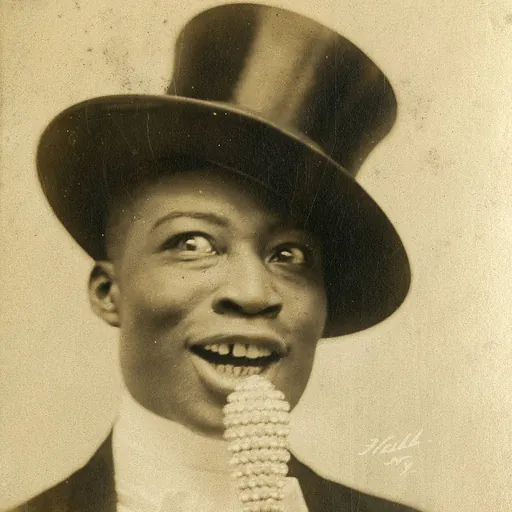
About George Walker
Lived 1872 – 1911 (aged 38–39). George Walker was an American actor, stage actor and composer.
George Walker (June 26, 1873 – January 6, 1911) was an American vaudevillian, actor, and producer. While in San Francisco during 1893, Walker at the age of 20 met Bert Williams, who was a year younger. The two young men became performing partners. Walker and Williams appeared in The Gold Bug, Clorindy (1898), The Policy Player (1899), Sons of Ham (1900), In Dahomey (1903), Abyssinia (1906), and Bandanna Land (1907). Walker married dancer Ada Overton, who later also was a choreographer.
The two men set up an agency, The Williams and Walker Company, to support African-American actors and other performers, create networking, and produce new works.
Early life George W. Walker was born in 1873 in Lawrence, Kansas, the son of a policeman and his wife. He began his career as a child performer, touring in black minstrel and medicine shows.
George Walker and Bert Williams
Walker and Bert Williams became two of the most prominent figures of the minstrel era and a famous duo. They met in 1893 in San Francisco and formed a vaudeville act when Walker was 20. Bert Williams had come to the United States as a child with his parents from the Bahamas, and became a vaudeville entertainer. Williams's first ambitions had been to attend Stanford University and become an engineer. Since he could not afford to go, he had worked as a singing waiter in hotels in San Francisco. Walker had performed in traveling medicine shows before ending up in San Francisco and joining up with Williams.
The two men decided to subvert vaudeville stereotypes and play against their appearances. With lighter skin expressing some European ancestry, and a fine voice, by the expectations of the time Williams would have performed as the "straight man" in comedy routines. Walker had darker skin and as such would be expected to play the fool. The two realized that they were much funnier when they reversed their roles, so "...Walker became the straight man--dressed a little too high-style and spending all the money he could borrow or trick out of the lazy, careless, unlucky Williams--and Williams became the blumbery, sorrowful, comical-in-spite-of-himself patsy." Their act grew popular in West Coast theatres, where the minstrel shows were being called vaudeville.
At the same time, white performing duos were billing themselves as "coons" (a disparaging term for blacks) and performing vaudeville in blackface. Williams and Walker decided to market themselves as the "Two Real Coons." In 1896, they appeared in a New York City production called The Gold Bug at the Casino Theatre. It was a short run and the production did not receive good reviews, but they were hired by another theatre for a record run of twenty-eight weeks. During that time, they popularized the cakewalk. This dance became very popular in high society in New York City and spread throughout all classes of whites. Their next project was The Sons of Ham. Williams and Alex Rogers wrote a song for it called "I'm a Jonah Man", and the song became a trademark for Williams. They participated in a "Benefit for New York's Poor" held on February 9, 1897 at the Metropolitan Opera House, their only appearance at that theater.
When Williams and Walker began to perform together, they wanted to change the dynamics of the theatre. But, they also had to satisfy audience demand, and audiences were predominately white. They began to feature the traditional cakewalk, a dance from slavery times. It is known to have been based in West African festive dances commonly performed during harvest festivals. Couples would form a circle, promenade, prance with buckets of water on their heads to the sound of banjos playing, and clap their hands. The winning couple got a cake.
When Williams and Walker worked with the cakewalk, "the dance had many variations and in some was apparently a slightly veiled comic parody of their masters' pretentious posturing and high falutin' attitudes." After Williams and Walker introduced this dance into their act, the cakewalk started being danced in stage shows, exhibitions, contests, and ballrooms. These were open only to white communities, with different venues appealing to working class through upper class. It eventually spread through the United States and over to Europe.
The two men were interested in incorporating African themes and characters into American shows. That opportunity came with the production of In Dahomey. Williams and Walker teamed up with composer Will Marion Cook, librettist Jesse Ship, and poet/lyricist Paul Laurence Dunbar to produce the musical comedy, In Dahomey, the first full-length musical to open on Broadway written and performed entirely by Blacks. This musical comedy had all original music and was supported by scenery and props. Unlike the vaudeville shows, it had a complete story line from beginning to end, although the songs were often loosely related to it.
Some critics have suggested that the story lines of later Bing Crosby and Bob Hope comedy films were similar. "The Crosby/Hope films may well have been inspired by Williams and Walker shows like 'In Dahomey'." This show generated so much success that it received great reviews in London, and toured throughout the United Kingdom and United States.
Williams and Walker worked very hard to produce quality theatre. They wanted their sets and costumes to be just as extravagant as those in the white theatres. They also had great lighting and elaborate props. Walker was the more business-savvy of the two and handled most of the management responsibilities of their productions. Walker's goal was to elevate the professionalism in black theatre. By 1906, Williams and Walker were active in organizing an African-American actors' union called The Negro's Society.
In 1908, Walker founded The Frogs, an organization for African-American professional entertainers. It was a place for black entertainers to get together and socialize in order to get to know each other and to create a support base. His organization held events that included black acts, dining, and dancing. They encouraged young performers to achieve a standard of excellence in their stage work.
The team produced and starred in two more successful plays, In Abyssinia and their final show, Bandanna Land (1907). Walker was taken ill and forced to retire from show business in the middle of the 1908-1909 season.
Death While touring with Bandanna Land in 1909, Walker began to stutter and suffer memory loss. They were the symptoms of syphilis. He died on January 6, 1911, in a sanitarium in Long Island and was buried at Oak Hill Cemetery, in his hometown of Lawrence, Kansas.
Williams's later years After Walker died, Williams had a hard time keeping their company operating. He was approached by Florenz Ziegfeld to perform in his Follies. Williams agreed and signed a three-year contract. The white actors threatened to walk out because they did not want competition from a black actor, but changed their minds when Ziegfeld said he could replace any of them except for Williams, because he was unique and talented. After his contract was up, Williams performed for another three years with the Follies because of his success.
By 1913, Williams gained success as a recording star. He starred in two short, silent films, Fish and Natural Born Gamblers, in 1916.
In 1920, he appeared in the Broadway Brevities of 1920, followed by Shuffle Along, in 1921. This seemed to reopen Broadway to black musicals. He produced an all-black show called Under the Bamboo Tree, which was not a great success. His health began to fail, and Williams died on March 4, 1922.
Contributions Walker became more than an entertainer, and was considered a race leader. He made many significant contributions through his shows and the management of his The Williams and Walker Company.
Contributions as an artist As vaudevillians, Walker and Williams reached the top of national theatre by performing on Broadway and beyond. Vaudeville was known for its performers' playing to the audience, creating an air of intimacy usually absent in legitimate theater.
As a leader of The William and Walker Company, Walker provided a place for talented colored artists to gather and communicate, which encouraged African American performers’ presence on stage.
Providing a meeting space for Black artists Once Williams and Walker first became successful in New York with their 1896 vaudeville act, their “first move was to hire a flat in Fifty-third Street, furnish it, and throw our door open to all colored men who possessed theatrical and musical ability and ambition.” The New York Age commended him for bringing “about conditions providing positions for colored writers, composers and performers— positions paying large salaries,” and declared him to be “the commander-in-chief of the colored theatrical forces.”
Don’t just read it —
keep it.
Full-length biographies made to live with: read them, listen on the way to work, watch them tonight.
- E-book
- Audio
- Video
Instant download · yours to keep · every purchase keeps this site free
Important facts
People in George Walker's life
Named in this biography and alive at the same time



Related people
Same field, nearest in time

Contemporaries
People whose lives overlapped George Walker's




Frequently asked questions
Who was George Walker?
African-American vaudevillian (1872-1911)
When was George Walker born?
George Walker was born in 1872 in Lawrence.
When did George Walker die?
George Walker died on 8 January 1911.
What was George Walker's occupation?
George Walker was an actor, stage actor and composer.
What nationality was George Walker?
George Walker was American.
Sources & further reading
· DBpedia: George Walker (vaudeville)
Cite this page
APA: Biography.guide. (2026). George Walker. https://biography.guide/george-walker-actor/
MLA: "George Walker." Biography.guide, https://biography.guide/george-walker-actor/.
Chicago: "George Walker." Biography.guide. https://biography.guide/george-walker-actor/.
Data last updated: 2026-09-21 · Spot an error? Report a correction.
Portrait: Wikimedia Commons · author & licence
Page generated 2026-09-27 04:59 UTC