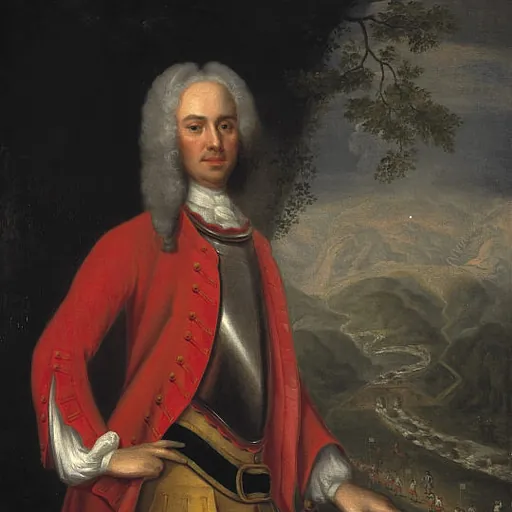
About George Wade
Lived 1673 – 1748 (aged 74–75). George Wade was an Irish military personnel, politician and soldier.
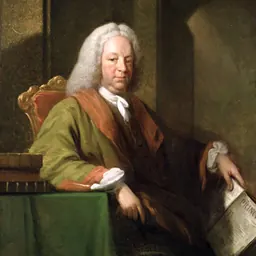
Field Marshal George Wade (1673 – 14 March 1748) was a British army officer and politician who served in the Nine Years' War, War of the Spanish Succession, Jacobite rising of 1715 and War of the Quadruple Alliance. He went on to be a military commander during the War of the Austrian Succession and Commander-in-Chief of the Forces during the Jacobite rising of 1745. While commanding the British Crown forces in Scotland, Wade was responsible for constructing hundreds of miles of military roads, many of which remain in use.
Early career Born the son of Jerome Wade in Killavally, County Westmeath, Ireland, he spent his early years in English Tangier, where his father was a member of the Tangier Garrison. Wade was commissioned into the Earl of Bath's Regiment on 26 December 1690 and served in Flanders in 1692, fighting at the Battle of Steenkerque in August 1692 during the Nine Years' War and earning a promotion to lieutenant on 10 February 1693. and was promoted to captain on 13 June 1695. and became commander of the British forces in Ireland in November 1714. On 19 March 1717, he became colonel of the Earl of Plymouth's Regiment of Horse. The same year he was one of the original backers of the Royal Academy of Music, establishing a London opera company that commissioned numerous works from Handel and others.
He became MP for Bath in 1722, retaining the seat for 25 years.
Scotland
The government of George I sent Wade to inspect Scotland in 1724. Over the next twelve years Wade directed the construction of some of roads and 30 bridges (including the Wade's Bridge at Aberfeldy).
A reference in verse is said to be inscribed on a stone at the start of one of his military roads in Scotland: poemquote|If you had seen this road before it was made, You would lift up your hands and bless General Wade. and raised the first six companies in 1725 (three of Campbells and one each of Frasers, Grants, and Munros). Also in 1725, Wade put down an insurrection after the government attempted to extend the "malt tax" to Scotland, and enraged citizens in Glasgow drove out the military and destroyed the home of their M.P. He was promoted to lieutenant general on 15 April 1727.
On 1 June 1732, he became Governor of Berwick-upon-Tweed, and on 19 June 1733, he became Governor of Fort William, Fort George and Fort Augustus. He was promoted to general of horse on 17 July 1739.
He raised four more "Highland Watch" companies in 1739, which were subsequently reorganized as the Black Watch regiment. On 22 June 1742, he was appointed Lieutenant-General of the Ordnance, and on 24 June 1742, he was appointed a member of the Privy Council.
War of the Austrian Succession On 17 December 1743 he became a field marshal with his appointment to the joint command of the Anglo-Austrian force in Flanders against the French in the War of the Austrian Succession.
It was because of the difficulties Wade encountered marching his troops cross-country from Newcastle to Carlisle that he built his Military Road west of Newcastle in 1746, entailing such destruction of Hadrian's Wall. Wade helped plan the road but had died before construction began in 1751. His Military Road is still in use today as the B6318; it should not be confused with the Military Way built by the Romans immediately south of Hadrian's Wall.
Wade received mention in a verse sung as part of God Save the King around 1745:
Wade left two natural (illegitimate) sons, Captains William and John Wade, and two natural daughters, Jane Erle and Emilia. Wade left most of his estate to his natural children although he provided generously for the widow and children of his brother William, Canon of Windsor, Berkshire. Wade had a second natural daughter named Emilia, who was married first in 1728 to a Mr John Mason and then to a Mr Jebb.
Don’t just read it —
keep it.
Full-length biographies made to live with: read them, listen on the way to work, watch them tonight.
- E-book
- Audio
- Video
Instant download · yours to keep · every purchase keeps this site free
Important facts
People in George Wade's life
Named in this biography and alive at the same time

Related people
Same field, nearest in time

Contemporaries
People whose lives overlapped George Wade's



Frequently asked questions
Who was George Wade?
British Field Marshal (1673-1748)
When was George Wade born?
George Wade was born in 1673 in County Westmeath.
When did George Wade die?
George Wade died on 14 March 1748 in London.
What was George Wade's occupation?
George Wade was a military personnel, politician and soldier.
What nationality was George Wade?
George Wade was Irish.
Sources & further reading
Cite this page
APA: Biography.guide. (2026). George Wade. https://biography.guide/george-wade-military-personnel/
MLA: "George Wade." Biography.guide, https://biography.guide/george-wade-military-personnel/.
Chicago: "George Wade." Biography.guide. https://biography.guide/george-wade-military-personnel/.
Data last updated: 2026-09-25 · Spot an error? Report a correction.
Portrait: Wikimedia Commons · author & licence
Page generated 2026-10-04 10:25 UTC