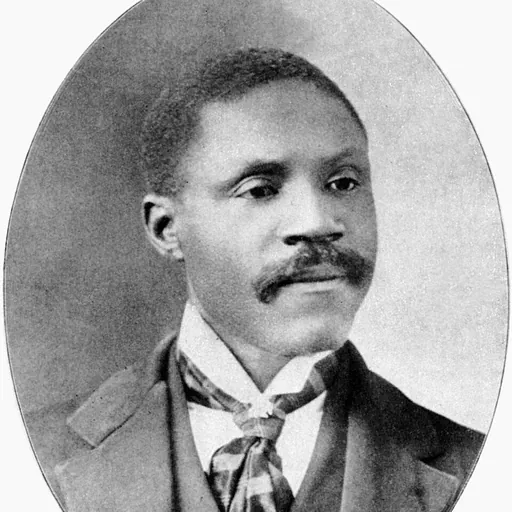
About George W. Murray
Lived 1853 – 1926 (aged 72). George W. Murray was an American politician.
George Washington Murray (September 22, 1853 – April 21, 1926) was an American politician, teacher, and farmer. After serving as chairman of the Sumter County Republican Party, Murray was elected in the 1890s as a United States congressman from South Carolina. He was the only black member in the 53rd and 54th Congresses. Because South Carolina passed a constitution in 1895 that effectively disenfranchised blacks and crippled the Republican Party, Murray was the last Republican elected in the state for about 70 years. The next Republican from South Carolina elected to the United States House of Representatives was former Democrat Albert Watson in 1965 while Tim Scott was the next black Republican from South Carolina elected to the United States House of Representatives in 2010.
In 1905, Murray was convicted of forgery in what he said was a discriminatory trial (with an all-white jury) and sentenced to three years' hard labor. He left the state and moved to Chicago. In 1915 he was pardoned in this case by the South Carolina governor, Coleman Blease. In Chicago, Murray again became active in the Republican Party. He lectured on race relations and his political career, and published two collections of his speeches. He died of a stroke on April 21, 1926.
Early life and education Murray was born into privilege on a cotton plantation near Rembert, Sumter County, South Carolina, in the Piedmont region. His parents' names are not known and he was separated from them by the end of the Civil War. He had two brothers, Prince and Frank. Murray did have formal schooling as a boy.
He worked as a teacher from 1871 until 1874. He entered the University of South Carolina at Columbia in 1874 when it was opened to black students by the Republican-dominated legislature.
With the end of the Reconstruction Era in 1877, the white Democrats retook control of the state legislature. They and the administration closed the college, forcing black students out. That year the legislature also passed a law restricting admission to whites and designating Claflin College for higher education for black students, in order to qualify for funding under the Morrill Land-Grant Act. Murray completed his education at the State Normal Institution at Columbia, a historically black college. Education was an urgent need and a high calling among the freedmen, and Murray taught school for fifteen years in Sumter County. He also invented some agricultural technology.
Under the national Republican administration, Murray was appointed in 1890 as a federal inspector of customs at the port of Charleston, South Carolina, serving to 1892. While white and black Populists struggled to create a third party in the state, Murray gained the Republican nomination from the black "shoestring district" (named for its shape) and was elected to the US Congress in 1892 as Democrats split their vote. He defeated the previous incumbent, Thomas E. Miller, for the Republican nomination. Murray represented South Carolina's 7th congressional district in the Fifty-third Congress (March 4, 1893 - March 3, 1895). He became known as the "Republican Black Eagle" for his speech against a proposed law in 1893 to remove federal inspectors from polling places, in which he recounted his own problems with harassment and discrimination in voting. Virtually no blacks were able to vote in the 1896 election.
In February 1897, Murray returned to Congress as a "lame duck". He wanted to gain a congressional investigation into South Carolina's disenfranchising of its black citizens; he intended to object to South Carolina's retaining nine electoral votes in the 1896 presidential election after excluding so many of its voters (all state electors had voted for the Democratic candidate). He had a petition signed by hundreds of South Carolina Republicans, and asserted that more than 100,000 eligible black voters had been disenfranchised from the 1896 election; therefore, the state should not have retained nine electoral votes. Fearful of potential effects on the apparent victory by the Republican William McKinley as president, Republicans did not want to disrupt the electoral vote count. Murray acceded to their request to drop his objection but continued to call for a federal investigation. Congress adjourned on schedule in March without acting on his request. The powerful southern Democratic bloc defeated any efforts to change electoral apportionment based on citizens who were able to vote, rather than total populations.
Murray returned to his farm. He invested in land in Sumter County, which he leased for cultivation to black tenant farmers. In 1903, he was charged with forging names on lease agreements in a matter that he said was related to a contract dispute between tenants. He was convicted in 1905 by an all-white jury and sentenced to three years of hard labor. His appeal failed.
Chicago decades Instead of serving his sentence, which he said was the result of a discriminatory trial, that year Murray moved to Chicago, Illinois. The historian John F. Marszalek agrees with Murray's assessment, describing the trial as "legal whitecapping, a way to rid the community of a troublesome black." As his wife Ella Murray refused to move, she and Murray divorced. He was pardoned in 1915 by South Carolina Governor Coleman Blease, who gave nearly 2,000 men a second chance.
In Chicago, Murray sold life insurance and real estate. In 1908, he married Cornelia Martin, who brought her daughter Gaynell to the marriage. Together in the 1920s, the Murrays adopted a 10-year-old boy, Donald; they also fostered numerous children.
Legacy James E. Clyburn, the current Democratic South Carolina congressman and Assistant Democratic Leader, is a relative of Murray. First elected to Congress in 1992 from the South Carolina's 6th congressional district, a new majority-minority district, Clyburn was the first African American to be elected to Congress from the state since George Murray. Demographic changes, including the Great Migration of blacks out of the state in the first half of the 20th century, had decreased former black majorities in certain counties and congressional districts prior to blacks' regaining the ability to vote.
Works Race Ideals: Effects, Cause, and Remedy for the Afro-American Race Troubles, Princeton, Indiana: Smith & Sons Publishing Company, 1914. Light in Dark Places (Chicago: Light in Dark Places Pub. Co., 1925).
Don’t just read it —
keep it.
Full-length biographies made to live with: read them, listen on the way to work, watch them tonight.
- E-book
- Audio
- Video
Instant download · yours to keep · every purchase keeps this site free
Important facts
People in George W. Murray's life
Named in this biography and alive at the same time



Related people
Same field, nearest in time




Contemporaries
People whose lives overlapped George W. Murray's



Frequently asked questions
Who was George W. Murray?
American politician (1853–1926)
When was George W. Murray born?
George W. Murray was born on 22 September 1853 in Sumter County.
When did George W. Murray die?
George W. Murray died on 21 April 1926 in Chicago.
What was George W. Murray's occupation?
George W. Murray was a politician.
What nationality was George W. Murray?
George W. Murray was American.
Sources & further reading
Cite this page
APA: Biography.guide. (2026). George W. Murray. https://biography.guide/george-w-murray/
MLA: "George W. Murray." Biography.guide, https://biography.guide/george-w-murray/.
Chicago: "George W. Murray." Biography.guide. https://biography.guide/george-w-murray/.
Data last updated: 2026-09-22 · Spot an error? Report a correction.
Portrait: Wikimedia Commons · author & licence
Page generated 2026-09-27 05:01 UTC