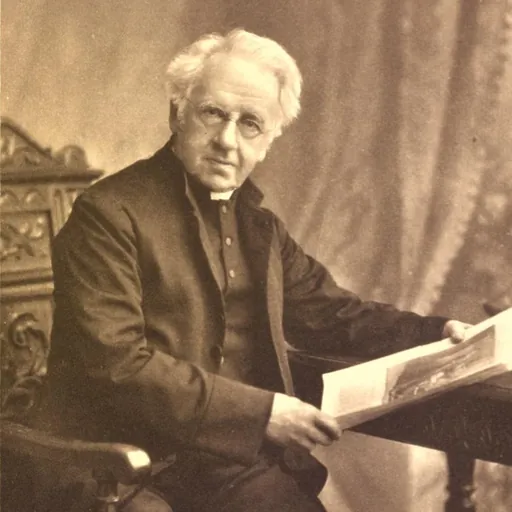
George Rundle Prynne
Church of England clergyman and writer
About George Rundle Prynne
Lived 1818 – 1903 (aged 84).
George Rundle Prynne (1818–1903) was a British Anglo-Catholic cleric in south-west England, known for his Tractarian and ritualist views. He is also notable as a hymn-writer: his "Jesu(s), Meek and Gentle" ranked with "Jesus Loves Me" and "Near the Cross" for American Protestants in the later 19th century".
Early life Born at West Looe, Cornwall, on 23 August 1818, he was a younger son in the family of eight children of John Allen Prynn from Newlyn and his wife Susanna, daughter of John and Mary Rundle of Looe: he later changed the spelling of his surname - (a)'pRynn being Cornish for 'Rynn's son'. He was education first at a school run by his sister in Looe, then at Devonport Classical and Mathematical School. He matriculated at St John's College, Cambridge, in October 1836, but migrated to Catharine Hall, graduating B.A. on 18 January 1840. He graduated M.A. in 1861, and M.A. ad eundem at Oxford on 30 May 1861).
Ordained deacon on 19 September 1841, and priest on 25 September 1842, Prynne was licensed as curate first to the parish of Tywardreath in Cornwall, and on 18 December 1843 to St Andrew's Church, Clifton, Bristol. There he first came in contact with Edward Pusey, whose views he adopted and publicly defended; but he declined Pusey's suggestion to join St Saviour Church, Richmond Hill in Leeds, because of an implied obligation of celibacy. On the nomination of the prime minister, Sir Robert Peel, he became vicar of the parish of Par, Cornwall, newly formed out of that of Tywardreath, from October 1846 to August 1847, when he took by exchange the living of St Levan with St Sennen. The parish contained poorer districts, and Prynne worked in its slums. The Five Fields area as drawn by J. M. W. Turner in 1813 was open land; it is now the location of Wantage Gardens, East Stonehouse.
Anti-Tractarian feeling Prynne's advocacy of Anglican Catholicism on Pusey's lines involved him in heated controversy. The conflict was largely fostered by John Hatchard. That was a misconstruction of the bishop's wish to stay within a strict interpretation of the rubrics in liturgical matters.
Prynne had as assistant-curate George Hilhouse Hetling, from 1849 to 1852. Hetling was a Bristol surgeon, had worked in the gaol there, and had much experience of cholera. He was ordained deacon by Phillpotts in 1849, and wrote in high praise of the Sisters. Prynne himself later wrote:
On S. Peter's parish, comprising as it does some of the lowest and most densely-populated parts of Plymouth, the pestilence raged with special severity. For three months we seemed to be living amongst the living and the dead.
The cholera deaths recorded in Plymouth during the outbreak, from July to November 1849, numbered 819. There were temporary cholera hospitals in Five Fields.
Prynne in court In 1850 Prynne brought a charge of criminal libel against Isaac Latimer, owner and editor of the Plymouth and Devonport Weekly Journal, over an article prompted by religious differences which seemed to reflect badly on him (24 January 1850). The trial took place at Exeter, before Mr. Justice Coleridge, on 6 and 7 August 1850, and excited bitter local feeling. and the Rev. Michael Hobart Seymour.
An inquiry on 22 September 1852 by Phillpotts into the allegations against Prynne's doctrine and practice worked out in Prynne's favour.
A riot then took place when Phillpotts held a confirmation at St Peter's the following month. That year Prynne joined the Society of the Holy Cross, and in 1861 the English Church Union 1862, becoming vice-president of the Union in 1901.
Prynne died at his vicarage after a short illness on 25 March 1903, and was buried at Plympton St Mary.
Works Prynne's major work was The Eucharistic Manual, 1865 (tenth and last edit. 1895); it was censured by the primate, Archbishop Charles Longley. He was also author of Truth and Reality of the Eucharistic Sacrifice (1894) and Devotional Instructions on the Eucharistic Office (1903). Other prose works consisted of sermons and doctrinal or controversial tracts.
As a writer of hymns Prynne enjoyed a reputation. A Hymnal compiled by him in 1875 contains his well-known "Jesu, meek and gentle", written in 1856, and some translations of Latin hymns. He also took part in the revision of Hymns Ancient and Modern, and published The Soldier's Dying Visions, and other Poems and Hymns (1881) and Via Dolorosa in prose, on the Stations of the Cross (1901).
Family Prynne married on 17 April 1849 Emily (died 1901), daughter of Admiral Sir Thomas Fellowes, and they had a family of four sons and six daughters. The sons Edward Arthur Fellowes Prynne and George Halford Fellowes Prynne were connected as artist and architect respectively with the plan and adornment of their father's church at Plymouth, and the Prynne memorial there, a mural painting, allegorically representing the Church Triumphant, is by Edward.
Don’t just read it —
keep it.
Full-length biographies made to live with: read them, listen on the way to work, watch them tonight.
- E-book
- Audio
- Video
Instant download · yours to keep · every purchase keeps this site free
Important facts
People in George Rundle Prynne's life
Named in this biography and alive at the same time



Contemporaries
People whose lives overlapped George Rundle Prynne's




Frequently asked questions
Who was George Rundle Prynne?
Church of England clergyman and writer
When was George Rundle Prynne born?
George Rundle Prynne was born on 23 August 1818.
When did George Rundle Prynne die?
George Rundle Prynne died on 25 March 1903.
Sources & further reading
· Wikipedia: George Rundle Prynne
· DBpedia: George Rundle Prynne
Cite this page
APA: Biography.guide. (2026). George Rundle Prynne. https://biography.guide/george-rundle-prynne/
MLA: "George Rundle Prynne." Biography.guide, https://biography.guide/george-rundle-prynne/.
Chicago: "George Rundle Prynne." Biography.guide. https://biography.guide/george-rundle-prynne/.
Data last updated: 2026-09-21 · Spot an error? Report a correction.
Portrait: Wikimedia Commons · author & licence
Page generated 2026-09-27 05:01 UTC