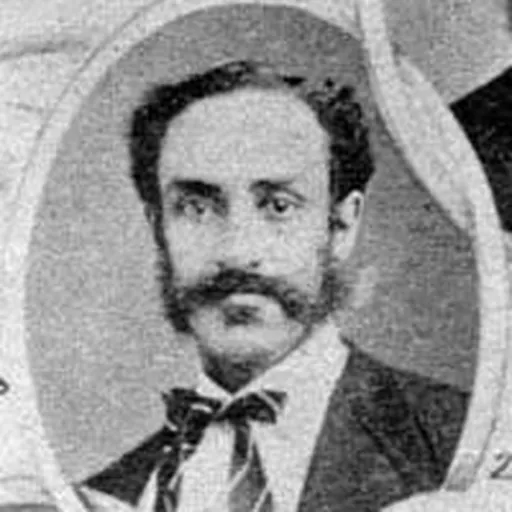
About George Ruby
Lived 1841 – 1882 (aged 40–41). George Ruby was an American journalist and politician.
George Thompson Ruby (July 1, 1841 – October 31, 1882) was an African-American Republican politician in Reconstruction-era Texas. Born in New York to African-American businessman Reuben Ruby and Rachel Humphey and raised in Portland, Maine, he worked in Boston and Haiti before starting teaching in New Orleans before the end of the American Civil War.
Moving to Galveston, Texas, in 1866, where he worked as an agent for the Freedmen's Bureau, Ruby also organized for the Republican Party. He served as one of ten African-Americans elected to the 1868-1869 state constitutional convention, in the Texas Senate, and as a delegate to two Republican Party national conventions. At the first he was the only African American delegate from Texas.
According to Barry Crouch, Ruby learned leadership roles in Louisiana from 1863 to 1866. The Army assigned Ruby to the Freedmen's Bureau. His roles encompassed that of a teacher, a school administrator, and a mobile inspector for the Bureau. His responsibilities included assessing local conditions, assisting in the establishment of black schools, and evaluating the performance of Bureau field officers. Ruby's endeavors were met with a positive response from the black population, who eagerly embraced education, but they also faced vehement opposition, including physical violence, from numerous planters and other white individuals. Ruby's career exemplifies the role played by the Black carpetbagger during the Civil War and Reconstruction era in Louisiana.
Texas politics In September 1866, with Louisiana schools shutting down for lack of funding, Ruby left for Texas. The Freedmen's Bureau agent assigned him as agent and teacher in Galveston. (This was not unusual; many black teachers with experience in Louisiana migrated to Texas, where their past association ensured that they had colleagues in their new surroundings). Working to set up and run schools for blacks, Ruby also helped organize local chapters of the Union League on which mobilization for the newly created Republican party would depend. In 1868, he was elected the League's first state president, a powerful political position. Later that year, he was the first African-American from Texas to attend the Republican National Convention. In time he became editor of the Galveston Standard. Like many Republican papers, it had a brief life.
Provisional Governor Elisha M. Pease appointed Ruby as a notary public in Galveston. When elections took place for delegates to a state constitutional convention in 1868, Ruby was chosen for the district comprising Brazoria, Galveston, and Matagorda counties. He was one of ten African Americans elected as delegates.
Although discussed as a possible running-mate for Republican gubernatorial nominee Edmund J. Davis, Ruby was far younger at age 28 than would have been the norm. In addition, Republicans were reluctant to nominate a black candidate, because of the risk of driving away white votes. Blacks were a minority statewide. In 1870, he was first elected to the Texas Senate in a very close vote, where he served two terms, in 1870-71 and again in 1873, for the 12th and 13th Texas Legislatures. He pressed hard for bills protecting the freed people's civil rights, including a measure opening public conveyances to all, regardless of race—a bill that white members made sure never came to a vote. At the same time, with an eye to his largely white constituency, Ruby introduced bills supporting construction of railroads radiating from Galveston, including several transcontinental projects such as the Southern Pacific and the International & Great Northern. Railroad aid was not a win-win deal; money or lands appropriated to help out their projects came at the expense of other needs of the state, such as a well-financed public school system. He served as a delegate to two Republican Party national conventions, the first time as the only African American from Texas.
He was also appointed as a customs officer in Galveston in 1869. With close connections to labor organizations in Galveston and as president of the Texas Colored Labor Convention in 1869, Ruby had influence far beyond Galveston. He also helped black workers gain jobs at the Galveston docks after 1870. "In the post-Civil War era no black man in Texas exercised more political power than did George Thompson Ruby," Moneyhon wrote. "An astute politician, Ruby built a base of power in the black community of Galveston, then used that support to make himself a major force in the state at large. He was a forceful advocate of civil and political rights for his race, but he knew when to compromise to gain his larger goals, and he moved carefully among hostile white politicians in his efforts to expand opportunities for black people."
Return to Louisiana and journalism With the return of the Democrats to power in 1874, Ruby left Texas and returned to Louisiana. He found work on the New Orleans Louisianian, a black Republican newspaper edited by Louisiana's former lieutenant-governor, Pinckney B. S. Pinchback. He gained a job in the New Orleans custom-house, but Ruby's main occupation was newspaper work. He worked with Pinchback's paper until 1878. That year he became editor of the New Orleans Observer, a paper which he established, operating it through the 1880 election. After its demise, he began another, the New Orleans Republic.
In the late 1870s, Ruby became a strong supporter of the Exoduster movement. It supported the voluntary migration of freedmen from the Deep South to Kansas, in order to escape segregation, violence and white supremacy.
Still an influential spokesperson for black interests in Louisiana, Ruby died on October 31, 1882, of malaria at his home on Euterpe Street, New Orleans.
Don’t just read it —
keep it.
Full-length biographies made to live with: read them, listen on the way to work, watch them tonight.
- E-book
- Audio
- Video
Instant download · yours to keep · every purchase keeps this site free
Important facts
People in George Ruby's life
Named in this biography and alive at the same time


Related people
Same field, nearest in time

Contemporaries
People whose lives overlapped George Ruby's

Frequently asked questions
Who was George Ruby?
African-American politician in Reconstruction Texas
When was George Ruby born?
George Ruby was born in 1841 in New York City, New York.
When did George Ruby die?
George Ruby died on 31 October 1882 in New Orleans.
What was George Ruby's occupation?
George Ruby was a journalist and politician.
What nationality was George Ruby?
George Ruby was American.
Sources & further reading
Cite this page
APA: Biography.guide. (2026). George Ruby. https://biography.guide/george-ruby/
MLA: "George Ruby." Biography.guide, https://biography.guide/george-ruby/.
Chicago: "George Ruby." Biography.guide. https://biography.guide/george-ruby/.
Data last updated: 2026-09-21 · Spot an error? Report a correction.
Portrait: Wikimedia Commons · author & licence
Page generated 2026-09-27 05:01 UTC