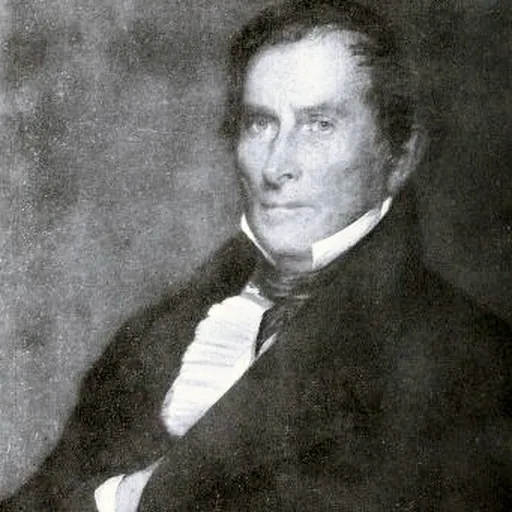
About George Poindexter
Lived 1779 – 1853 (aged 74). George Poindexter was an American politician, judge and lawyer.
George Poindexter (1779 – September 5, 1853) was an American politician, lawyer, and judge from Mississippi. Born in Virginia, he moved to the Mississippi Territory in 1802. He served as United States Representative from the newly admitted state, was elected as Governor (1820–1822), and served as a United States senator.
Early life Poindexter was born in Louisa County, Virginia in 1779. He was the son of Thomas Poindexter and Lucy (Jones) Poindexter; the Poindexters were a large Virginia family of French Huguenot and English ancestry. Poindexter received a sporadic education,
The exact details of Poindexter's legal studies are not known, but according to family tradition, Poindexter studied under practicing attorneys, first in Kentucky, and later in Richmond. He was admitted to the bar in 1800 and began to practice in Milton, an Albemarle County town along the Rivanna River which no longer exists.
Move to Mississippi
After moving to the Mississippi Territory in 1802, Poindexter set up his law practice in Natchez. He soon became a friend of Governor William C. C. Claiborne, and a leader in the local Democratic-Republican Party. As a result, in 1803, he was appointed Attorney General of the Territory; he served until 1807, when he took up his duties as a member of the Territorial House of Representatives, to which he had been elected in 1806. (He had been an unsuccessful candidate for the legislature in 1804.)
During Mississippi's early years, nearby areas were under Spanish control. When tensions rose over Mississippi's expansion, and the Spanish threatened an attack, residents of Adams County formed a militia; Poindexter was one of the main organizers of a company in Natchez, the Mississippi Blues; he was elected commander with the rank of captain. No attack from Spain materialized, and the militia soon disbanded.
When former U.S. Vice President Aaron Burr appeared in Mississippi while traveling south as part of the Burr conspiracy in 1807, acting Governor Cowles Mead declared martial law, appointed Poindexter and William B. Shields as aides-de-camp on his military staff, and sent them to interview Burr and determine his intentions. When Burr was arrested, Poindexter conducted the prosecution until Burr escaped from custody. Poindexter initially "refused to bring charges, on the ground that Burr had committed no crime within the jurisdiction." After Burr escaped, Governor Robert Williams returned from vacation at his home in North Carolina to personally take control of the situation; he criticized Mead and fired the militia officers Mead had appointed, including Poindexter.
Territorial delegate to Congress Poindexter was elected as a delegate to the United States House of Representatives from the Mississippi Territory; he served in the 10th, 11th and 12th Congresses (1807 to 1813). As a delegate, Poindexter concentrated his efforts largely on questions germane to Mississippi, such as federal patronage, as well as advocating for Mississippi's admission to the United States. Poindexter also worked to resolve and standardize land titles in Mississippi, where residents possessed deeds and grants from Spain, France, England, and the United States, due to the number of times the area had changed hands. He also opposed those who claimed the Yazoo lands, but in 1810 the United States Supreme Court's ruling in Fletcher v. Peck, resolved the claims in their favor.
Before leaving for Washington, DC to begin his duties, Mead informed Poindexter of disparaging comments Williams had made to Mead about Poindexter following Burr's escape. Poindexter responded by challenging Williams to a duel; Williams replied that he would admit to any comment Mead attributed to him, but that he would not "involve either his public or private character with such a man." Poindexter responded by writing letters to the editor that made it appear that he had been wronged by Williams and was unable to obtain satisfaction, which had the effect of making Williams appear cowardly in the eyes of his constituents.
Poindexter was in Richmond in October 1807 to testify at Burr's treason trial; his testimony suggested that Burr's arrest had been based on flimsy evidence, which probably played a part in Burr's acquittal.
In 1811, Poindexter's outspoken opposition to the Federalist Party resulted in a duel with wealthy merchant and planter Abijah Hunt. Poindexter killed Hunt, but afterward, Poindexter's political opponents alleged that he had broken the code duello by firing at Hunt prematurely. the National Intelligencer, and other newspapers. Political opponents and the editor of the Mississippi Republican challenged Poindexter's account based on Poindexter's supposed dereliction of duty on the day of the battle. In March 1815, Poindexter confronted the editor and was subsequently arrested for assault. The "beauty or booty" story had a profound effect on how the war was perceived and became central to contemporary accounts of Jackson's victory because it made the British appear to be degenerates bent on rape and plunder, while the Americans were depicted as benevolent and morally superior for the charity and medical aid they rendered to British troops after the fighting.
House of Representatives Poindexter was chair of the committee appointed to draft a constitution for the new state of Mississippi. After its admission in 1817, he was elected to be the state's first representative in Congress.
After that, he was an unsuccessful candidate for the U.S. House of Representatives in 1820 to the 17th Congress and in 1822 to the 18th Congress.
Governor of Mississippi In 1819 Poindexter was elected the second Governor of Mississippi by a large margin, winning over 60% of the vote in the general election. He served from 1820 to 1822. During his time in office he oversaw a reorganization of the militia, the state created its first free public schools, state courts were reorganized, and Jackson was selected as the site for the state capital.
Poindexter served as chairman of the Committee on Private Land Claims in the 22nd Congress from 1831 to 1833, of the Committee on Public Lands in the 23rd Congress from 1833 to 1835 and was President pro tempore of the Senate from June to November 1834.
Poindexter's tenure as chair of the Committee on Private Land Claims had been then considered moderately controversial. He had espoused some views that could be regarded as socialist regarding government repossession of land. Poindexter was thought to have made these claims to support President Andrew Jackson's fight with the Second Bank of the United States. He was a supporter of President Jackson and had defended him against calls for censure stemming from Jackson's 1818 invasion of Florida (including the Arbuthnot and Ambrister incident), but had slowly become less happy with the President's policies.
Poindexter was selected to be President pro temp of the Senate in 1834, but Jacksonians objected with one newspaper bringing up Poindexter's alleged drinking problem: "One editor said: 'This man...yet rank with the fumes of a low debauch, his step yet tottering, and his eyes rolling with a drunken leer, this man, all filth and vermon [sic], called, probably, from a brothel or a gin cellar, to the Senate Chamber, this man, they chose...to preside over the Senate of the United States.'" He was interred in Greenwood Cemetery in Jackson.
Personal
In 1804 Poindexter married Lydia Carter (1789–1824), the daughter of a prominent Natchez businessman and plantation owner. They had two sons, George Littleton (or Lytleton) and Albert Gallatin. They divorced after Poindexter publicly accused his wife of infidelity and claimed that their second child, whom he disavowed, was the product of an extramarital affair between his wife and their neighbor. In 1820 Lydia Carter Poindexter married Reverend Lewis Williams and moved to Brimfield, Massachusetts. Her sons remained with her; Poindexter provided for the support of George, but disavowed Albert and refused to provide for him.
In 1816 Poindexter married Agatha Ball Chinn (1794–1822). They had one son who died of yellow fever as a child while Poindexter was Governor, and Agatha Poindexter died soon afterward.
He was said to have a serious, non-consensual liaison with an enslaved woman.
When several years before, Representative Richard Mentor Johnson of Kentucky was criticized for his common-law marriage with Julia Chinn, an enslaved woman; he said, "Unlike Jefferson, Clay, Poindexter and others, I married my wife under the eyes of God, and apparently He has found no objections."
Historian Burke has written, During slavery times, there was no particular stigma attached to the fact that many southern plantation owners, along with their white overseers, often fathered mulatto children born of black slave women. As long as the white father denied the facts, the customs that created miscegenation were usually overlooked by Southern society. He married his third wife, Ann Hewes of Boston, in 1832.
Don’t just read it —
keep it.
Full-length biographies made to live with: read them, listen on the way to work, watch them tonight.
- E-book
- Audio
- Video
Instant download · yours to keep · every purchase keeps this site free
Important facts
People in George Poindexter's life
Named in this biography and alive at the same time

Related people
Same field, nearest in time



Contemporaries
People whose lives overlapped George Poindexter's

Frequently asked questions
Who was George Poindexter?
American politician (1779-1853)
When was George Poindexter born?
George Poindexter was born on 19 April 1779 in Louisa County.
When did George Poindexter die?
George Poindexter died on 5 September 1853 in Jackson.
What was George Poindexter's occupation?
George Poindexter was a politician, judge and lawyer.
What nationality was George Poindexter?
George Poindexter was American.
Sources & further reading
· Wikipedia: George Poindexter
Cite this page
APA: Biography.guide. (2026). George Poindexter. https://biography.guide/george-poindexter/
MLA: "George Poindexter." Biography.guide, https://biography.guide/george-poindexter/.
Chicago: "George Poindexter." Biography.guide. https://biography.guide/george-poindexter/.
Data last updated: 2026-09-20 · Spot an error? Report a correction.
Portrait: Wikimedia Commons · author & licence
Page generated 2026-09-27 04:58 UTC