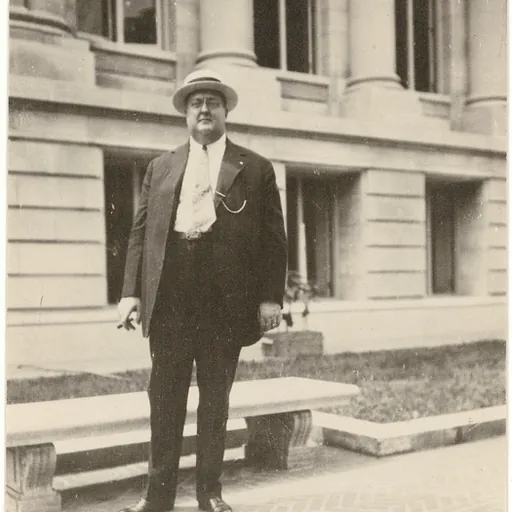
George Gustav Heye
Collector of Native American artifacts
About George Gustav Heye
Lived 1874 – 1957 (aged 82–83). George Gustav Heye was an American americanist, known for Indigenous peoples of the Americas.
George Gustav Heye (1874 – January 20, 1957) was an American collector of Native American artifacts in the Western Hemisphere, particularly in North America. He founded the Museum of the American Indian, and his collection became the core of the National Museum of the American Indian.
Heye's collection is described as the largest and most comprehensive of its kind in the world. During his years of collecting and study, Heye funded numerous archeological expeditions and supported scholarly work of the time. He established the Heye Foundation in the early 20th century to support such work, as well as contributing independently.
Life and career Heye was born in 1874, the son of Carl Friederich Gustav Heye and Marie Antoinette Lawrence of Hudson, New York. His father was a German immigrant who earned wealth in the new petroleum industry.
George Gustav Heye graduated from Columbia School of Mines (now Columbia School of Engineering and Applied Science) in 1896 with a degree in electrical engineering. While superintending railroad construction in Kingman, Arizona in 1897, Heye acquired a Navajo deerskin shirt, his first Native American item. He continued to acquire individual items until 1903, then he began collecting material in larger numbers.
In 1901, Heye started a career in investment banking that lasted until 1909. His success gave him the financial means to fund archeological expeditions conducted by scholars in the field. For instance, he funded an expedition in 1907 to Ecuador and Colombia by Professor Saville of the Department of Anthropology of Columbia University, Heye's alma mater. Saville had already completed two expeditions to sites in those countries. Other parts of the archeological site were excavated in 1965–1967, including two villages and two earthwork mounds.
In 1916, he purchased the collection of Alaskan Native artifacts that had won the gold medal for ethnological collections at the 1909 Alaska–Yukon–Pacific Exposition, from J. E. Standley of Ye Olde Curiosity Shop. Eventually, the Heye collection was moved to the Heye Foundation's Museum of the American Indian at 155th Street and Broadway, which broke ground in May 1916. He had been encouraged to build there by Archer Milton Huntington, who had already established The Hispanic Society of America in its own building and sponsored a complex of cultural institutions.
In 1919, Heye founded the journal Indian Notes and Monographs. It closed in 1994, after the collection had been moved in 1989 to the Smithsonian Institution. In 1994 the George Gustav Heye Center of the National Museum of the American Indian opened in the former Alexander Hamilton U.S. Custom House near Battery Park in Lower Manhattan.
Heye died on January 20, 1957, at his house in the Ritz Tower in New York City.. He is interred in Woodlawn Cemetery in the Bronx, New York City.
Museum of the American Indian
Heye created the Museum of the American Indian in 1916 in New York City and was its director until 1956. The collection contains over one million objects, particularly from Native Americans, Inuit and Alaskan Natives, and also other indigenous peoples of the Western Hemisphere. The collection was transferred to the Smithsonian Institution in 1989, which established the National Museum of the American Indian. (It now has two locations, in New York City and in Washington, DC.)
About one-third of the original collection has been repatriated under the National Museum of the American Indian Act. This federal legislation recognized that grave goods and other sacred items had been taken from Native American tribes without permission through archeological and other collecting expeditions. Artifacts were once stored in the Bronx in a building along the Interstate 95 corridor. After the land and building were sold, the property was cleared for redevelopment as private housing.
After 1930, the library of the Museum formed the bulk of the Native American Collection at the Huntington Free Library. The 40,000+ books and archival artifacts were sold to Cornell University in 2004.
Membership American Anthropological Association American Museum of Natural History American Geographical Society American Association for the Advancement of Science The Explorers Club; he served twice as president, from 1922 to 1925 and 1928 to 1930
Publications George G. Heye, Frederick W. Hodge, and George H. Pepper, The Nacoochee Mound in Georgia. New York: Museum of the American Indian, Heye Foundation, 1918.
Don’t just read it —
keep it.
Full-length biographies made to live with: read them, listen on the way to work, watch them tonight.
- E-book
- Audio
- Video
Instant download · yours to keep · every purchase keeps this site free
Important facts
People in George Gustav Heye's life
Named in this biography and alive at the same time

Related people
Same field, nearest in time





Contemporaries
People whose lives overlapped George Gustav Heye's
Frequently asked questions
Who was George Gustav Heye?
collector of Native American artifacts (1874–1957)
When was George Gustav Heye born?
George Gustav Heye was born in 1874.
When did George Gustav Heye die?
George Gustav Heye died on 20 January 1957.
What was George Gustav Heye's occupation?
George Gustav Heye was an americanist.
What was George Gustav Heye known for?
George Gustav Heye was known for Indigenous peoples of the Americas.
What nationality was George Gustav Heye?
George Gustav Heye was American.
Sources & further reading
· Wikipedia: George Gustav Heye
Cite this page
APA: Biography.guide. (2026). George Gustav Heye. https://biography.guide/george-gustav-heye/
MLA: "George Gustav Heye." Biography.guide, https://biography.guide/george-gustav-heye/.
Chicago: "George Gustav Heye." Biography.guide. https://biography.guide/george-gustav-heye/.
Data last updated: 2026-09-22 · Spot an error? Report a correction.
Portrait: Wikimedia Commons · author & licence
Page generated 2026-09-27 05:01 UTC