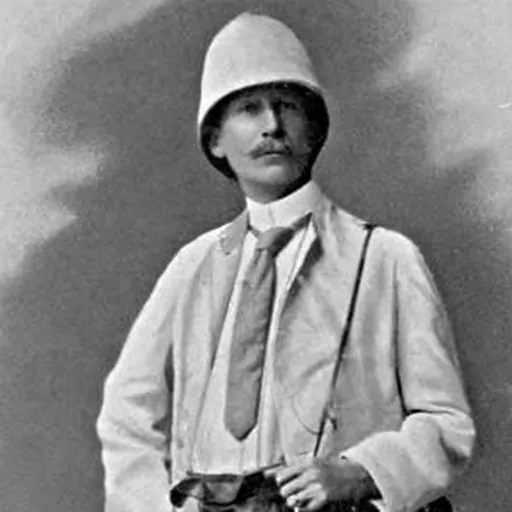
George Griffith
British science fiction writer and explorer
About George Griffith
Lived 1857 – 1906 (aged 48–49). George Griffith was a British author, scientist, science fiction writer, journalist and writer.
George Chetwynd Griffith-Jones (20 August 18574 June 1906) was a British writer. He was active mainly in the science fiction genre—or as it was known at the time, scientific romance—in particular writing many future-war stories and playing a significant role in shaping that emerging subgenre. For a short period of time, he was the leading science fiction author in his home country both in terms of popularity and commercial success.
Griffith grew up with his parents and older brother, receiving home-schooling and moving frequently during his childhood due to his father's career as a clergyman. Following his father's death when Griffith was 14 years old, he went to school for a little over a year before leaving England and travelling the world, returning at the age of 19. He then worked as a teacher for ten years before pursuing a career in writing. After an initial setback that left Griffith without the means to provide for himself, he was hired by the publisher C. Arthur Pearson in 1890. Griffith made his literary breakthrough with his debut novel The Angel of the Revolution (1893), which was serialized in Pearson's Weekly before being published in book format. He signed a contract of exclusivity with Pearson and followed it up with the likewise successful sequel Olga Romanoff (1894).
Griffith was highly active as a writer throughout the 1890s, producing numerous serials and short stories for Pearson's various publications. He also wrote non-fiction for Pearson and went on various travel assignments. Among these were an 1894 publicity stunt in which he circumnavigated the world in 65 days, an 1895 journey to South America where he covered the various revolutionary movements active there at the time, and an 1896 trip to Southern Africa that resulted in Griffith writing the novel Briton or Boer? (1897) anticipating the outbreak of the Boer War (1899–1902). Griffith's career declined in the latter part of the 1890s, and he was surpassed by H. G. Wells as the favourite science fiction writer of both Pearson and the reading public. His last outright success was A Honeymoon in Space (1901), and he parted ways with Pearson shortly thereafter. With his health in decline, likely due to alcoholism, he continued writing prolifically up until his death at the age of 48.
Griffith was both successful and influential as a writer at the peak of his career, but he has since descended into obscurity. Retrospective assessments have found his works to have been timely and prescient—in particular with regard to the importance of aerial warfare—but not timeless, and he is commonly regarded as a relatively poor writer, especially when compared to his main rival, Wells. He regularly incorporated his personal viewpoints into his fiction, and anti-American sentiments expressed in this way ensured that he never established a readership in the United States as publishers there would not print his works. He was irreligious and in his youth advocated fiercely for secularism. Politically, Griffith was early an outspoken socialist, though he is believed to have gradually shifted towards more right-leaning sympathies later in his life. Socially, he has been described as embodying Victorian ideals, including social conservatism and staunch pro-British views.
Biography
Early life George Chetwynd Griffith-Jones was born in Plymouth, Devon, on 20 August 1857. His parents were the clergyman George Alfred Jones and Jeanette Henry Capinster Jones. They moved from Plymouth to Tring, Hertfordshire, in 1860, then on to two poverty-stricken parishes in the Greater Manchester area: first to Ashton-under-Lyne in 1861, and then to Mossley, where his father was appointed vicar in 1864. He also spent considerable time exploring his father's extensive library, which was filled with the works of authors who would later serve as Griffith's literary influences, including Walter Scott and Jules Verne.
Then I went to another school, or perhaps I should put it more correctly if I said that I matriculated in the greatest of all universities—the world. I went to sea as an apprentice on a Liverpool lime-juicer ... In the seventy-eight days between Liverpool and Melbourne I learnt more of the world than I had learnt in fourteen years, but the methods of tuition didn't suit me. The learning was hammered in a little too hard, mostly with a rope's end and the softest part of a belaying pin, so I took French leave of that class-room and went to another; in plain English, I ran away from my ship and went up in the bush. — George Griffith, quoted in Sam Moskowitz, Strange Horizons: The Spectrum of Science Fiction He later claimed both to have received an offer to marry a Polynesian princess He returned to England at the age of 19. At this time, he had no formal qualifications and studied at night to be able to give lessons in the daytime.
C. Arthur Pearson, whom Griffith worked for throughout the 1890s A friend of Griffith's wrote him a letter of introduction to the publisher C. Arthur Pearson. The future war genre had been popular since the publication of George Tomkyns Chesney's novella "The Battle of Dorking" (1871) , and the rival magazine Black & White had just had a major success in the genre with the serialized novel The Great War of 1892 (1892) by Philip Howard Colomb.
The London-based Tower Publishing Company quickly secured the book rights to The Angel of the Revolution, publishing an abridged hardcover edition in October 1893. The book version was likewise a success, receiving rave reviews and becoming a best-seller; it was printed in six editions within a year and at least eleven editions in total, and a review in The Pelican declared Griffith to be "a second Jules Verne". Griffith accomplished the feat in 65 days , starting on 12 March 1894 and finishing on 16 May.
Pearson tasked Griffith with writing a new future-war serial to boost sales of Short Stories , a magazine he had acquired in mid-1893. Moskowitz speculates that this could have happened during this assignment. During the second half of the 1890s, Wells also supplanted Griffith as the best-selling science fiction writer, and the one most acclaimed by the public. During his time there, he wrote A Honeymoon in Space, a scientific romance novel about a newlywed couple traversing the Solar System. E. F. Bleiler, in the 1990 reference work Science-Fiction: The Early Years, comments that Griffith may be considered the first professional English-language science fiction author. and similarly writes that he played a key role in the development of the scientific romance genre.
In spite of all this, Griffith and his works have now descended into obscurity, something several modern writers have remarked upon as being peculiar. The antiquarian bookseller Jeremy Parrott comments that the outbreak of World War I in 1914, along with the development of powered flight and emergence of submarine warfare, quickly rendered Griffith's visions of the future obsolete. Robert Godwin and the publishing house Collector's Guide Publishing further attribute it in part to the bankruptcy of the Tower Publishing Company in 1896 leaving his successful first three novels without a publisher thereafter. with some critics such as Stableford and Darko Suvin opining that he peaked as early as his debut novels in The Angel of the Revolution sequence. He is similarly credited with anticipating developments in warfare, in particular the coming importance of aerial warfare, though Moskowitz comments that this did not require particularly keen foresight.
In relation to H. G. Wells H. G. Wells (1866–1946), Griffith's principal literary rival During Griffith's lifetime, comparisons were frequently made between his works and those of H. G. Wells—to the chagrin of Wells, who viewed himself as producing literature of a higher class than Griffith. Scholars on Wells, by contrast, usually do not consider Griffith to have been an important influence.
Wells is generally regarded as the superior writer . Moskowitz further writes that Griffith appears to have taken up an interest in the occult in the later years of his life. 1898 The Destined Maid F. V. White 1897 August "A Run to Freetown" Pearson's Magazine "I.D.B." story 1901 In an Unknown Prison Land: An Account of Convicts and Colonists in New Caledonia Hutchinson 1903 With Chamberlain through South Africa George Routledge & Sons 1903 Sidelights on Convict Life John Long Ltd originally published irregularly in Pearson's Magazine Explanatory notes
Don’t just read it —
keep it.
Full-length biographies made to live with: read them, listen on the way to work, watch them tonight.
- E-book
- Audio
- Video
Instant download · yours to keep · every purchase keeps this site free
Important facts
Family & relationships
People in George Griffith's life
Named in this biography and alive at the same time




Related people
Same field, nearest in time


Contemporaries
People whose lives overlapped George Griffith's


Frequently asked questions
Who was George Griffith?
British science fiction writer and explorer (1857–1906)
When was George Griffith born?
George Griffith was born in 1857 in Plymouth.
When did George Griffith die?
George Griffith died in 1906 in Port Erin.
What was George Griffith's occupation?
George Griffith was an author, scientist, science fiction writer, journalist and writer.
What nationality was George Griffith?
George Griffith was British.
Sources & further reading
Cite this page
APA: Biography.guide. (2026). George Griffith. https://biography.guide/george-griffith/
MLA: "George Griffith." Biography.guide, https://biography.guide/george-griffith/.
Chicago: "George Griffith." Biography.guide. https://biography.guide/george-griffith/.
Data last updated: 2026-09-22 · Spot an error? Report a correction.
Portrait: Wikimedia Commons · author & licence
Page generated 2026-09-27 05:04 UTC