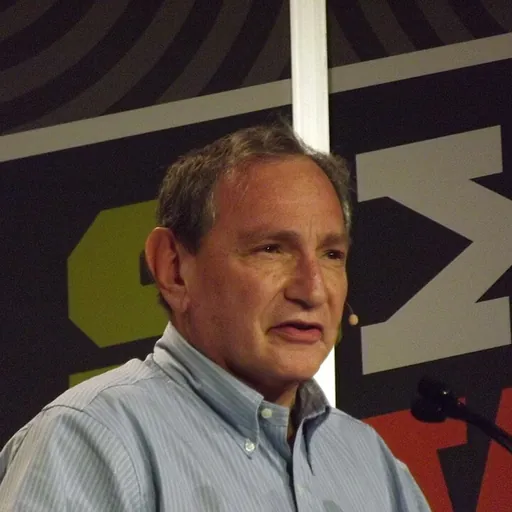
George Friedman
American businessman and political scientist
About George Friedman
Born 1949. George Friedman is an American geopolitical analyst, political scientist, non-fiction writer and businessperson.
Early life and education Friedman was born in Budapest, Hungary, in 1949. His family immigrated to the United States. Friedman describes his family's story as "a very classic story of refugees making a new life in America." He grew up in New York City.
Career After the collapse of the Soviet Union, Friedman studied the potential for a Japan-U.S. conflict and co-authored with his wife The Coming War with Japan in 1991. The war he predicted did not occur.
Friedman spent nearly 20 years in academia, during which time he taught political science at Dickinson College.
In 1996, Friedman founded Stratfor, a private intelligence and forecasting company, and served as the company's CEO and Chief Intelligence Officer. Stratfor's head office is in Austin, Texas. He resigned from Stratfor in May 2015. That year, he founded Geopolitical Futures.
Friedman's reputation as a forecaster of geopolitical events led The New York Times magazine to comment, in a profile, "There is a temptation, when you are around George Friedman, to treat him like a Magic 8 Ball".
Decade Forecasts at Stratfor During his tenure at Stratfor, George Friedman oversaw the publication of the company's recurring Decade Forecasts, which aimed to predict long-term global trends based on structural factors such as geography, demography, and national interest.
1995–2005: The first forecast emphasized the continued supremacy of the United States in a unipolar world and projected a fragmented international system marked by tension and economic growth. Stratfor saw no credible rivals to U.S. power, predicting Japan would reemerge militarily and that Germany would be unable to lead European monetary integration. Neither of these occurred: Japan remained pacifist, and the euro was successfully launched. The report also failed to anticipate the rise of Islamist terrorism or the impact of 9/11, a major blind spot for a forecast released just a few years earlier.
Friedman predicts that China will face a severe internal crisis brought on by its rapid economic growth and resulting regional inequality. He argues that tensions between the prosperous coastal regions and the poorer interior will strain the political system. According to Friedman, "Either the government will crush dissent with an iron fist, or the country will begin to unravel." He concludes that national fragmentation is the more likely scenario, with provinces gaining autonomy as the central government loses effective control.
The Next Decade (2010) In The Next Decade, George Friedman argues that the United States, now the sole global superpower following the collapse of the Soviet Union in 1991, must move beyond denial of its imperial status and confront the burden of managing an international system shaped by its dominance. The decade ahead, he contends, will test whether the U.S. can preserve the institutions of its republican democracy while exercising global power—two forces he views as increasingly in tension. Friedman warns that America's post-Cold War pattern of reacting to crises with uncoordinated military interventions has destabilized the global order and weakened its own domestic institutions. Instead, he calls for a deliberate strategy of indirect influence, where the U.S. acts as a balancer among regional powers rather than a direct occupier or enforcer.
Regarding China, Friedman remains skeptical of its long-term cohesion and power. While acknowledging its economic rise, he argues that deep structural weaknesses—including vast regional disparities, heavy reliance on volatile export markets, and ethnic divisions—threaten its political stability. He predicts that rather than emerging as a unified global hegemon, China will face growing internal pressures that may force Beijing to loosen control or face resistance from powerful regional actors. Friedman suggests that the U.S. should respond not with confrontation, but by fostering regional counterweights like Japan and India.
Elsewhere, Friedman foresees Russia temporarily regaining influence in Eastern Europe before succumbing to demographic and economic decline. He highlights Turkey, Poland, and Japan as rising regional powers whose trajectories will shape the decade. Ultimately, Friedman stresses that U.S. leadership must blend moral vision with pragmatic realism, embracing complexity and abandoning ideological rigidity in order to sustain both its global role and domestic political health.
Friedman also addresses China's long-term stability, forecasting that the country will eventually face internal fracture due to persistent regional inequality and political tensions. He describes China as a divided state, with a wealthy coastal corridor contrasted by an impoverished interior, and culturally distinct frontier regions such as Xinjiang, Tibet, and Inner Mongolia. Despite China's global economic reach, Friedman notes its relatively low per capita income and lack of meaningful military alliances. He argues that China is "desperately trying to hold it all together," and predicts that these internal contradictions will prevent it from sustaining its centralized model of governance over the long term. Rather than a sudden collapse, Friedman anticipates a gradual fragmentation of China's internal cohesion, limiting its capacity to rival the United States as a dominant global power.
Personal life Friedman is married to Meredith Friedman (née LeBard), has four children, and lives in Austin, Texas. He and his wife have co-authored several publications, including The Coming War with Japan.
Don’t just read it —
keep it.
Full-length biographies made to live with: read them, listen on the way to work, watch them tonight.
- E-book
- Audio
- Video
Instant download · yours to keep · every purchase keeps this site free
Important facts
People in George Friedman's life
Named in this biography and alive at the same time

Related people
Same field, nearest in time


Contemporaries
People whose lives overlapped George Friedman's



Frequently asked questions
Who is George Friedman?
American businessman and political scientist
When was George Friedman born?
George Friedman was born on 1 February 1949 in Budapest.
What is George Friedman's occupation?
George Friedman is a geopolitical analyst, political scientist, non-fiction writer and businessperson.
What nationality is George Friedman?
George Friedman is American.
Sources & further reading
Cite this page
APA: Biography.guide. (2026). George Friedman. https://biography.guide/george-friedman/
MLA: "George Friedman." Biography.guide, https://biography.guide/george-friedman/.
Chicago: "George Friedman." Biography.guide. https://biography.guide/george-friedman/.
Data last updated: 2026-09-20 · Spot an error? Report a correction.
Page generated 2026-09-27 05:10 UTC