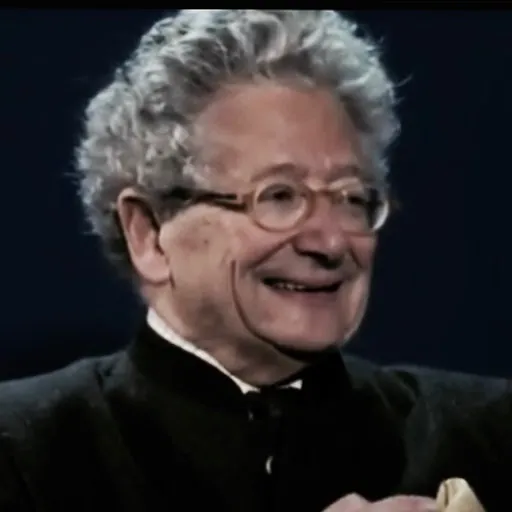
About Dominique Moïsi
Born 1946. Dominique Moïsi is a French geopolitical analyst, writer, political scientist and docent.
Dominique Moïsi (born 21 October 1946 ) is a French political scientist and writer.
He was a co-founder and is a senior advisor of the Paris-based Institut Français des Relations Internationales (IFRI), Pierre Keller Visiting Professor at Harvard University, and the chairholder for Geopolitics at the College of Europe, the oldest educational institution in European affairs, in Natolin. He is also a Fellow at CEDEP, the European Centre for Executive Development. Moïsi regularly contributes op-ed articles and essays to the Financial Times, Foreign Affairs, the Project Syndicate as well as Die Welt and Der Standard.
Moïsi is married to the historian and writer Diana Pinto. The couple has two sons.
Life His father Jules Moïsi was an Auschwitz survivor, member of the Mauthausen concentration camp's kommando. Dominique Moïsi studied Political science at the Sorbonne and at Harvard University. He was research assistant to Raymond Aron and taught at the École nationale d'administration (ENA), the École des Hautes Études en Sciences Sociales, and the Institut d’Études Politiques de Paris. He was editor in chief of Politique étrangère.
After the fall of the Berlin Wall in 1989, he aroused attention as one of the first French commentators to welcome the conceivable end of Germany's division as an opportunity for Europe. Many years later Moïsi explained his position by pointing to his father whose fate as an Auschwitz survivor had made him "fall in love with Europe". Like Simone Veil, Jules Moïsi believed that the unification of Europe was the best way of overcoming the "tragedy of the past".
During the 1990s Timothy Garton Ash, Michael Mertes and Dominique Moïsi wrote several "trilateral" (British-German-French) pleas in favour of a combined eastward enlargement and institutional modernisation of the EU.
Moïsi is a member of the International Advisory Council of the Moscow School of Political Studies and of the European Council on Foreign Relations.
In 2008, he published La géopolitique de l’émotion: Comment les cultures de peur, d’humiliation et d’espoir façonnent le monde (English translation 2009).
Selected bibliography Le Nouveau Continent: Plaidoyer pour une Europe renaissante (with Jacques Rupnik). Calmann-Lévy, Paris 1991, Les Cartes de la France à l’heure de la mondialisation (based on an interview with Hubert Védrine). Fayard, Paris 2000, The Geopolitics of Emotion: How Cultures of Fear, Humiliation, and Hope are Reshaping the World. Anchor Books, New York 2010. Un Juif improbable. Flammarion, Paris 2011.
Don’t just read it —
keep it.
Full-length biographies made to live with: read them, listen on the way to work, watch them tonight.
- E-book
- Audio
- Video
Instant download · yours to keep · every purchase keeps this site free
Important facts
People in Dominique Moïsi's life
Named in this biography and alive at the same time





Related people
Same field, nearest in time

Contemporaries
People whose lives overlapped Dominique Moïsi's

Frequently asked questions
Who is Dominique Moïsi?
French political scientist
When was Dominique Moïsi born?
Dominique Moïsi was born on 21 October 1946 in Strasbourg.
What is Dominique Moïsi's occupation?
Dominique Moïsi is a geopolitical analyst, writer, political scientist and docent.
What nationality is Dominique Moïsi?
Dominique Moïsi is French.
Sources & further reading
Cite this page
APA: Biography.guide. (2026). Dominique Moïsi. https://biography.guide/dominique-moisi/
MLA: "Dominique Moïsi." Biography.guide, https://biography.guide/dominique-moisi/.
Chicago: "Dominique Moïsi." Biography.guide. https://biography.guide/dominique-moisi/.
Data last updated: 2026-09-21 · Spot an error? Report a correction.
Portrait: Wikimedia Commons · author & licence
Page generated 2026-09-27 04:59 UTC