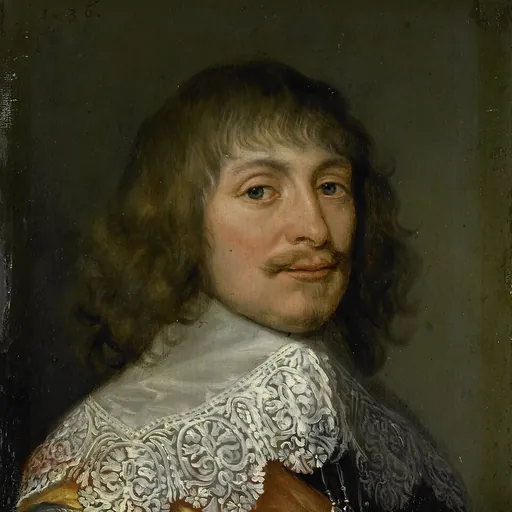
George Frederick, Prince of Nassau-Siegen
Prince of Nassau-Siegen
About George Frederick, Prince of Nassau-Siegen
Lived 1606 – 1674 (aged 68). George Frederick, Prince of Nassau-Siegen was a military personnel, captain (armed forces), colonel, dutch States Army, governor and major.
Prince George Frederick of Nassau-Siegen (23 February 1606 – 2 October 1674), , official titles: Prinz von Nassau, Graf zu Katzenelnbogen, Vianden und Diez, Herr zu Beilstein, was a count from the House of Nassau-Siegen, a cadet branch of the Ottonian Line of the House of Nassau. In 1664 he was elevated to the rank and title of prince. He served as an officer in the Dutch States Army, and was successively commander of Rheinberg and governor of Bergen op Zoom.
Biography George Frederick was born at Dillenburg Castle on 23 February 1606 as the second son of Count John VII 'the Middle' of Nassau-Siegen and his second wife, Duchess Margaret of Schleswig-Holstein-Sonderburg. His full given names were George Frederick Louis, He studied in Kassel in 1622 together with his younger brother William Otto.
In the Dutch States Army Group portrait of four counts of Nassau by Adriaen Hanneman, 1660–1669. Stadhouderlijk Hof, Leeuwarden. From left: Henry of Nassau-Siegen, Henry Casimir I of Nassau-Diez, George Frederik of Nassau-Siegen, William Frederick of Nassau-Diez. George Frederick entered the service of the Republic of the United Netherlands and became captain of the infantry in 1627, and in 1633 also ritmeester of the cavalry. In 1637 he was promoted to major and in 1642 to colonel. were captured by the Spanish near Geldern, and a third part of the administration of the city of Siegen. For the eldest son from the first marriage, John 'the Younger', only one third of the county was provided for in this will. On 6 August 1621, he was informed of this, with a precise statement of the reasons that had led his father to take this step. On 9 May 1623, i.e. not until two years later, John 'the Younger' protested against this with a letter from Frankfurt to the councillors of Siegen. In the meantime he had not been idle and had not hesitated to denounce his father to the Emperor. At the time of his letter of protest he was certainly already aware of the Poenale mandatum cassatorium, which Emperor Ferdinand II officially issued some time later, on 27 June 1623, informing John 'the Middle' that at the time of making his third will as a fellow combatant of the outlawed 'Winter King' he was not entitled to make a will. He had to revoke it and answer to an imperial court within two months. It seems that John 'the Younger' then shrank from having the imperial decree delivered to his seriously ill father.
Siegen in 1617. From Braun & Hogenberg, Civitates orbis terrarum Band 6, Cologne, 1617. On the left Siegen Castle. John 'the Middle' died at on 27 September 1623. None of the three sons mentioned in the will were present at the death of their father. On 13 October William and John Maurice arrived in Siegen, and on 26 October John 'the Younger'. Everyone knew that there would be a dispute at the reading of the will on 11 December 1623. John 'the Younger' had the imperial decree read out, and when his brothers demurred, he said as he stood up: "Der Kaiser wird uns scheiden!" ("The Emperor will part us!"). He had taken the precaution of obtaining a further imperial decree on 20 November 1623 against Countess Dowager Margaret and her sons, in which the Emperor strictly forbade impeding John's assumption of government, his taking possession of the land and his inauguration. On 12 January 1624, John 'the Younger' was able to accept the homage from the town of Siegen but only because he beforehand had secretly let a squadron of selected horsemen into the town through the castle gate (that is, not through a city gate) in a heavy snowstorm, so that they could not be seen or heard by the town guards.
John 'the Younger' thus received the entire inheritance, and the provisions of the will made in favour of William and John Maurice remained a dead letter. However, on 13/23 January 1624, John 'the Younger' voluntarily ceded the sovereignty over the Hilchenbach district with and some villages belonging to the and Netphen districts, to William. With the exception of John Maurice and George Frederick, the younger brothers accepted only modest appanages. Henceforth, until 1645, the county of Nassau-Siegen had two governments, one in Siegen, the other in Hilchenbach. However, for a short period (1632–1635) this situation underwent a temporary change: during the Thirty Years' War, his brothers, who were fighting on the Protestant side, rebelled against John 'the Younger'. Countess Dowager Margaret, through the mediation of Louis Henry, turned to Gustavus Adolphus and asked for help against the machinations of her stepson John 'the Younger'. On 14 February 1632 the Swedish king sent an order from Frankfurt to Louis Henry to provide military support for his first cousin John Maurice. Louis Henry then occupied the city of Siegen with his regiment of Dutch and Swedish soldiers. One day later, on 29 February, John Maurice and his brother Henry arrived in Siegen. Just as John 'the Younger' had kept his cavalry in reserve eight years earlier, now John Maurice and Henry, supported by the presence of the Swedish regiment, negotiated with the citizens, who felt bound by the oath they had sworn to John 'the Younger'. On 4 March, after long and difficult negotiations, the citizens paid homage to John Maurice and Henry. John Maurice obtained for himself not only the Freudenberg district, which his father had intended for him in the will of 1621, but also Netphen, which had been intended for John 'the Younger' in the same will. William was not only confirmed in the possession of Hilchenbach, but also received and Krombach, as stipulated in his father's will. The city of Siegen paid homage to William and John Maurice only, who only in 1635 re-admitted their elder brother John 'the Younger' into co-sovereignty. However, the latter soon restored the old order: in 1636, he again became the sole owner of his father's property, with the exception of Hilchenbach, which he left to William, and he again governed the city of Siegen alone. John Maurice was again excluded from the county's sovereignty.
John 'the Younger' died in Ronse on 27 July 1638. On 22 January 1645, after his return from Brazil, the latter, with his brothers George Frederick and Henry and an 80-man entourage, had forcibly occupied Siegen Castle and on 15 February had received the renewed homage from the citizens, albeit this time only for two thirds of the county. In order to end the constant dispute, John Maurice wanted to adhere strictly to his father's will of 1621 and leave his nephew John Francis Desideratus the one third that was due to him. Already before his departure to Brazil, on 25 October 1635, he had explicitly authorised his subjects to recognise the then still living John 'the Younger' as co-ruler. In 1645 John Maurice relinquished his rights to the Freudenberg district, granted by the will of 1621, in favour of his brother George Frederick.
Death, burial and succession The entrance to the Fürstengruft in Siegen. Photo: Bob Ionescu, 2009. George Frederick died in Bergen op Zoom on 2 October 1674. He was first buried in Terborg
Marriage Princess Mauritia Eleonora of Portugal. Portrait by Gerard van Honthorst, 1636. Royal Dutch Collections, The Hague. George Frederick married in The Hague on 4 June 1647 to his second cousin Mauritia Eleonora of Portugal (baptised Delft, 10 May 1609 ("Europäische Stammtafeln situates her death in 1679.) Dek (1962) does not know the place of death, but Dek (1970) says «gest. Bergen op Zoom 16 juni 1674» (in contrast to 25 June in Dek (1962)). See for this death: a. the death registers of the city of Bergen op Zoom: «1674. Junius 16 de heer Governeur vrau». This is probably the date of the funeral, because: b. notification sent by the husband from Bergen op Zoom 15 June 1674 in State Archives Wiesbaden (130II, 2201): «Eleonora Mauritia, Fürstin zu Nassau-Siegen, geb. Prinzessin von Portugal, heute, zwischen 3 u. 4 Uhren nachmittags»; c. two other death announcements, identical to the previous one, in State Archives Wiesbaden (130II, 2380III e)." The marriage remained childless.
Illegitimate child George Frederick had one illegitimate daughter: Margaretha Sofia of Nassau (d. The Hague, 24 April 1737 ). She married in Terheide on 30 June 1669 to Johan Fer from 's-Hertogenbosch, Great-great-grandparents
Philip I of Brunswick-Grubenhagen(ca. 1476–1551)⚭ 1517Catherine of Mansfeld(1501–1535)
Great-grandparents
Grandparents
Parents
Don’t just read it —
keep it.
Full-length biographies made to live with: read them, listen on the way to work, watch them tonight.
- E-book
- Audio
- Video
Instant download · yours to keep · every purchase keeps this site free
Important facts
Family & relationships
People in George Frederick, Prince of Nassau-Siegen's life
Named in this biography and alive at the same time


Related people
Same field, nearest in time




Contemporaries
People whose lives overlapped George Frederick, Prince of Nassau-Siegen's





Frequently asked questions
Who was George Frederick, Prince of Nassau-Siegen?
Prince of Nassau-Siegen
When was George Frederick, Prince of Nassau-Siegen born?
George Frederick, Prince of Nassau-Siegen was born on 23 February 1606 in Dillenburger Schloss.
When did George Frederick, Prince of Nassau-Siegen die?
George Frederick, Prince of Nassau-Siegen died on 2 October 1674 in Bergen op Zoom.
What was George Frederick, Prince of Nassau-Siegen's occupation?
George Frederick, Prince of Nassau-Siegen was a military personnel, captain (armed forces), colonel, dutch States Army, governor and major.
Sources & further reading
· Wikipedia: George Frederick, Prince of Nassau-Siegen
· DBpedia: George Frederick of Nassau-Siegen
Cite this page
APA: Biography.guide. (2026). George Frederick, Prince of Nassau-Siegen. https://biography.guide/george-frederick-prince-of-nassau-siegen/
MLA: "George Frederick, Prince of Nassau-Siegen." Biography.guide, https://biography.guide/george-frederick-prince-of-nassau-siegen/.
Chicago: "George Frederick, Prince of Nassau-Siegen." Biography.guide. https://biography.guide/george-frederick-prince-of-nassau-siegen/.
Data last updated: 2026-09-22 · Spot an error? Report a correction.
Portrait: Wikimedia Commons · author & licence
Page generated 2026-09-27 05:02 UTC