
About George Emil Palade
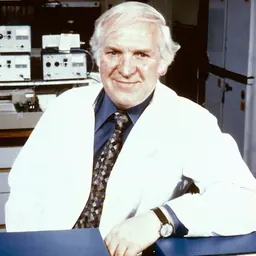
Lived 1912 – 2008 (aged 95). George Emil Palade was a Romanian and American physician, cell biologist, chemist, inventor, university teacher and physicist, known for Ribosomes and Rough ER.
George Emil Palade (; November 19, 1912 – October 7, 2008) was a Romanian-American cell biologist. In 1974 he was awarded the Nobel Prize in Physiology or Medicine along with Albert Claude and Christian de Duve. The prize was granted for his innovations in electron microscopy and cell fractionation which together laid the foundations of modern molecular cell biology,
Palade also received the U.S. National Medal of Science in Biological Sciences for "pioneering discoveries of a host of fundamental, highly organized structures in living cells" in 1986, and was previously elected a Member of the U.S. National Academy of Sciences in 1961. In 1968 he was elected as an Honorary Fellow of the Royal Microscopical Society (HonFRMS) and in 1984 he became a Foreign Member of the Royal Society .
Education and early life George Emil Palade was born on November 19, 1912, in Iași, Romania. Palade's father was a professor of philosophy at the University of Iași and his mother was a high school teacher. Palade received his M.D. in 1940 from the Carol Davila School of Medicine in Bucharest.
Career and research
Palade was a member of the faculty at University of Bucharest until 1946, when he went to the United States He later joined Claude at the Rockefeller Institute for Medical Research.
In 1952, Palade became a naturalized citizen of the United States. He worked at the Rockefeller Institute (1958–1973), and was a professor at Yale University Medical School (1973–1990), and University of California, San Diego (1990–2008). At UCSD, Palade was Professor of Medicine in Residence (Emeritus) in the Department of Cellular & Molecular Medicine, as well as a Dean for Scientific Affairs (Emeritus), in the School of Medicine at La Jolla, California.
In 1970, he was awarded the Louisa Gross Horwitz Prize from Columbia University, together with Renato Dulbecco (winner of the 1975 Nobel Prize in Physiology or Medicine) "for discoveries concerning the functional organization of the cell that were seminal events in the development of modern cell biology", related to his previous research carried out at the Rockefeller Institute for Medical Research. His Nobel lecture, delivered on December 12, 1974, was entitled: "Intracellular Aspects of the Process of Protein Secretion", published in 1992 by the Nobel Prize Foundation, He was elected an Honorary member of the Romanian Academy in 1975. He received the Golden Plate Award of the American Academy of Achievement in 1975. In 1981, Palade became a founding member of the World Cultural Council. In 1985, he became the founding editor of the Annual Review of Cell and Developmental Biology. In 1988 he was also elected an Honorary Member of the American-Romanian Academy of Arts and Sciences (ARA).
Palade was the first Chairman of the Department of Cell Biology at Yale University. Presently, the Chair of Cell Biology at Yale is named the "George Palade Professorship".
Palade was known for his support and mentorship with young scientists and that colleagues of his saw him regularly engaged with graduate students at conferences and encouraged innovative experimental approaches that would be normally been seen as un-regular. Including the use of electron microscopy in the secretory pathway research.
At the Rockefeller Institute for Medical Research, Palade used electron microscopy to study the internal organization of such cell structures as ribosomes, mitochondria, chloroplasts, the Golgi apparatus, and others. His most important discovery was made while using an experimental strategy known as a pulse-chase analysis. In the experiment Palade and his colleagues were able to confirm an existing hypothesis that a secretory pathway exists and that the Rough ER and the Golgi apparatus function together.
He was a member of the American Association for Anatomy.
Palade's coworkers and approach in the 1960s The following is a concise excerpt from Palade's Autobiography appearing in the Nobel Award documents
Personal life He married Irina Malaxa (born in 1919, the daughter of industrialist Nicolae Malaxa) on June 12, 1941. The couple had two children: Georgia (born in 1943) and Theodore (born in 1949). After his wife died in 1969, Palade married Marilyn Farquhar, a cell biologist at the University of California, San Diego.
Don’t just read it —
keep it.
Full-length biographies made to live with: read them, listen on the way to work, watch them tonight.
- E-book
- Audio
- Video
Instant download · yours to keep · every purchase keeps this site free
Important facts
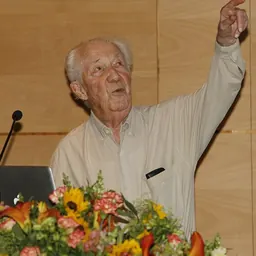
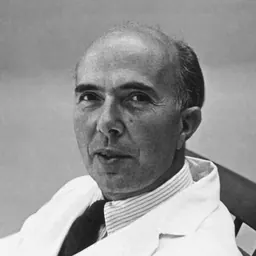
People in George Emil Palade's life
Named in this biography and alive at the same time





Related people
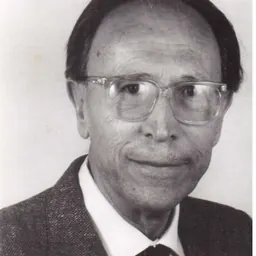
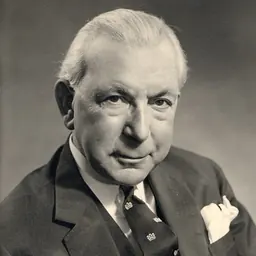
Same field, nearest in time
Contemporaries
People whose lives overlapped George Emil Palade's





Frequently asked questions
Who was George Emil Palade?
Romanian cell biologist, physician and Nobel laureate (1912–2008)
When was George Emil Palade born?
George Emil Palade was born on 19 November 1912 in Iași.
When did George Emil Palade die?
George Emil Palade died on 7 October 2008 in Del Mar.
What was George Emil Palade's occupation?
George Emil Palade was a physician, cell biologist, chemist, inventor, university teacher and physicist.
What was George Emil Palade known for?
George Emil Palade was known for Ribosomes and Rough ER.
What nationality was George Emil Palade?
George Emil Palade was Romanian and American.
Sources & further reading
· Wikipedia: George Emil Palade
Cite this page
APA: Biography.guide. (2026). George Emil Palade. https://biography.guide/george-emil-palade/
MLA: "George Emil Palade." Biography.guide, https://biography.guide/george-emil-palade/.
Chicago: "George Emil Palade." Biography.guide. https://biography.guide/george-emil-palade/.
Data last updated: 2026-09-20 · Spot an error? Report a correction.
Page generated 2026-09-27 05:21 UTC