
About George Devol
Lived 1912 – 2011 (aged 99). George Devol was an American inventor and entrepreneur.
George Charles Devol Jr. (February 20, 1912 – August 11, 2011) was an American inventor, best known for creating Unimate, the first industrial robot. The National Inventors Hall of Fame says, "Devol's patent for the first digitally operated programmable robotic arm represents the foundation of the modern robotics industry."
Early life George Devol was born in an upper-middle-class family in Louisville, Kentucky. He attended Riordan Prep school. This control would automatically open and close laundry presses when workers approached the machines. After World War II began, the patent office told Devol that his patent application would be placed on hold for the duration of the conflict.
Around that time, Devol sold his interest in United Cinephone and approached Sperry Gyroscope to pitch his ideas on radar technology. He was retained by Sperry as manager of the Special Projects Department, which developed radar devices and microwave test equipment. which automatically cooked and dispensed hotdogs in places such as Grand Central Terminal.
In the early 1950s, Devol licensed his digital magnetic recording device to Remington Rand of Norwalk, Connecticut, and became manager of their magnetics department. There he worked with a team to develop his magnetic recording system for business data applications. He also worked on developing the first high-speed printing systems. While the magnetic recording system proved too slow for business data, Devol's invention was re-purposed as a machine control that would eventually become the "brains" of the Unimate robot.
Devol wrote that his invention "makes available for the first time a more or less general purpose machine that has universal application to a vast diversity of applications where cyclic digital control is desired." But the company was sold that year and its aircraft division was slated to be closed. Engelberger sought a backer to buy out the aircraft division and found one in Consolidated Diesel Electronic (Condec), which agreed to finance the continued development of the robot under a new division, Unimation Incorporated, with Engelberger as its president.
The first Unimate prototypes were controlled by vacuum tubes used as digital switches though later versions used transistors. Most off-the-shelf components available in the late 1950s, such as digital encoders, were inadequate for the Unimate. With Devol's guidance, a team of engineers at Unimation designed and machined practically every part in the first Unimates.
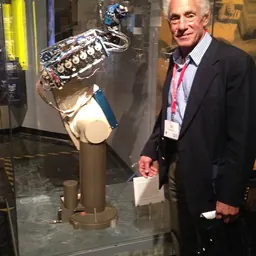
In 1960, Devol personally sold the first Unimate robot, which was shipped in 1961 to General Motors. GM first used the machine for die casting handling and spot welding. The first Unimate robot was installed at GM's Inland Fisher Guide Plant in Ewing Township, New Jersey, in 1961 to lift hot pieces of metal from a die-casting machine and stack them. Soon companies such as Chrysler, Ford, and Fiat saw the necessity for large Unimate purchases.
The company spent about $5 million to develop the first Unimate. In 1966, after many years of market surveys and field tests, full-scale production began in Connecticut. Unimation's first production robot was a materials handling robot and was soon followed by robots for welding and other applications.
In 1975, Unimation showed its first profit. In 1978, the PUMA (Programmable Universal Machine for Assembly) robot was developed by Unimation from Vicarm (Victor Scheinman) and with support from General Motors.
In 2005, Popular Mechanics magazine selected Devol's Unimate as one of the Top 50 Inventions of the Past 50 Years.
Additional work
Elected to honorary member of the Society of Manufacturing Engineers (1985) Inducted into the National Inventor's Hall of Fame (2011) Henry Ford and Smithsonian Museum collections both include Unimate robots Devol's archives are with the Henry Ford Museum in Dearborn, Michigan
Death
Devol died on August 11, 2011, aged 99, at his home in Wilton, Connecticut. He was survived by two daughters, two sons, five grandchildren and five great-grandchildren. His funeral service was held in a Methodist church and he was laid to rest in Wilton.
Don’t just read it —
keep it.
Full-length biographies made to live with: read them, listen on the way to work, watch them tonight.
- E-book
- Audio
- Video
Instant download · yours to keep · every purchase keeps this site free
Important facts
People in George Devol's life
Named in this biography and alive at the same time



Related people
Same field, nearest in time


Contemporaries
People whose lives overlapped George Devol's






Frequently asked questions
Who was George Devol?
American inventor (1912–2011)
When was George Devol born?
George Devol was born on 20 February 1912 in Louisville.
When did George Devol die?
George Devol died on 11 August 2011 in Wilton.
What was George Devol's occupation?
George Devol was an inventor and entrepreneur.
What nationality was George Devol?
George Devol was American.
Sources & further reading
Cite this page
APA: Biography.guide. (2026). George Devol. https://biography.guide/george-devol/
MLA: "George Devol." Biography.guide, https://biography.guide/george-devol/.
Chicago: "George Devol." Biography.guide. https://biography.guide/george-devol/.
Data last updated: 2026-09-27 · Spot an error? Report a correction.
Page generated 2026-09-27 05:17 UTC