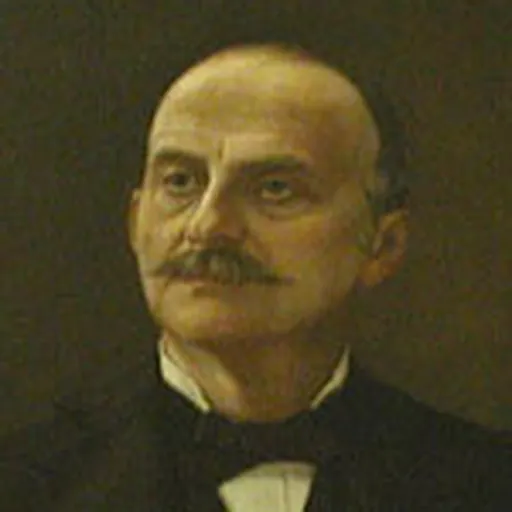
About George D. Robinson
Lived 1834 – 1896 (aged 62). George D. Robinson was an American politician, lawyer and governor.
George Dexter Robinson (born George Washington Robinson; January 20, 1834 – February 22, 1896) was an American lawyer and Republican politician from Chicopee, Massachusetts. After serving in the Massachusetts General Court and United States House of Representatives, Robinson served three one-year terms as Governor of Massachusetts, notably defeating Benjamin Franklin Butler in the 1883 election.
After leaving office, his most famous legal client was Lizzie Borden, notoriously accused of killing her father and stepmother. She was acquitted in a highly sensationalized trial.
Born in Lexington and educated at Harvard, Robinson taught high school before becoming a lawyer. He gained a reputation as a fine Parliamentarian while serving in Congress. As governor, he promoted the passage of civil service reform legislation and labor-friendly wage and dispute-resolution laws. He aligned with the state's industrial leaders against public health advocates, and banned discrimination in the issuance of life insurance policies. As a lawyer, he gained notoriety for Borden's defense, and was criticized for defending fraudulent fraternal benefit societies.
Early years George Washington Robinson was born in Lexington, Massachusetts to Charles and Mary (Davis) Robinson. The son of farmers, he attended Lexington Academy and Hopkins Classical School in Cambridge, and graduated from Harvard University in 1856. While at Harvard he was admitted to the Zeta Psi fraternity. In 1855, he had his name legally changed to "George Dexter Robinson", supposedly because someone else in Lexington had a similar name to his.
Although he had intended to study medicine, Robinson entered the teaching profession, serving as the principal of Chicopee High School in Chicopee, Massachusetts from 1856 to 1865. During this time, he engaged in some study of medicine. In 1865, he engaged in the study of law with his brother, and was admitted to the bar in 1866, opening a practice in Chicopee. A civil service reform bill, at the time the strictest in the nation, passed in 1884. It required even laborers hired by state and municipal governments to have minimal certification from a civil service commission established for the purpose. This effectively reduced certain types of patronage dispensed by elected officials, and may have been a Republican move to curtail the growing power of predominantly Democratic Irish-American urban party bosses. An attempt to weaken the civil service reform, by exempting veterans from its requirements, was vetoed by Robinson in 1886.
One controversy that Robinson inherited from the Butler administration concerned the state's board of health, charity and lunacy. This board had been created by merging several previously independent boards, and Butler had appointed as its chairman an activist concerned with industrial pollution. Butler had made this appointment following criticism that its public health mission had been diluted by the merger. The state's textile and manufacturing interests, hostile to the board's calls for more significant pollution control legislation, prevailed on Robinson to replace the chairman with a more business-friendly choice. A petition campaign by activists followed, prompting Robinson to separate the public health functions into a separate board.
Robinson refused to run for reelection in 1886, and resumed the practice of law in Springfield. He refused an offer from Grover Cleveland of a seat on the Interstate Commerce Commission in 1887, and a seat on the Cherokee Commission from Benjamin Harrison in 1889.
Later legal work In 1892, Robinson took on his most famous client, Lizzie Borden. Borden stood accused of the murder of her father and stepmother, and had been compelled to give testimony in the coroner's inquest into their deaths. Robinson's addition to her defense team may have been due to the fact that he had, while governor, appointed the presiding judge to the bench. He was able to get Borden's inconsistent inquest testimony excluded from the criminal trial (on the grounds that she had not been represented in those hearings), and was also able to cast significant doubt on the reliability of several witnesses to the events surrounding the murders. Borden was ultimately acquitted of the criminal charges, and Robinson was a highly visible presence in the media circus that attended the trial. The organization was essentially a fraudulent investment vehicle that was a combination of a tontine (where increased benefits accrue to survivors as investors die) and a Ponzi scheme (where deposits of later investors are used to pay off earlier ones). Tontines were illegal under Massachusetts insurance regulations, and the Iron Hall was threatened in 1887 with an injunction to stop doing business in the state. It hired Robinson to appear before the legislature, and he was able to secure legislative alteration to the statute governing fraternal societies that would permit continued operation. Iron Hall went into receivership in 1892, (The Iron Hall was one of the more high-profile of a large number of similar investment schemes, in which the operators of the organization also frequently siphoned funds away in the guise of salaries and expenses.)
Robinson remained a prominent lawyer until his death in Chicopee; he is buried in Chicopee's Fairview Cemetery. His law firm remains in business, and is now known as Robinson Donovan P.C.
Family Robinson was married twice. The first marriage was in 1859 to Hannah Stevens, with whom he had one child before her death in 1864. He then married Susan Simonds in 1867, with whom he also had one child. Robinson was active in the Unitarian Church.
Don’t just read it —
keep it.
Full-length biographies made to live with: read them, listen on the way to work, watch them tonight.
- E-book
- Audio
- Video
Instant download · yours to keep · every purchase keeps this site free
Important facts
People in George D. Robinson's life
Named in this biography and alive at the same time



Related people
Same field, nearest in time




Contemporaries
People whose lives overlapped George D. Robinson's




Frequently asked questions
Who was George D. Robinson?
politician in Massachusetts, US (1834-1896)
When was George D. Robinson born?
George D. Robinson was born on 20 January 1834 in Lexington.
When did George D. Robinson die?
George D. Robinson died on 22 February 1896 in Chicopee.
What was George D. Robinson's occupation?
George D. Robinson was a politician, lawyer and governor.
What nationality was George D. Robinson?
George D. Robinson was American.
Sources & further reading
· Wikipedia: George D. Robinson
Cite this page
APA: Biography.guide. (2026). George D. Robinson. https://biography.guide/george-d-robinson/
MLA: "George D. Robinson." Biography.guide, https://biography.guide/george-d-robinson/.
Chicago: "George D. Robinson." Biography.guide. https://biography.guide/george-d-robinson/.
Data last updated: 2026-09-22 · Spot an error? Report a correction.
Portrait: Wikimedia Commons · author & licence
Page generated 2026-09-27 05:03 UTC