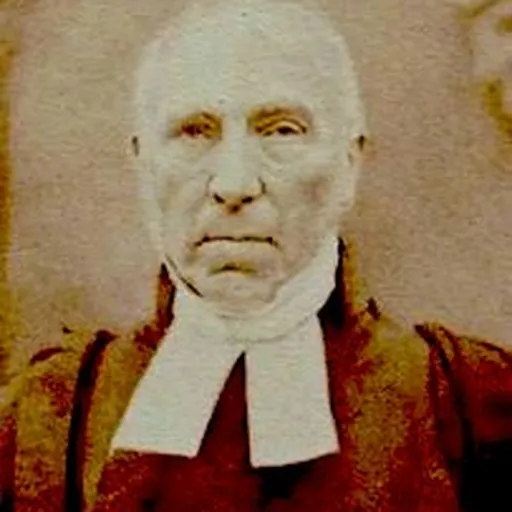
About George Croly
Lived 1780 – 1860 (aged 80). George Croly was a British poet, writer, anglican priest, moral theologian and catholic theologian.
George Croly (17 August 1780 – 24 November 1860) was an Irish poet, novelist, historian, and Anglican priest. He was rector of St Stephen Walbrook in the City of London from 1835 until his death.
Early life Croly was born in Dublin. His father was a physician. He graduated from Trinity College Dublin with an MA in 1804. The college was to award him an honorary LLD in 1831.
He was ordained in 1804, and served as a curate at a parish in the diocese of Meath until around 1810. Then, accompanied by his widowed mother, his brother Henry and his sisters, he moved to London. Finding himself unable to obtain preferment in the church, he dedicated himself to a literary career.
Literary career Croly was a leading contributor to the Literary Gazette and Blackwood's Magazine, from the establishment of both in 1817, In 1835, however, through the influence of Lord Brougham, a distant relative of his wife He usually preached extemporare. S.C. Hall described him as having "'a sort of rude and indeed angry eloquence that would have stood him in better stead at the bar than in the pulpit."
Family In 1819 Croly married Margaret Helen Begbie, whom he had come to know though his work for the Literary Gazette, to which she was also a contributor. They had five sons and a daughter.
Death
He died suddenly on 24 November 1860 while walking near his home in Bloomsbury, and was buried in St Stephen's. Paris in 1815, a poem, 1817. The Angel of the World, 1820. May Fair, 1820. Catiline, a tragedy, 1822. Tales of the Saint Bernard The Apocalypse of St. John (1827). The Beauties of the British Poets, With a Few Introductory Observations, 1828. Historicist interpretation. Salathiel, a novel, 1828. Anonymous [George Croly], "Colonna, the Painter," Blackwood's Edinburgh Magazine, vol. XXVI, no. CLVI (September, 1829), pp. 351–385. Divine Providence, or the Three Cycles of Revelation, Showing the Parallelism of the Patriarchal, Jewish, and Christian Dispensations : Being a New Evidence of the Divine Origin of Christianity, 1834. Life and times of George IV (1830). This is described by Richard Garnett in the Dictionary of National Biography as "a work of no historical value, but creditable to his independence of spirit." A Sketch of the Life and Times of Bishop Taylor (1838). Preface to The Rule and Exercises of Holy Living, Jeremy Taylor, D.D., 1860, Philadelphia: J.W. Bradley Marston, a novel, 1846, The Modern Orlando, a poem, 1846. The Holy Land, Syria, Idumea, Arabia, Egypt, and Nubia, 1855 The Book of Job, published posthumously in 1863.
His collected poems were published in 1830.
Don’t just read it —
keep it.
Full-length biographies made to live with: read them, listen on the way to work, watch them tonight.
- E-book
- Audio
- Video
Instant download · yours to keep · every purchase keeps this site free
Important facts
People in George Croly's life
Named in this biography and alive at the same time

Related people
Same field, nearest in time

Contemporaries
People whose lives overlapped George Croly's



Frequently asked questions
Who was George Croly?
Irish poet, novelist, historian, and divine (1780-1860)
When was George Croly born?
George Croly was born on 17 August 1780 in Dublin.
When did George Croly die?
George Croly died on 24 November 1860.
What was George Croly's occupation?
George Croly was a poet, writer, anglican priest, moral theologian and catholic theologian.
What nationality was George Croly?
George Croly was British.
Sources & further reading
Cite this page
APA: Biography.guide. (2026). George Croly. https://biography.guide/george-croly/
MLA: "George Croly." Biography.guide, https://biography.guide/george-croly/.
Chicago: "George Croly." Biography.guide. https://biography.guide/george-croly/.
Data last updated: 2026-09-23 · Spot an error? Report a correction.
Portrait: Wikimedia Commons · author & licence
Page generated 2026-09-27 05:08 UTC