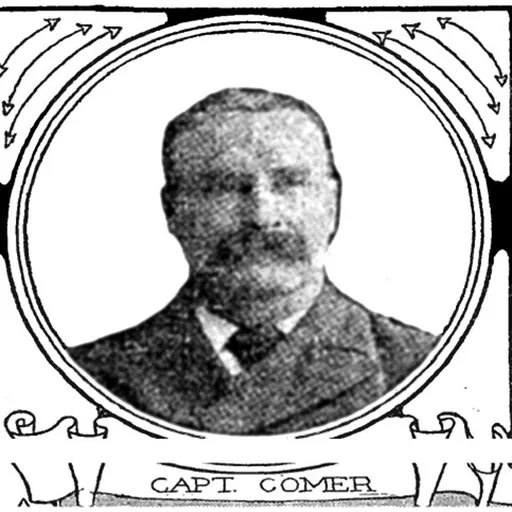
About George Comer
Lived 1858 – 1937 (aged 78–79). George Comer was an American explorer, military officer, politician, sea captain, botanical collector and whaler, known for Polar region.
Captain George Comer (April 1858 – 1937) was considered the most famous American whaling captain of Hudson Bay, and the world's foremost authority on Hudson Bay Inuit in the early 20th century.
Comer was a polar explorer, whaler/sealer, ethnologist, cartographer, author, and photographer. He made 14 Arctic and three Antarctic voyages in his lifetime. These expeditions (ca. 1875–1919) commonly began in New London, Connecticut or New Bedford, Massachusetts. Comer's circle of friends and colleagues included other notable explorers of the time, such as Robert Peary and Capt. Frederick Cook, and his mentor, Franz Boas, the "Father of American Anthropology".
Personal life Comer was born in Quebec City, Canada East in 1858. His father was English, and his mother was Irish. The family immigrated to the United States in 1860 and Comer grew up in East Haddam, Connecticut. He attended school for only two years. After Comer's father was lost at sea, his mother couldn't support the children. Subsequently, Comer spent time in an orphanage and an East Haddam foster home. In 1877, Comer (age 19), married Julia Chipman (age 20; born in Pennsylvania) and they made their home on Mount Parnassus Road in East Haddam. They had two children: daughter, Nellie G. (born April 1878), and son, Thomas L. (April 1886 – 1930), a seaship officer.
Arctic expeditions Comer made the first of his Arctic voyages at age 17 on the whaler Nile bound for Cumberland Sound, Baffin Island in 1875.
Capt. Comer's Aivillik companion Niviatsinaq (aka "Shoofly"), c. 1903–4 at Cape Fullerton. While wintering in the Hudson Bay, Comer became acquainted with and concerned for the Aivilingmiut, Netsilingmiut, and Kivallirmiut (also known as Qaernermiut or Caribou Inuit. Comer photographed the Inuit on many occasions and for that he was given the Inuktitut name "Angakkuq" (meaning, "the shaman"), as the images were not a reality easily understood by the Inuit.
Comer developed a bond with an Aivilik woman named Niviatsianaq (or Nivisanaaq), referred to amongst Inuit as "Shoofly Comer". She was Comer's traveling companion on his ships for several years, bringing her son Oudlanak, referred to as "John Ell", who was rumored to be Comer's biological son, with her. Comer fathered at least one other child while in Hudson Bay with an Inuk woman named Ooktok, Laurent Pameolik (1911–?). Pameolik was adopted by Shoofly and the shaman Angutimarik after the death of his birth mother. Comer then became captain of Monjo's next purchase, the schooner A. T. Gifford, which he commanded from 1907 until 1912. This whaler operated out of New London, Connecticut, for the 1907 voyage and New Bedford, MA, for the 1910 voyage, hunting for whales and furs, and wintering at Cape Fullerton.
His 1907 Anthony Fiala expedition was chartered to establish supply bases in the Arctic in preparation for a second team who would attempt to the reach the North Pole. Comer retired from whaling in 1912. a hill near Pituffik, where he unearthed evidence of what is now referred to as the Thule people, ancestors of the Inuit. His find is called "Comer's Midden" as it included a kitchen-midden.
Antarctic expeditions Comer visited Antarctica on several sealing voyages, including: South Georgia (October 9, 1885 – February 11, 1886) and Kerguelen Island (November 24, 1887 – February 5, 1888).
On his third voyage, he was Second Mate on the American schooner, the Francis Alleyn that sealed at Gough Island (August 22, 1888 – January 23, 1889). Comer is noted as having written the first account of the island's endemic flightless moorhen, the species Gallinula comeri, named after him. Comer wrote of them:
They cannot fly and only use their wings to help them in running ... They are quite plentiful and can be caught by hand. Could not get on a table three feet high. The bushes grow on the island up to about , and these birds are found as far up as the bushes grow ... Tip of bill bright yellow, scarlet between the eyes. Legs and feet yellow, with reddish spots.
Ethnologist and cartographer Comer was highly regarded for his Arctic anthropology, ethnology, natural history, geography, and cartography work. Lacking formal training, Comer was mentored by anthropologist Franz Boas. On board the Era, Comer made plaster casts of their faces. The 300 masks can be found in museums in Germany, Canada, and New York. The Canadian Museum of Civilization bought a large collection of Comer's artifacts in 1913, including a group of animal ivories (fox, musk ox, narwhal, polar bear, wolf), most of which, if not all, were created by "Harry" Ippaktuq Tasseok (or Teseuke), Chief of the Aivilingmiut, and Comer's chief Inuit shipmate while wintering at Cape Fullerton. Commissioned by the American Museum of Natural History, Comer also collected Arctic and Antarctic animal skins, birds, bird's eggs, and geological specimens now at the museum's Comer Collection.
Later years Comer retired in East Haddam, but he continued to send presents to his Inuit friends. He remained active, serving in the Connecticut State Legislature. He was in ill health in his latter years, and died in East Haddam in 1937 at the age 79.
Vessels Green mate, Nile (whaler), 1875 Mate, Era (whaler), 1889–1892 Mate, Canton (whaler), 1893–1894 Master, Era (schooner), 1895–1906 Master, A. T. Gifford (whaling/sealing schooner of New Bedford), 1907–1912 Master, George B. Cluett, 1915–1917 Lt. J. G. George Comer, navigation officer, U.S.S. Radnor (freighter) and U.S.S. Wyska (freighter), 1918–1919 Lt. George Comer, 2nd officer, U.S.S. Elinor (steamship), 1919 Master, Finback (auxiliary schooner), 1919 Master, Blossom (schooner), 1923–1924
Partial bibliography
Awards and honors Fellow in the council of the American Geographical Society Named in his honor: Comer Strait, off Southampton Island, Nunavut Gallinula comeri, flightless bird on Gough Island
Don’t just read it —
keep it.
Full-length biographies made to live with: read them, listen on the way to work, watch them tonight.
- E-book
- Audio
- Video
Instant download · yours to keep · every purchase keeps this site free
Important facts
People in George Comer's life
Named in this biography and alive at the same time



Related people
Same field, nearest in time



Contemporaries
People whose lives overlapped George Comer's

Frequently asked questions
Who was George Comer?
Whaler, Polar explorer
When was George Comer born?
George Comer was born in 1858 in Quebec City.
When did George Comer die?
George Comer died in 1937 in East Haddam.
What was George Comer's occupation?
George Comer was an explorer, military officer, politician, sea captain, botanical collector and whaler.
What was George Comer known for?
George Comer was known for Polar region.
What nationality was George Comer?
George Comer was American.
Sources & further reading
Cite this page
APA: Biography.guide. (2026). George Comer. https://biography.guide/george-comer/
MLA: "George Comer." Biography.guide, https://biography.guide/george-comer/.
Chicago: "George Comer." Biography.guide. https://biography.guide/george-comer/.
Data last updated: 2026-09-21 · Spot an error? Report a correction.
Portrait: Wikimedia Commons · author & licence
Page generated 2026-09-27 05:00 UTC