
George Clarke
English convict
About George Clarke
Lived 1806 – 1835 (aged 28–29).
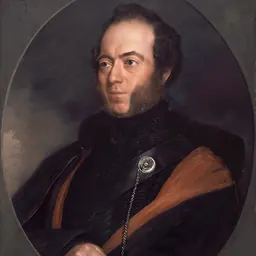
George "The Barber" Clarke (1806 – 11 August 1835) was an English convict who was transported to Australia, escaped and became a notable bushranger while living with Aboriginal Australians in the Liverpool Plains district of New South Wales. He is famous for giving an exaggerated account to the colonial authorities of an immense river that spanned the continent to the north-west. This story prompted Thomas Mitchell to conduct his four expeditions of exploration into the interior of Australia. After being re-captured, Clarke was sent to the penal colony of Norfolk Island and was later hanged to death in Hobart in Van Diemen's Land.
Early life George Clarke was born in 1806 in Bewdley, England to William and Susanna Clarke. George spent part of his childhood working in London as a messenger-boy for the engineering firm of John Rennie the Elder, where he received an education. It appears that he returned to the mid-west of England to take up an apprenticeship as a barber, from which he obtained his later moniker of "The Barber".
Arrest and transportation to New South Wales In 1824, Clarke was arrested in Shropshire and charged with house-stealing and robbery under arms. He was tried at Shrewsbury on 11 August and found guilty. He was sentenced to death which was later commuted to transportation for life to New South Wales. Clarke was placed in a prison ship and then assigned to the convict vessel Royal Charlotte which sailed from Portsmouth in January 1825. The vessel arrived in Sydney in late April of the same year.
Clarke was accepted into their society, being viewed as a re-incarnation of one of their deceased relatives. He became immersed in their culture, learning their language, abandoning European clothing for a possum-skin cloak and acquiring at least one wife. He became initiated, probably at the Terry Hie Hie bora ground, with his skin being marked with the customary scarifications.
Over the next four years, Clarke led men from this clan on cattle-stealing raids on the herds brought into the area by the British colonists. The stolen cattle were brought back to Barber's Lagoon where they were slaughtered for meat and hide to the benefit of the clan.
In October 1832, Clarke was placed aboard the vessel Governor Phillip and sent to Norfolk Island. On this journey Clarke and 18 other convicts were accused of trying to orchestrate a mutiny whereby they would poison the crew, take control of the ship and sail it to South America. The mutiny failed but Clarke was not subject to further punishment as the authorities thought being sent to the notoriously harsh Norfolk Island settlement was already sufficient.
In 1834, Clarke was alleged to have been a leader in another failed convict mutiny this time at the actual prison on the island. However, he was judged to have played no active role, thereby avoiding being one of thirteen other convicts hanged for the rebellion.
Clarke managed to survive his three years incarceration on Norfolk Island and was returned to Sydney in March 1835.
Transportation to Van Diemen's Land Back in Sydney, Clarke was again transferred to the Phoenix prison ship. He was not released due to information that he was overheard threatening to do harm to Thomas Mitchell once he was given his freedom. Mitchell, himself, informed the authorities that he thought Clarke would cause "serious mischief" if he was released to return to his Aboriginal friends. It was therefore decided to retain Clarke in custody and transport him to the isolated penal colony of Van Diemen's Land where recent genocidal activity had cleared the island of virtually all the Aboriginal population; a place the authorities concluded where Clarke would have "no blacks to associate with".
Death Clarke arrived in Hobart in May 1835 and was assigned to a convict work gang at Oatlands. Within a month, he and two other convicts broke out of their shackles, obtained a firearm and robbed an elderly couple. They were arrested the same evening and later sent for trial. Clarke was found guilty and sentenced to death. He was hanged at the Hobart public gallows on 11 August 1835.
Don’t just read it —
keep it.
Full-length biographies made to live with: read them, listen on the way to work, watch them tonight.
- E-book
- Audio
- Video
Instant download · yours to keep · every purchase keeps this site free
Important facts
People in George Clarke's life
Named in this biography and alive at the same time

Contemporaries
People whose lives overlapped George Clarke's






Frequently asked questions
Who was George Clarke?
English convict
When was George Clarke born?
George Clarke was born in 1806.
When did George Clarke die?
George Clarke died in 1835.
Sources & further reading
· DBpedia: George Clarke (convict)
Cite this page
APA: Biography.guide. (2026). George Clarke. https://biography.guide/george-clarke-1806/
MLA: "George Clarke." Biography.guide, https://biography.guide/george-clarke-1806/.
Chicago: "George Clarke." Biography.guide. https://biography.guide/george-clarke-1806/.
Data last updated: 2026-09-20 · Spot an error? Report a correction.
Page generated 2026-09-27 05:14 UTC