
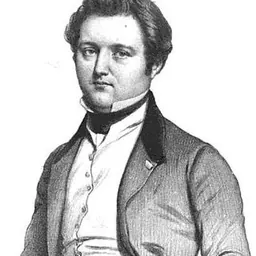
George Campbell, 8th Duke of Argyll
Scottish peer, Liberal politician and writer on science, religion, and politics
About George Campbell, 8th Duke of Argyll
Lived 1823 – 1900 (aged 76). George Campbell, 8th Duke of Argyll was a British economist, politician, writer and scientist.
George John Douglas Campbell, 8th and 1st Duke of Argyll (30 April 1823 – 24 April 1900; styled Marquess of Lorne until 1847), was a Scottish polymath and Liberal statesman. He made a significant geological discovery in the 1850s when his tenant found fossilised leaves embedded among basalt lava on the Island of Mull. He also helped to popularise ornithology and was one of the first to give a detailed account of the principles of bird flight in the hopes of advancing human flight. His literary output was extensive writing on topics varying from science and theology to economy and politics. In addition to this, he served prominently in the administrations of Lord Aberdeen, Lord Palmerston, John Russell and William Gladstone.
Background Argyll was born at Ardencaple Castle, Dunbartonshire, the second but only surviving son of John Campbell, 7th Duke of Argyll, and his second wife Joan Glassel, the only daughter of John Glassel. Argyll succeeded his father as Duke of Argyll (Peerage of Scotland) in 1847.
Political career
By the time of his succession, Argyll had already obtained notice as a writer of pamphlets on the disruption of the Church of Scotland, which he strove to avert, and he rapidly became prominent on the Liberal side in parliamentary politics via the Peelite Conservative Party faction. He was a frequent and eloquent speaker in the House of Lords. A close associate of Prince Albert, he served as Lord Privy Seal between 1852 and 1855 in the cabinet of Lord Aberdeen, and then as Postmaster General between 1855 and 1858 in Lord Palmerston's first cabinet.
He was again Lord Privy Seal between 1859 and 1866 in the second Palmerston administration, and then under Lord Russell's second administration, in which position he was notable as a strong advocate of the Northern cause in the American Civil War.
Argyll was a major catalyst of the Education (Scotland) Act 1872. Under his leadership in 1866, the Argyll Commission looked into the Scottish schooling system and found it severely inadequate. The report – eventually finished in 1869 – was used to call for education reforms. As a result of this lobbying, the Education Act (Scotland) 1872 was passed making primary school education mandatory in Scotland for children aged between 5 and 13.
In William Ewart Gladstone's first government of 1868 to 1874, Argyll became Secretary of State for India, in which role his refusal to promise support against the Russians to the emir of Afghanistan helped lead to the Second Afghan War. In 1886, he fully broke with Gladstone over the question of the prime minister's support for Irish Home Rule, although he did not join the Liberal Unionist Party, but pursued an independent course. Having been already Vice Lord Lieutenant from 1847, appointed a Knight of the Thistle in 1856 and a Knight of the Garter in 1883. In 1892 he was created Duke of Argyll in the Peerage of the United Kingdom.
Scholarship
Argyll was also an amateur scientist dedicated to many areas of science. Aside from his own work in ornithology, he wrote on anthropology, evolution, glaciology and economics. He was a leader in the scholarly opposition against Darwinism (1869, 1884b) although he was not against the theory of evolution, Argyll argued instead for theistic evolution. He did argue against the erosive capability of glaciers (1873) and was an important economist (1893) and institutionalist (1884a), in which latter capacity he was quite similar to his political opponent, Benjamin Disraeli.
In 1851, he was elected a Fellow of the Royal Society and was appointed Chancellor of the University of St Andrews. Three years later, he became additionally Rector of the University of Glasgow. In 1855 he became president of the British Association for the Advancement of Science. From 1872 to 1874 he was President of The Geological Society. In 1866, he was a founding member of Britain's first aeronautical society, the Aeronautical Society of Great Britain (later renamed the Royal Aeronautical Society), and served as its president from 1866 to 1895. He was elected a member of the American Antiquarian Society in 1869. In 1886, he was elected as a member to the American Philosophical Society.
Private life Garter-encircled arms of George Campbell, 8th Duke of Argyll, KG, KT, PC, FRS, FRSEArgyll was married three times. He married firstly Lady Elizabeth Leveson-Gower, eldest daughter of George Sutherland-Leveson-Gower, 2nd Duke of Sutherland, in 1844.
John Campbell, 9th Duke of Argyll (6 August 1845 – 2 May 1914), married Princess Louise, daughter of Queen Victoria on 21 March 1871. Lord Archibald Campbell (18 December 1846 – 29 March 1913), married Janey Callander on 12 January 1869. They had two children, including Niall Campbell, 10th Duke of Argyll. Lord Walter Campbell (30 July 1848 – 2 May 1889), married Olivia Rowlandson Milns on 14 April 1874. They had two children, including Douglas Walter Campbell, whose son was Ian Campbell, 11th Duke of Argyll. Lady Edith Campbell (7 November 1849 – 6 July 1913), married Henry Percy, 7th Duke of Northumberland on 23 December 1868. They had thirteen children. Lord George Granville Campbell (25 December 1850 – 21 April 1915), married Sybil Lascelles Alexander, daughter of James Brace Alexander, on 9 May 1879. They had three children. Lady Elisabeth Campbell (14 February 1852 – 24 September 1896) she married Lt.-Col. Edward Harrison Clough-Taylor on 17 July 1880. They had one daughter. Lord Colin Campbell (9 March 1853 – 18 June 1895), married Gertrude Blood in 1881. Lady Victoria Campbell (22 May 1854 – 6 July 1910). Lady Evelyn Campbell (17 August 1855 – 22 March 1940), married James Baillie-Hamilton on 10 August 1886. Lady Frances Campbell (22 February 1858 – 25 February 1931), married Eustace Balfour on 12 May 1879. They had five children. Lady Mary Emma Campbell (22 September 1859 – 22 March 1947), married Rt. Rev. Hon. Edward Carr Glyn on 4 July 1882. They had three children. Lady Constance Harriett Campbell (11 November 1864 – 9 February 1922), married Charles Emmott on 27 June 1891.
The Duchess of Argyll died aged 53 in May 1878. In 1881, Argyll married Amelia Maria (born 1843), daughter of the Right Reverend Thomas Claughton, Bishop of St Albans, and widow of Augustus Anson. She died aged 50 in January 1894. In 1895, Argyll married a third time, to Ina, daughter of Archibald McNeill. Ina survived the duke by a quarter of a century, dying in December 1925. There were no children from either the second or third marriages.
Argyll died at Inveraray Castle in April 1900, six days before his 77th birthday, and is buried at Kilmun Parish Church. He was succeeded in his titles by his eldest son John.
Legacy Argyll Road in Penang, Malaysia is named in his honour.
Key works (1867) The Reign of Law. London: Strahan. (5th Ed. in 1868). (1869) Primeval Man: An Examination of some Recent Speculations. New York: Routledge. (1873) President's Anniversary Address. Proceedings of the Geological Society. pp. li - lxxviii. (1879) The Eastern Question. London: Strahan. (1884) The Unity of Nature. New York: Putnam. (1887) Scotland As It Was and As It Is (1893) The Unseen Foundations of Society. An Examination of the Fallacies and Failures of Economic Science Due to Neglected Elements. London: John Murray. (1896) The Philosophy of Belief; Or, Law in Christian Theology (1898) Organic Evolution Cross-Examined (1906) Autobiography and Memoirs
Don’t just read it —
keep it.
Full-length biographies made to live with: read them, listen on the way to work, watch them tonight.
- E-book
- Audio
- Video
Instant download · yours to keep · every purchase keeps this site free
Important facts
more
VIII duca di Argyll, Eighth Duke of ArgyllFamily & relationships
People in George Campbell, 8th Duke of Argyll's life
Named in this biography and alive at the same time




Related people
Same field, nearest in time



Contemporaries
People whose lives overlapped George Campbell, 8th Duke of Argyll's



Frequently asked questions
Who was George Campbell, 8th Duke of Argyll?
Scottish peer, Liberal politician and writer on science, religion, and politics (1823-1900)
When was George Campbell, 8th Duke of Argyll born?
George Campbell, 8th Duke of Argyll was born on 30 April 1823 in Ardencaple Castle, Argyll and Bute.
When did George Campbell, 8th Duke of Argyll die?
George Campbell, 8th Duke of Argyll died on 24 April 1900 in Inveraray Castle.
What was George Campbell, 8th Duke of Argyll's occupation?
George Campbell, 8th Duke of Argyll was an economist, politician, writer and scientist.
What nationality was George Campbell, 8th Duke of Argyll?
George Campbell, 8th Duke of Argyll was British.
Sources & further reading
· Wikipedia: George Campbell, 8th Duke of Argyll
· DBpedia: George Campbell, 8th Duke of Argyll
Cite this page
APA: Biography.guide. (2026). George Campbell, 8th Duke of Argyll. https://biography.guide/george-campbell-8th-duke-of-argyll/
MLA: "George Campbell, 8th Duke of Argyll." Biography.guide, https://biography.guide/george-campbell-8th-duke-of-argyll/.
Chicago: "George Campbell, 8th Duke of Argyll." Biography.guide. https://biography.guide/george-campbell-8th-duke-of-argyll/.
Data last updated: 2026-09-20 · Spot an error? Report a correction.
Page generated 2026-09-27 05:32 UTC