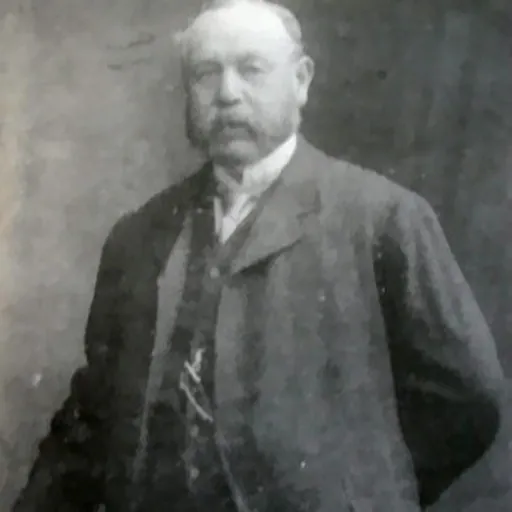
George Backhouse Witts
British civil engineer and archaeologist
About George Backhouse Witts
Lived 1846 – 1912 (aged 65–66). George Backhouse Witts was an archaeologist and civil engineer.
George Backhouse Witts (1846 – 6 September 1912) was a British civil engineer and archaeologist who specialised in the prehistoric barrows of Gloucestershire. His Archaeological Handbook of the County of Gloucester, the first such survey of the county, remained a standard work until the mid-20th century.
He later became a notable figure in the life of Leckhampton in Gloucestershire and as the local magistrate was once required to read the Riot Act on Leckhampton Hill to disperse a crowd of protesters intent on property damage.
Early life and family George Backhouse Witts was born in Winchcombe, Gloucestershire, in 1846 to Sophia Witts and the clergyman Edward Francis Witts, who was rector of Upper Slaughter in Gloucestershire as was his father the diarist Francis Edward Witts. George's father and grandfather were Lords of the Manor of Upper Slaughter. He was educated at the private Rugby School in Warwickshire.
In 1878, Witts married Sybil Catharine Vavasour in Cheltenham. Their daughter was Sybil Holdsworth Witts.
Witts qualified as a civil engineer and worked on the construction of the Cheltenham to Bourton-on-the-Water railway line as well as other railway projects in Gloucestershire such as the first Severn Railway Bridge.
His other activities included the Gloucestershire Rifle Volunteers, in which he was a lieutenant, being honorary secretary of the Cotswold Hunt, and participation in the Ancient Order of Foresters. He was a churchgoer and gave talks on the local area after which he would sometimes entertain the audience with Gloucestershire folk songs such as "The stwuns [stones] that built George Ridler's oven", a song with a secret meaning originally known only to members of The Gloucestershire Society.
Death and legacy George Witts died on 6 September 1912. His address at the time of his death was Hill House, Leckhampton, Cheltenham. Probate was granted to his daughter Sybil Holdsworth Witts, spinster, and Edward Clare Sewell, solicitor. He received an obituary in The Gloucester Journal.
Documents from Witts, and artefacts that he excavated, form the G. B. Witts Collection at the Wilson Museum in Cheltenham.
Selected publications Archaeological Handbook of the County of Gloucester, Being an Explanatory Description of the Archaeological Map of Gloucester, by the same author &c. G. Norman, Cheltenham, 1883.
Don’t just read it —
keep it.
Full-length biographies made to live with: read them, listen on the way to work, watch them tonight.
- E-book
- Audio
- Video
Instant download · yours to keep · every purchase keeps this site free
Important facts
People in George Backhouse Witts's life
Named in this biography and alive at the same time
Related people
Same field, nearest in time



Contemporaries
People whose lives overlapped George Backhouse Witts's



Frequently asked questions
Who was George Backhouse Witts?
British civil engineer and archaeologist (1856-1912)
When was George Backhouse Witts born?
George Backhouse Witts was born in 1846 in Winchcombe.
When did George Backhouse Witts die?
George Backhouse Witts died on 6 September 1912 in Leckhampton.
What was George Backhouse Witts's occupation?
George Backhouse Witts was an archaeologist and civil engineer.
Sources & further reading
· Wikipedia: George Backhouse Witts
· DBpedia: George Backhouse Witts
Cite this page
APA: Biography.guide. (2026). George Backhouse Witts. https://biography.guide/george-backhouse-witts/
MLA: "George Backhouse Witts." Biography.guide, https://biography.guide/george-backhouse-witts/.
Chicago: "George Backhouse Witts." Biography.guide. https://biography.guide/george-backhouse-witts/.
Data last updated: 2026-09-22 · Spot an error? Report a correction.
Portrait: Wikimedia Commons · author & licence
Page generated 2026-09-27 04:58 UTC