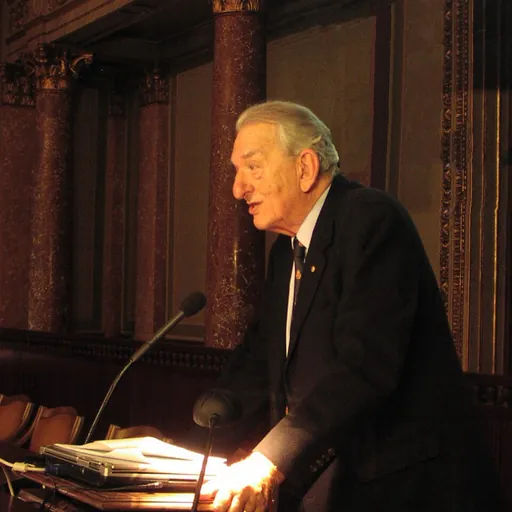
About George Andrew Olah
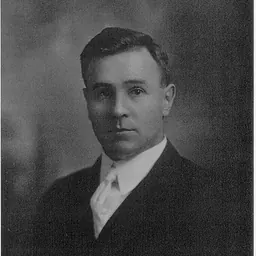
Lived 1927 – 2017 (aged 89). George Andrew Olah was a Hungarian and American chemist and university teacher, known for Carbocation.
George Andrew Olah (born Oláh András György; May 22, 1927 – March 8, 2017) was a Hungarian-American chemist. His research involved the generation and reactivity of carbocations via superacids. For this research, Olah was awarded a Nobel Prize in Chemistry in 1994 "for his contribution to carbocation chemistry." He was also awarded the Priestley Medal, the highest honor granted by the American Chemical Society and F.A. Cotton Medal for Excellence in Chemical Research of the American Chemical Society in 1996.
After the Hungarian Revolution of 1956, he immigrated to the United Kingdom, which he left for Canada in 1964, finally resettling in the United States in 1965. According to György Marx, he was one of The Martians.
Early life and education Olah was born in Budapest, Hungary, on May 22, 1927, to a Jewish couple, Magda (Krasznai) and Gyula Oláh, a lawyer. After the high school of Budapesti Piarist Gimnazium, he studied under organic chemist Géza Zemplén at the Technical University of Budapest, now the Budapest University of Technology and Economics, where he earned M.S. and Ph.D. degrees in chemical engineering. In 1965, he returned to academia at Case Western Reserve University in Cleveland, Ohio, chairing the department of chemistry from 1965 to 1969, and from 1967 through 1977 he was the C. F. Maybery Distinguished Professor of Research in Chemistry. He then moved to the University of Southern California in 1977. Starting in 1980, he served as the Distinguished Donald P. and Katherine B. Loker Professor of Chemistry and later became a distinguished professor in USC's school of engineering. In particular, Olah's search for stable nonclassical carbocations led to the discovery of protonated methane stabilized by superacids, like FSO3H-SbF5 ("Magic Acid"). CH4 + H+ → CH5+
Because these cations were able to be stabilized, scientists could now use infrared spectroscopy and nuclear magnetic resonance (NMR) spectroscopy to study them in greater depth, as well as use them as catalysts in organic synthesis reactions.
Olah, with Canadian chemist Saul Winstein, was also involved in a career-long battle with Herbert C. Brown of Purdue over the existence of so-called "nonclassical" carbocations – such as the norbornyl cation, which can be depicted as cationic character delocalized over several bonds. Olah's studies of the cation with NMR spectroscopy provided more evidence suggesting that Winstein's model of the non-classical cation, "featuring a pair of [delocalized] electrons smeared between three carbon atoms," was correct.
In 1997, the Olah family formed an endowment fund (the George A. Olah Endowment) which grants annual awards to outstanding chemists, including the George A. Olah Award in Hydrocarbon or Petroleum Chemistry, formerly known as the ACS Award in Petroleum Chemistry. The awards are selected and administered by the American Chemical Society.
Later in his career, his research shifted from hydrocarbons and their transformation into fuel to the methanol economy, namely generating methanol from methane. He joined with Robert Zubrin, Anne Korin, and James Woolsey in promoting a flexible-fuel mandate initiative. In 2005, Olah wrote an essay promoting the methanol economy in which he suggested that methanol could be produced from hydrogen gas (H2) and industrially derived or atmospheric carbon dioxide (CO2), using energy from renewable and nuclear sources to power the production process.
Personal life He married Judit Ágnes Lengyel (Judith Agnes Lengyel) in 1949, and they had two children, György (George), born in Hungary in 1954, and Ronald, born in the U.S. in 1959. After his death, the Hungarian government said that the "country has lost a great patriot and one of the most outstanding figures of Hungarian scientific life." 1989 California Scientist of the Year 1994 Nobel Prize in Chemistry 1996 Golden Plate Award of the American Academy of Achievement 1997 Elected a Foreign Member of the Royal Society (ForMemRS) in 1997. 2001 Arthur C. Cope Award 2001 Elected a member of the American Philosophical Society 2005 Priestley Medal from the American Chemical Society
Don’t just read it —
keep it.
Full-length biographies made to live with: read them, listen on the way to work, watch them tonight.
- E-book
- Audio
- Video
Instant download · yours to keep · every purchase keeps this site free
Important facts
People in George Andrew Olah's life
Named in this biography and alive at the same time



Related people
Same field, nearest in time



Contemporaries
People whose lives overlapped George Andrew Olah's
Frequently asked questions
Who was George Andrew Olah?
Hungarian chemist (1927-2017)
When was George Andrew Olah born?
George Andrew Olah was born on 22 May 1927 in Budapest.
When did George Andrew Olah die?
George Andrew Olah died on 8 March 2017 in Beverly Hills.
What was George Andrew Olah's occupation?
George Andrew Olah was a chemist and university teacher.
What was George Andrew Olah known for?
George Andrew Olah was known for Carbocation.
What nationality was George Andrew Olah?
George Andrew Olah was Hungarian and American.
Sources & further reading
· Wikipedia: George Andrew Olah
Cite this page
APA: Biography.guide. (2026). George Andrew Olah. https://biography.guide/george-andrew-olah/
MLA: "George Andrew Olah." Biography.guide, https://biography.guide/george-andrew-olah/.
Chicago: "George Andrew Olah." Biography.guide. https://biography.guide/george-andrew-olah/.
Data last updated: 2026-09-24 · Spot an error? Report a correction.
Portrait: Wikimedia Commons · author & licence
Page generated 2026-09-27 05:08 UTC