
About George Abbot
Lived 1604 – 1648 (aged 43–44). George Abbot was an English politician and writer.
George Abbot or Abbott (1604 – 2 February 1649) was an English lay writer, known as "The Puritan", and a politician who sat in the House of Commons in two periods between 1640 and 1649. He is known also for his part in defending Caldecote House against royalist forces in the early days of the English Civil War.
Life Abbott was the son of George Abbott of York (died 1607) and his wife Joan Penkeston. While Alumni Cantabrigienses states that he matriculated at King's College, Cambridge in 1622, the Oxford Dictionary of National Biography discounts the identification, for lack of evidence. He owned property in Baddesley Clinton, Warwickshire, and was a good friend of Richard Vines, minister at Caldecote some way to the east. In April 1640, he was elected as a member of parliament (MP) for Tamworth in the Short Parliament.
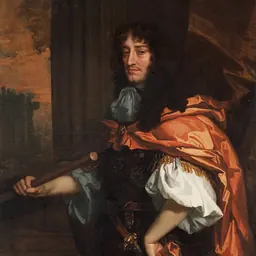
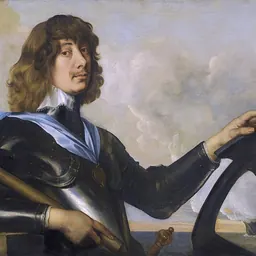
In the English Civil War, Abbot worked closely in Warwickshire with his stepfather William Purefoy, and made a notable defence, with his mother Joan, of the Purefoy house at Caldecote, Warwickshire, gaining the family coverage in the London press. On 15 August 1642, with eight men, his mother and maids, he held out for a time against Prince Rupert of the Rhine, with about 18 troops of horses and dragoons. Baxter in writing on the Sabbath referred to "my dear friend Mr. George Abbot". In his memoirs Reliquiæ Baxterianæ, Baxter placed Abbot's defence of Caldecote House, where barns were burnt, in local context: royalists under Spencer Compton, 2nd Earl of Northampton were attacking Warwick Castle, defended by John Bridges, and Coventry, defended by John Barker.
Abbot was re-elected MP for Tamworth in 1645 for the Long Parliament and held the seat until his death in 1649. He died unmarried in his 44th year, and was buried in Caldecote church where his monument describes his defence of Caldecote. It was supported by land left to it at Baddesley Ensor.
Works Abbot was a lay theologian and scholar. His Whole Booke of Job Paraphrased, or made easy for any to understand (1640), was written in a terse style, and his Vindiciae Sabbathi (1641) influenced the Sabbatarian controversy. His The Whole Book of Psalms Paraphrased (1650) was published posthumously by Richard Vines, and dedicated to Joan Purefoy, his mother.
Mistaken identifications Abbot has been confused with others of the same name and has been described as a clergyman, which he never was. His writings have been incorrectly attributed in some bibliographical authorities to a relation of George Abbot the archbishop of Canterbury. One of the sons of Sir Morris Abbot called George was also an MP in the Long Parliament but for the constituency of Guildford.
Don’t just read it —
keep it.
Full-length biographies made to live with: read them, listen on the way to work, watch them tonight.
- E-book
- Audio
- Video
Instant download · yours to keep · every purchase keeps this site free
Important facts
People in George Abbot's life
Named in this biography and alive at the same time



Related people
Same field, nearest in time

Contemporaries
People whose lives overlapped George Abbot's



Frequently asked questions
Who was George Abbot?
English religious writer and politician
When was George Abbot born?
George Abbot was born in 1604 in York.
When did George Abbot die?
George Abbot died on 2 February 1648.
What was George Abbot's occupation?
George Abbot was a politician and writer.
What nationality was George Abbot?
George Abbot was English.
Sources & further reading
· DBpedia: George Abbot (author)
Cite this page
APA: Biography.guide. (2026). George Abbot. https://biography.guide/george-abbot/
MLA: "George Abbot." Biography.guide, https://biography.guide/george-abbot/.
Chicago: "George Abbot." Biography.guide. https://biography.guide/george-abbot/.
Data last updated: 2026-09-20 · Spot an error? Report a correction.
Page generated 2026-09-27 05:10 UTC