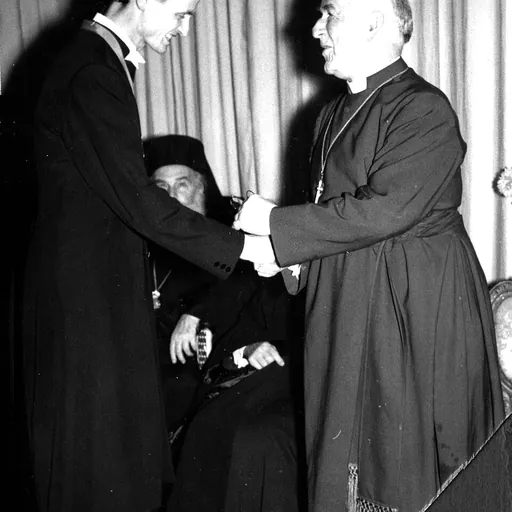
About Geoffrey Fisher
Lived 1887 – 1972 (aged 85). Geoffrey Fisher was a British politician, anglican priest, anglican theologian and archbishop.
Geoffrey Francis Fisher, Baron Fisher of Lambeth, (5 May 1887 – 15 September 1972) was an English Anglican priest, and 99th Archbishop of Canterbury, serving from 1945 to 1961.
From a long line of parish priests, Fisher was educated at Marlborough College, and Exeter College, Oxford. He achieved high academic honours but was not interested in a university career. He was ordained priest in 1913, and taught at Marlborough for three years; in 1914, aged 27, he was appointed headmaster of Repton School where he served for 18 years. In 1932, having left Repton, he was made Bishop of Chester. In 1939 he accepted the post of Bishop of London, the third most senior post in the Church of England. His term of office began shortly after the start of the Second World War, and his organising skills were required to keep the diocese functioning despite the devastation of the London Blitz.
In 1944 the Archbishop of Canterbury, William Temple, died suddenly, and Fisher was chosen to succeed him. He served from 1945 to 1961. One of the main themes of his time in office was church unity. He worked continually to build bridges to other Christian churches, and in 1960 became the first Archbishop of Canterbury to meet a Pope since the English Reformation, more than four centuries earlier. He overhauled the administration of the Church of England, strengthened international ties with other Anglican churches, and spoke out on a range of topical issues, from divorce to homosexuality, and the Suez Crisis to nuclear disarmament.
Theologically, Fisher was nearer the Evangelical wing of the Church than the Anglo-Catholic, but strongly believed that neither had a monopoly of religious truth. His predecessor and his successor at Canterbury – Temple and Michael Ramsey – were known for scholarly spirituality; Fisher was distinguished by a simple faith combined with outstanding organisational flair. In 1961 he retired from Canterbury and for the first time in his life became a parish priest, serving as honorary curate of a country parish in Dorset. He died in 1972, aged 85.
Life and career Early years
Geoffrey Francis Fisher was born on 5 May 1887 at the rectory, Higham on the Hill, Leicestershire, youngest of the ten children of the Rev Henry Fisher and his wife Katherine, née Richmond. A Fisher had served as rector of Higham since 1772: Henry Fisher's father and grandfather had preceded him; his eldest son, Legh, later held the post. |group=n After a short time in the Higham village school Fisher was sent to Lindley Lodge, a local preparatory school and in September 1901, having gained a scholarship, he entered Marlborough College, a public school in Wiltshire. |group=n under whose guidance he did well both academically and in sport.
From Marlborough, Fisher won a scholarship to Exeter College, Oxford, going up in October 1906. The college had a strong Anglican tradition with both the low church evangelical and high church Anglo-Catholic wings represented. Fisher, though temperamentally inclined to the former, felt that both had much to offer. He disapproved of those in either camp who believed they had a monopoly of the truth. He rowed and played rugby for the college and distinguished himself academically, leaving with a triple first.
After completing his studies Fisher declined two offers of lecturerships in theology from Oxford colleges. Although intellectually able he was not of an academic turn of mind. In the words of his biographer David Hein, "scholars must be intellectually imaginative and also persistently dissatisfied, even sceptical, in a way that Fisher never was". He accepted an invitation from Fletcher to return to Marlborough as a member of the teaching staff, remaining there for three years, during which time he went to Wells Theological College during the long summer vacation in 1911, and was ordained deacon in 1912, and priest in 1913.
Within two months of his appointment Fisher was confronted by problems arising from the outbreak of the First World War. Six of his teaching staff volunteered for the armed forces, as did sixty of the senior boys. he was no disciplinarian or organiser.
Fisher was in charge of Repton for 18 years, during which he improved the facilities, instilled firm discipline and modernised the curriculum. His biographer Alan Webster writes: blockindent|Fisher was never narrowly dictatorial as headmaster. He encouraged wide reading including Alec Waugh's The Loom of Youth (1917), which dealt frankly with homosexuality; and allowed Victor Gollancz to teach highly critical "civics" even in wartime, until outside protests became too strong. Another only partial success for Fisher was his attempt to regulate the variety of forms of worship in London churches. The diocese had a tradition of High Church ritualism, (Anglo-Catholicism was dubbed the "London, Brighton and South-Coast religion".) In his view Canterbury needed "a dynamic presence for some years, not a caretaker", and he welcomed working with Fisher. Nonetheless, after Churchill lost the 1945 general election, the Church was left, in Webster's words, with "a reforming Labour government" but "a conservative, headmasterly archbishop who, though warm-hearted, was determined to maintain the protestant establishment".
Canon law Fisher put considerable effort into revising the Church of England's canon law. The canons of 1604 were still nominally in force, despite being substantially out of date. His efforts provoked bitter controversy. In 1946 he preached a university sermon at Cambridge on the theme that communion between the Church of England and the Free Churches was possible and should be pursued. His enthusiastic support for the World Council of Churches and his blessing of the new Church of South India, an Anglican and Free Church coalition, were viewed with hostility by some Anglo-Catholics. They suspected Fisher of fostering pan-Protestantism, and the force with which he criticised the exclusiveness of the Church of Rome added to their resistance. They regarded his detailed and painstaking revision of canon law with similar suspicion. The Times summed up:
Notes, references and sources
Don’t just read it —
keep it.
Full-length biographies made to live with: read them, listen on the way to work, watch them tonight.
- E-book
- Audio
- Video
Instant download · yours to keep · every purchase keeps this site free
Important facts
People in Geoffrey Fisher's life
Named in this biography and alive at the same time




Related people
Same field, nearest in time




Contemporaries
People whose lives overlapped Geoffrey Fisher's




Frequently asked questions
Who was Geoffrey Fisher?
Archbishop of Canterbury (1887-1972)
When was Geoffrey Fisher born?
Geoffrey Fisher was born on 5 May 1887 in Nuneaton.
When did Geoffrey Fisher die?
Geoffrey Fisher died on 15 September 1972 in Sherborne.
What was Geoffrey Fisher's occupation?
Geoffrey Fisher was a politician, anglican priest, anglican theologian and archbishop.
What nationality was Geoffrey Fisher?
Geoffrey Fisher was British.
Sources & further reading
Cite this page
APA: Biography.guide. (2026). Geoffrey Fisher. https://biography.guide/geoffrey-fisher/
MLA: "Geoffrey Fisher." Biography.guide, https://biography.guide/geoffrey-fisher/.
Chicago: "Geoffrey Fisher." Biography.guide. https://biography.guide/geoffrey-fisher/.
Data last updated: 2026-09-22 · Spot an error? Report a correction.
Portrait: Wikimedia Commons · author & licence
Page generated 2026-09-27 05:04 UTC