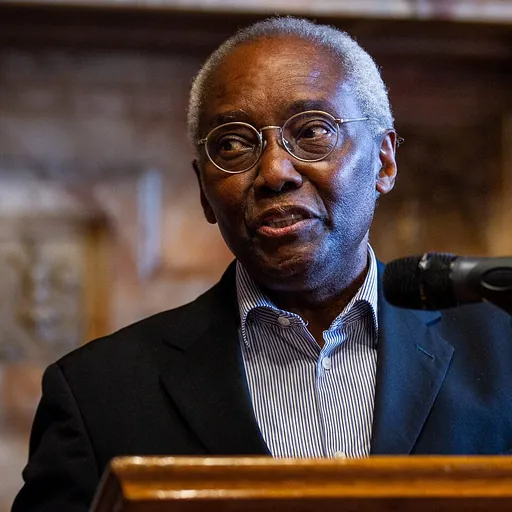
About Geoff Palmer
Lived 1940 – 2025 (aged 85). Geoff Palmer was a British writer.
Sir Godfrey Henry Oliver "Geoff" Palmer (9 April 1940 – 11 June 2025) was a Jamaican-British academic and human rights activist who was professor emeritus in the School of Life Sciences at Heriot-Watt University in Edinburgh, Scotland.
Palmer discovered the barley abrasion process while he was a researcher at Heriot-Watt University under the guidance of Anna Macleod. In 1998, Palmer was honoured with the American Society of Brewing Chemists Award of Distinction, considered the "Nobel Prize of brewing".
In 1989, he became the first black professor in Scotland, becoming a professor emeritus after he retired in 2005. He was knighted in the 2014 New Year Honours.
Early life Palmer was born in St Elizabeth, Jamaica, on 9 April 1940. His father left home when Palmer was seven years old; Palmer grew up in Kingston, Jamaica, in the care of his eight aunts.
Palmer joined his mother in London in March 1955, shortly before his 15th birthday, living at a house on the Caledonian Road. He told the story as a student at Heriot-Watt University that he was a stowaway on a banana boat from Jamaica to London. Too young to work, he was assessed as educationally subnormal at his first school, After completing his PhD thesis titled Ultra-structure of cereal grains in relation to germination in 1967, he began his research work at the Brewing Research Foundation in Surrey in 1968, He eventually became a senior scientist at the foundation After the Nigerian government banned the importation of European malt and barley in the 1980s, Palmer advised the government on the uses of local grains.
He attracted and received funding to set up the International Centre for Brewing and Distilling at Heriot-Watt University, through initiating contact with the distilling industry. He also contributed to the Encyclopedia of Seeds and the Encyclopedia of Grain Science, writing the foreword for the latter.
On 29 April 2021, it was announced that Palmer had been appointed the Chancellor of Heriot-Watt University, for an initial term of five years. The role was central to promoting Heriot-Watt's prominence and profile in research in the university's campuses in Scotland, Malaysia and Dubai.
Views Human rights and racial equality work Alongside his academic work, Palmer was also a prominent human rights activist and was involved in a considerable amount of charity work in the community. He wrote a series of articles for the Times Educational Supplement from 1969 to 1971 on ways to improve the education of children from ethnic minorities. and he contributed an article to The Scotsman titled "Stephen Lawrence analysis: Society is more mixed but racism has not gone away – we still have a long way to go" (5 January 2012). Palmer also authored a book on the history of slavery, The Enlightenment Abolished: Citizens of Britishness (2007), and spoke out extensively against the slave trade. As an accepted world authority on slavery and the Atlantic slave trade, Toronto and the City of Edinburgh Councils have adopted his views rather than new research from T. M. Devine.
In 2007, the Bicentenary of the passage of the Slave Trade Act 1807 by Parliament, which abolished the slave trade, Professor Geoff Palmer was named among the "100 Great Black Britons", as well as on the 2020 updated list.
He served as the Honorary President of Edinburgh and Lothians Regional Equality Council (ELREC), an Edinburgh-based organisation that works to tackle discrimination and promote human rights and equality in the community, specifically with regard to the nine protected characteristics outlined in the Equality Act 2010. Palmer spoke about the Ethnic Coding in NHS Scotland at ELREC's 40th Annual General Meeting.
Presenter of television programme "Slavery and abolition"
Palmer presented a special episode in the second series of the Scottish Television produced People's History. The programme features the story of James McCune Smith, and as part of it Palmer interviewed Stephen Mullen, the author of the book It wisnae us, which centres on Glasgow and slavery.
Melville Monument and slavery During the George Floyd protests, Palmer was the leading proponent of calls to reinterpret the Melville Monument, a large column in St Andrew Square, Edinburgh, dedicated to Scottish statesman Henry Dundas, due to his support for "gradual abolition", which delayed the abolition of the slave trade by fifteen years. Noting that he did not support the removal of controversial statues "because [they are] part of black history", Palmer instead called on Scottish society to "take down... racism". On 4 April 2021, Palmer appeared on an episode of the BBC's Antiques Roadshow, presenting his antique collection of silver sugar bowls and tongs. On the programme, he described the significance of these items to slavery: "After the 200-year commemoration of the abolition of the slave trade, I decided to look at sugar, because it was one of the main reasons for slavery. I thought I would find some evidence of this and acquired these silver items. While slaves were working and dying, people... were consuming the sugar, in those bowls, and with those tongs. To me, those silver bowls tell us the sort of things we do in order to make money, and to have a lifestyle that we think we deserve."
Awards and honours In recognition of his work and achievements in the field of grain science, Palmer was appointed Officer of the Order of the British Empire (OBE) in the 2003 Birthday Honours. The Open University in 2010, the University of the West Indies in 2015, and Heriot-Watt University in 2015.
He was knighted in the 2014 New Year Honours for services to human rights, science, and charity.
In August 2015, Palmer was the guest of interviewer Jim Al-Khalili on the BBC Radio 4 programme The Life Scientific.
In 2020, Palmer was awarded Commander of Order of Distinction in the Jamaican national honours. In December 2021, the Citizens Advice building in Penicuik was named "Palmer House" in his honour.
On 14 November 2022, Palmer received the Edinburgh Award from the Edinburgh City Council. In December 2022, with Lord Carloway, Lord President of the Court of Session, Palmer unveiled a plaque commemorating the 1778 Knight v Wedderburn case, which ruled that slavery was incompatible with Scots law.
In March 2024, King Charles III appointed Palmer a Knight of the Most Ancient and Most Noble Order of the Thistle (KT), the highest order of chivalry in Scotland.
Personal life and death Palmer lived in the town of Penicuik in Midlothian from 1977 onwards.
Palmer died on 11 June 2025, at the age of 85.
Don’t just read it —
keep it.
Full-length biographies made to live with: read them, listen on the way to work, watch them tonight.
- E-book
- Audio
- Video
Instant download · yours to keep · every purchase keeps this site free
Important facts
People in Geoff Palmer's life
Named in this biography and alive at the same time








Related people
Same field, nearest in time

Contemporaries
People whose lives overlapped Geoff Palmer's



Frequently asked questions
Who was Geoff Palmer?
Jamaican-British academic and human rights activist (1940–2025)
When was Geoff Palmer born?
Geoff Palmer was born on 9 April 1940 in Saint Elizabeth Parish.
When did Geoff Palmer die?
Geoff Palmer died on 12 June 2025 in Edinburgh.
What was Geoff Palmer's occupation?
Geoff Palmer was a writer.
What nationality was Geoff Palmer?
Geoff Palmer was British.
Sources & further reading
· DBpedia: Geoff Palmer (scientist)
Cite this page
APA: Biography.guide. (2026). Geoff Palmer. https://biography.guide/geoff-palmer-writer/
MLA: "Geoff Palmer." Biography.guide, https://biography.guide/geoff-palmer-writer/.
Chicago: "Geoff Palmer." Biography.guide. https://biography.guide/geoff-palmer-writer/.
Data last updated: 2026-09-23 · Spot an error? Report a correction.
Portrait: Wikimedia Commons · author & licence
Page generated 2026-09-27 05:07 UTC