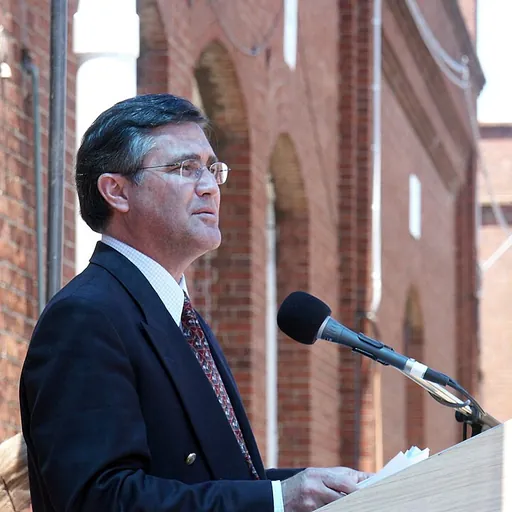
About Geoff Gallop
Born 1951. Geoff Gallop is an Australian politician and writer.
Geoffrey Ian Gallop (born 27 September 1951) is an Australian academic and former politician who was the premier of Western Australia from 16 February 2001 to 25 January 2006. A member of the Labor Party, he served in the Western Australian Legislative Assembly from 1986 to 2006 and was a minister in the Lawrence government from 1990 to 1993.
Born and raised in Geraldton, Gallop studied economics at the University of Western Australia before attending the University of Oxford on a Rhodes Scholarship. He completed a Master of Philosophy at Murdoch University and a Doctor of Philosophy at Oxford before working as a lecturer at Murdoch and a City of Fremantle councillor from 1983. In 1986, Gallop was elected to the Western Australian Legislative Assembly for the seat of Victoria Park. Carmen Lawrence appointed him to cabinet after his role in the 1990 leadership spill, but lost his cabinet position after Labor's defeat in the 1993 state election. Gallop became the leader of the state Labor Party close to the 1996 state election, in which he led Labor to defeat. He stayed on as leader, leading the party to victory in the 2001 state election, defeating the eight-year-old Coalition government led by Richard Court.
As premier, Gallop ended the logging of old-growth forests, started construction of the Perth–Mandurah rail line, increased the leaving age of school students from 15 to 17, introduced one vote, one value electoral reform in the Legislative Assembly, and commissioned the state's first major desalination plant at Kwinana. Generally popular throughout his time as premier, Gallop led Labor to a second victory in 2005, but in January 2006, he resigned from parliament due to depression. He was succeeded as premier and Labor leader by Alan Carpenter. Gallop has since worked as a professor at the University of Sydney, and chaired the Australian Republican Movement from 2012 to 2015.
Early life Gallop was born on 27 September 1951 in the city of Geraldton, Western Australia, to Douglas John Gallop and Eunice Grigsby. Doug was the secretary and part owner of the Geraldton Building Company. As a result, he leaned towards supporting the Liberal Party, whereas Eunice's family were Labor supporters. Gallop attended Beachlands Primary School and Geraldton Senior High School, On election day, the Coalition government suffered an 8.3 percent swing on a two-party-preferred basis, making Gallop the premier of Western Australia.
Premier Gallop's cabinet was unveiled on 14 February As promised, there were only 14 cabinet ministers. Gallop himself held the portfolios of public sector management, federal affairs, science, and citizenship and multicultural interests. Newly elected MP and former assistant police commissioner Bob Kucera was promoted straight to cabinet as the minister for health. The final cabinet position went to Nick Griffiths, against the wishes of Gallop, who wanted either Mark McGowan or Ljiljanna Ravlich in cabinet as they had performed well in the shadow ministry. Gallop and Ripper were outvoted after Left] powerbroker McGinty and Right powerbroker Michelle Roberts supported Griffiths. Soon after cabinet was sworn in, the minister for planning and infrastructure, Alannah MacTiernan, had her driver's licence suspended for drink driving. Gallop transferred the road safety component of her portfolio to Roberts. In September 2004, after Tom Stephens resigned from parliament to run for the federal seat of Kalgoorlie, Ravlich was promoted to cabinet.
Achievements The Gallop government established two royal commissions: one into the finance brokers' scandal, and another on the police force. It passed legislation in 2003 to establish the Crime and Corruption Commission. The logging of old-growth forests was ended in 2001 and a proposed resort and marina at Mauds Landing near Coral Bay, next to the Ningaloo Reef, was blocked on environmental grounds in 2003. Due to climate change, rainfall into Perth's dam catchments had decreased significantly since the 1980s, so Gallop committed to building the state's first major desalination plant at Kwinana for $346million and the Emu Downs Wind Farm to offset the power required for the plant. He closed the Swan Valley Nyungah Community.
The early years of the Gallop government were in a poor financial situation. Gallop had inadvertently promised at an election campaign television debate not to increase taxes or charges, when he had meant to say that the increases would be kept below inflation. He was forced by the poor financial situation to break that promise. He had considered introducing a premium property tax on houses valued over $1million like had been done in New South Wales, but abandoned that plan after it polled poorly. Later on, the financial problems eased, and a budget surplus was achieved, which prompted calls from the opposition for stamp duty relief.
During her time in shadow cabinet, MacTiernan had been working with Professor Peter Newman on planning to reroute the proposed Perth–Mandurah railway line from the circuitous route proposed by the Coalition government, to a more direct route via the Kwinana Freeway and Narrows Bridge. The new route was 12 minutes faster and more expense to construct. In July 2001, cabinet officially approved the new route. Construction started in February 2004.
In the period between the February 2005 state election and the swearing in of the newly-elected Legislative Council (upper house) members in May 2005, the Gallop government passed legislation implementing one vote, one value in the Legislative Assembly (lower house), giving each electoral district in the lower house the same number of electors, removing a pro-rural malapportionment that favoured conservative parties. As Labor did not have a majority in the upper house, the legislation was passed with the support of the Greens and Alan Cadby, who had left the Liberal Party in 2004 after being disendorsed.
2005 state election Opposition Leader Colin Barnett promised to cancel the desalination plant if he won the upcoming state election, and build the $2billion Kimberley–Perth Canal, which would carry water to Perth from the Fitzroy River in the state's north instead. Labor attacked this proposal due to its high cost.
Concurrently with the state election, the retail trading hours referendum was held and defeated.
In March 2005, cabinet was reshuffled. It was expanded from 14 to 17 members, with five new ministers. Gallop accepted a proposal from the Left and New Right factions for Fran Logan, John D'Orazio and Jon Ford to be given cabinet positions, and handpicked the unaligned MPs Mark McGowan and John Bowler to round out cabinet. The Old Right faction, lead by former premier Brian Burke, lost out on having Norm Marlborough promoted to cabinet, as Gallop believed him to be too closely aligned with Burke. Gallop had earlier placed a ban on all ministers communicating with Burke and his lobbying partner Julian Grill. Marlborough was later promoted to cabinet by Gallop's successor, Alan Carpenter, but demoted after a CCC investigation revealed that he had been receiving instructions from Burke on certain decisions. Later that year, Kucera was forced to resign from cabinet after it was revealed his wife owned shares in Alinta, which cabinet was making decisions over. He was replaced by Margaret Quirk in November.
Resignation On 16 January 2006, Gallop announced his resignation as the premier of Western Australia. Ripper acted as premier until the Labor Party could elect a new leader. and sworn in the following day, on which Gallop ceased to be premier and a member of parliament. Gallop later revealed that he had been suffering from depression since childhood, but had only been diagnosed recently.
Post-political career In July 2006, Gallop became a professor and director at the University of Sydney's Graduate School of Government.
In the 2008 Queen's Birthday Honours, Gallop was made a companion of the Order of Australia for "distinguished service to the Parliament of Western Australia, to the promotion of economic development and environmental sustainability, and to the community through educational, health and social reform."
In November 2012, Gallop was elected the chair of the Australian Republican Movement (ARM), serving in the position until July 2015.
Personal life Gallop married his first wife, Beverley Diane Jones, on 1 March 1975 in Maylands. They have two sons. He met his second wife, Sydney doctor Ingrid van Beek, on a Qantas flight to Jakarta about a month later. They got married at Vaucluse House in Sydney on 4 April 2010.
Don’t just read it —
keep it.
Full-length biographies made to live with: read them, listen on the way to work, watch them tonight.
- E-book
- Audio
- Video
Instant download · yours to keep · every purchase keeps this site free
Important facts
People in Geoff Gallop's life
Named in this biography and alive at the same time




Related people
Same field, nearest in time





Contemporaries
People whose lives overlapped Geoff Gallop's


Frequently asked questions
Who is Geoff Gallop?
Australian politician
When was Geoff Gallop born?
Geoff Gallop was born on 27 September 1951 in Geraldton.
What is Geoff Gallop's occupation?
Geoff Gallop is a politician and writer.
What nationality is Geoff Gallop?
Geoff Gallop is Australian.
Sources & further reading
Cite this page
APA: Biography.guide. (2026). Geoff Gallop. https://biography.guide/geoff-gallop/
MLA: "Geoff Gallop." Biography.guide, https://biography.guide/geoff-gallop/.
Chicago: "Geoff Gallop." Biography.guide. https://biography.guide/geoff-gallop/.
Data last updated: 2026-09-23 · Spot an error? Report a correction.
Portrait: Wikimedia Commons · author & licence
Page generated 2026-09-27 05:06 UTC