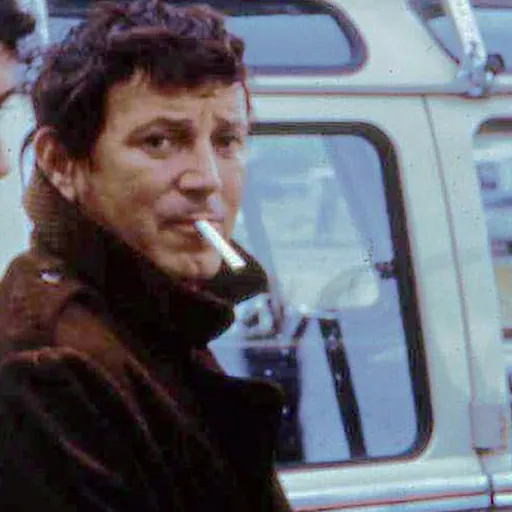
About Gene Vincent
Lived 1935 – 1971 (aged 36). Gene Vincent was an American guitarist, singer, singer-songwriter, rockabilly musician, bandleader and composer.
Vincent Eugene Craddock (February 11, 1935 – October 12, 1971), known as Gene Vincent, was an American rock-and-roll musician who pioneered the style of rockabilly. His 1956 top-10 hit with his backing band the Blue Caps, "Be-Bop-a-Lula", is considered a significant early example of rockabilly.
Biography Early life Vincent Eugene Craddock was born February 11, 1935, in Norfolk, Virginia, to Mary Louise and Ezekiah Jackson Craddock. His musical influences included country, rhythm and blues, and gospel. His favorite composition was Beethoven's Egmont overture. He showed his first real interest in music while his family lived in Munden Point (now Virginia Beach), in Princess Anne County, Virginia, near the North Carolina line, where they ran a country store. He received his first guitar at the age of 12 as a gift from a friend.
Craddock's father volunteered to serve in the U.S. Coast Guard and patrolled American coastal waters to protect Allied shipping against German U-boats during World War II. Craddock's mother maintained the general store in Munden Point. His parents moved the family to Norfolk, the home of a large naval base, and opened a general store and sailors' tailoring shop.
Craddock dropped out of school at 17 in 1952 and enlisted in the United States Navy. As he was under the age of enlistment, his parents signed the forms allowing him to enter. He completed boot camp and joined the fleet as a crewman aboard the fleet oiler , with a two-week training period in the repair ship , before returning to the Chukawan. He never saw combat but completed a Korean War deployment. He sailed home from Korean waters aboard the battleship , but he was not part of the ship's company.
Craddock planned a career in the Navy, and in 1955, he used his $612 re-enlistment bonus to buy a new Triumph motorcycle. On July 4, 1955, while he was in Norfolk, his left leg was shattered in an auto crash. He refused to allow the leg to be amputated, and the leg was saved, but the injury left him with a limp and pain. He wore a steel sheath as a leg brace for the rest of his life. Most accounts relate the accident as the fault of a drunk driver who struck him. Years later in some of his music biographies, no mention is made of an accident, but it was claimed that his injury was due to a wound incurred in combat in Korea. He spent time in the Portsmouth Naval Hospital and was medically discharged from the Navy shortly thereafter. The band included Willie Williams on rhythm guitar (replaced in late 1956 by Paul Peek), Jack Neal on upright bass, Dickie Harrell on drums (died May 31, 2023, at age 82), and Cliff Gallup on lead guitar.
Biggest hits
In 1956, he wrote "Be-Bop-a-Lula", which drew comparisons to Elvis Presley and which Rolling Stone later listed as number 103 on its "500 Greatest Songs of All Time". Local radio DJ "Sheriff Tex" Davis arranged for a demonstration recording of the song to be made, and this secured Vincent a contract with Capitol Records. and launching Vincent's career as a rock-and-roll star.
After "Be-Bop-a-Lula" became a hit, Vincent and His Blue Caps were unable to follow it up with the same level of commercial success, although they released critically acclaimed songs such as "Race with the Devil" (number 96 on the Billboard chart and number 50 on the Cash Box chart) and "Bluejean Bop" (number 49 on the Billboard chart and another million-selling disc). The group had another hit in 1957 with "Lotta Lovin' (highest position number 13 and spending 19 weeks on the Billboard chart and number 17 and 17 weeks on the Cashbox chart). Vincent was awarded gold records for two million sales of "Be-Bop-a-Lula", and 1.5 million sales of "Lotta Lovin. The same year, he toured the east coast of Australia with Little Richard and Eddie Cochran, drawing audiences totaling 72,000 to their Sydney Stadium concerts. Vincent also made an appearance in the film The Girl Can't Help It, with Jayne Mansfield, performing "Be-Bop-a-Lula" with the Blue Caps in a rehearsal room. On November 17, 1957, Vincent and His Blue Caps performed the song on the nationally broadcast television program The Ed Sullivan Show. The song spent nine weeks on the Billboard chart and peaked at number 23 on January 23, 1958, and reached number 36 and spent eight weeks on the Cashbox chart. It was Vincent's last American hit single. The song was used in the movie Hot Rod Gang for a dance-rehearsal scene featuring dancers doing the West Coast Swing. They appeared on October 25, 1958, and July 25 and November 7, 1959, but by the end of 1959, the Blue Caps were no longer part of the billing on Gene Vincent records. The late 1959 single "Wild Cat" was credited solely to Gene Vincent, and this was the case on all subsequent Gene Vincent releases.
Europe A dispute with the US tax authorities and the American Musicians' Union over payments to his band and his having sold the band's equipment to pay a tax bill led Vincent to leave the United States for Europe.
On December 15, 1959, Vincent appeared on Jack Good's TV show, Boy Meets Girl, his first appearance in England. He wore black leather, gloves, and a medallion, and stood in a hunched posture.
On April 16, 1960, while on tour in the UK, Vincent, Eddie Cochran, and songwriter Sharon Sheeley were involved in a high-speed traffic accident in a private-hire taxi in Chippenham, Wiltshire. Vincent broke his ribs and collarbone and further damaged his weakened leg. Sheridan soon relocated to Hamburg, where he helped influence the musical training of many British groups who would later become part of the British Invasion, including one of his backing bands, the Beatles.
Promoter Don Arden had Vincent return to the UK in 1961 to do an extensive tour in theatres and ballrooms, with Chris Wayne and the Echoes. In 1962, Vincent was on the same bill as the Beatles in Hamburg; Paul McCartney recalled an incident with a pistol at Vincent's girlfriend's hotel. After the overwhelming success of the UK tour, Vincent moved to Britain in 1963. On a UK tour, Vincent had pulled a gun on Jet Harris, Harris hid behind John Leyton, the situation was defused and the three later became friends. His accompanying band, Sounds Incorporated, a six-piece outfit with three saxophones, guitar, bass, and drums, went on to play with the Beatles at their Shea Stadium concert. Vincent toured the UK again in 1963 with the Outlaws, featuring future Deep Purple guitar player Ritchie Blackmore, as a backing band. Vincent's alcohol problems marred the tour, resulting in problems both on stage and with the band and management.
Later career
Vincent's attempts to re-establish his American career in folk rock and country rock proved unsuccessful; he is remembered today for recordings of the 1950s and early 1960s released by Capitol Records.
In 1969, he recorded the album I'm Back and I'm Proud for long-time fan John Peel's Dandelion Records, He recorded two other albums for Kama Sutra Records, reissued on one CD by Rev-Ola in March 2008. On his 1969 tour of the UK, he was backed by the Wild Angels, a British band that had performed at the Royal Albert Hall with Bill Haley & His Comets and Duane Eddy. Because of pressure from his ex-wife Margaret Russell, the Inland Revenue, and promoter Don Arden, Vincent returned to the US.
His final US recordings were four tracks for Rockin' Ronny Weiser's Rolling Rock label, a few weeks before his death. These were released on a compilation album of tribute songs, including "Say Mama", by his daughter, Melody Jean Vincent, accompanied by Johnny Meeks on guitar. On September 19, 1971, he began his last series of gigs in Britain. He was backed by Richard Cole and Kansas Hook (Dave Bailey, Bob Moore, and bass player Charlie Harrison from Poco and Roger McGuinn's Thunderbyrd). They recorded four tracks ("Say Mama", "Be-Bop-A-Lula", "Roll Over Beethoven", and "Distant Drums") at the BBC studios in Maida Vale, London, for Johnnie Walker's Radio 1 show. The fifth record ("Whole Lotta Shakin' Goin' On") remained unfinished. He managed one show at the Garrick Night Club in Leigh, Lancashire, and two shows at the Wookey Hollow Club in Liverpool on October 3 and 4. Vincent then returned to the US and died a few days later. In September 1974, the BBC launched pop label BEEB with a maxi single by Vincent ("Roll Over Beethoven", BEEB 001). The single comprised three of these tracks. The four tracks are now on Vincent's album White Lightning.
Death and legacy Vincent died at the age of 36 on October 12, 1971, from a combination of a ruptured ulcer, internal hemorrhage, and heart failure, while visiting his father in Saugus, California. He is interred at Eternal Valley Memorial Park, in Newhall, California.
Vincent is mentioned in one of Ian Dury's earliest songs, "Upminster Kid" (on the 1975 Kilburn and the High Roads album Handsome ), with the words "Well, Gene Vincent Craddock remembered the love of an Upminster rock 'n' roll teen". Vincent had died four years earlier. The following year, he was inducted into the Rock and Roll Hall of Fame. Vincent has a star on the Hollywood Walk of Fame at 1749 North Vine Street. In 2012, his band, the Blue Caps, were retroactively inducted into the Rock and Roll Hall of Fame by a special committee, alongside Vincent. On September 23, 2003, Vincent was honored with a Norfolk's Legends of Music Walk of Fame bronze star embedded in the Granby Street sidewalk.
Writing for AllMusic, Ritchie Unterberger called Vincent "an American rockabilly legend who defined the greasy-haired, leather-jacketed, hot rods 'n' babes spark of rock and roll." Village Voice critic Robert Christgau was less impressed by the musician's career, saying "Vincent was never a titan – his few moments of rockabilly greatness were hyped-up distillations of slavering lust from a sensitive little guy who was just as comfortable with 'Over the Rainbow' in his normal frame of mind." However, he included Vincent's compilation album The Bop That Just Won't Stop (1974) in his "basic record library", published in Christgau's Record Guide: Rock Albums of the Seventies (1981).
Discography Studio albums Bluejean Bop! (Capitol T764. US & UK) (8/13/1956) Gene Vincent and the Blue Caps (Capitol T811, US & UK) (1957) Gene Vincent Rocks! And the Blue Caps Roll (Capitol T970, US & UK) (3/1958) A Gene Vincent Record Date (Capitol T1059, US & UK) (11/1958) Sounds Like Gene Vincent (Capitol T1207, US & UK) (6/1959) Crazy Times (Capitol T1342, US & UK mono) (Capitol ST1342, US & UK stereo) (3/1960) The Crazy Beat of Gene Vincent (Capitol T 20453, UK) (1963) Shakin' Up a Storm (Columbia 33-OSX 1646, UK) (1964) Gene Vincent (London HAH 8333, UK) (1967) I'm Back and I'm Proud (Dandelion D9 102, US) (1969) (Dandelion 63754, UK) (1970) Gene Vincent (Kama Sutra KSBS 2019, US) (1970) retitled If Only You Could See Me Today (Kama Sutra 2361009, UK) (1971) The Day the World Turned Blue (Kama Sutra KSBS 2027, US) (1970) (Kama Sutra 2316005, UK) (1971)
Compilations and bootlegs Rhythm in Blue (bootleg) (Bluecap Records BC2-11-35, Canada) (1979) Be-Bop-a-Lula (bootleg) (Koala KOA 14617, US) (1980) Forever Gene Vincent (Rolling Rock LP 022, US) (1980) (contains four rare recordings by Vincent) Dressed in Black (Magnum Force MFLP 016, UK) (1982) Gene Vincent with Interview by Red Robinson (bootleg) (Great Northwest Music Company GNW 4016, US) (1982) From LA to Frisco (Magnum Force MFLP 1023, UK) (1982) For Collectors Only (Magnum Force MFLP 020, UK) (1984) Rarities Vol 2 (bootleg) (Doktor Kollector DK 005, France) (1985) Rareties (bootleg) (Dr Kollector CRA 001, France) (1986) Important Words (Rockstar RSR LP 1020, UK) (1990) Lost Dallas Sessions (Rollercoaster RCCD 3031) (1998) Hey Mama! (Rollercoaster ROLL 2021, UK) (1998)
EPs Hot Rod Gang (Capitol EAP 1–985 US & UK) (9/58) Be-Bop-a-Lula '62 (Capitol EAP 1-20448 France) (62) Live and Rockin''' (Fan club issue UK) (69) The Screamin' Kid Live! (bootleg) (no label 20240 France) (69) The Screaming Kid (bootleg) (no label 20.266 France) (69) Rainyday Sunshine (Rollin' Danny RD1 UK) (80) On Tour with Gene Vincent & Eddie Cochran (Rockstar RSR-EP 2013 UK) (86) In Concert Vol 1 (bootleg) (Savas SA 178305 France) (88) The Last Session (Strange Fruit SFNT 001 UK) (88) Hey Mama! (Rollercoaster RCEP 123 UK) (98) Blue Gene (Norton EP-076 US) (99) (NB: This listing omits the many EPs of album tracks & compilations)
Singles
Film appearances The Girl Can't Help It (1956) Hot Rod Gang (1958, a.k.a. Fury Unleashed) It's Trad, Dad! (1962, a.k.a. Ring a Ding Rhythm) Live It Up! (1963, a.k.a. Sing and Swing) The Rock And Roll Singer (1970) - documentary of Vincent's London tour of 1969
Vincent was played by Carl Barât in the 2009 film Telstar: The Joe Meek Story.
Don’t just read it —
keep it.
Full-length biographies made to live with: read them, listen on the way to work, watch them tonight.
- E-book
- Audio
- Video
Instant download · yours to keep · every purchase keeps this site free
Important facts
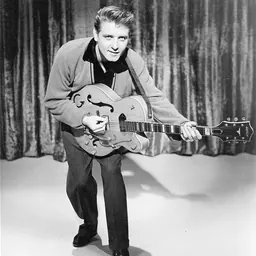
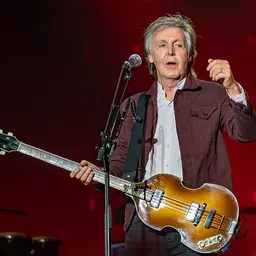
People in Gene Vincent's life
Named in this biography and alive at the same time




Related people
Same field, nearest in time

Contemporaries
People whose lives overlapped Gene Vincent's

Frequently asked questions
Who was Gene Vincent?
American rock musician (1935–1971)
When was Gene Vincent born?
Gene Vincent was born on 11 February 1935 in Norfolk, Virginia.
When did Gene Vincent die?
Gene Vincent died on 12 October 1971 in Newhall.
What was Gene Vincent's occupation?
Gene Vincent was a guitarist, singer, singer-songwriter, rockabilly musician, bandleader and composer.
What nationality was Gene Vincent?
Gene Vincent was American.
Sources & further reading
Cite this page
APA: Biography.guide. (2026). Gene Vincent. https://biography.guide/gene-vincent/
MLA: "Gene Vincent." Biography.guide, https://biography.guide/gene-vincent/.
Chicago: "Gene Vincent." Biography.guide. https://biography.guide/gene-vincent/.
Data last updated: 2026-09-22 · Spot an error? Report a correction.
Portrait: Wikimedia Commons · author & licence
Page generated 2026-09-27 05:01 UTC