
About Gene Colan
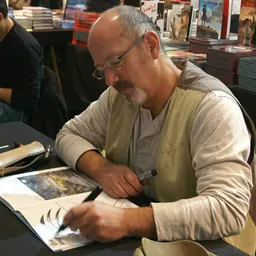
Lived 1926 – 2011 (aged 84). Gene Colan was an American comics artist, visual artist, inker and penciller.
Eugene Jules Colan (; September 1, 1926 – June 23, 2011) was an American comic book artist best known for his work for Marvel Comics, where his signature titles include the superhero series Daredevil, the cult-hit satiric series Howard the Duck, and The Tomb of Dracula, considered one of comics' classic horror series. He co-created the Falcon, the first African-American superhero in mainstream comics; Carol Danvers, who would become Ms. Marvel and Captain Marvel; and the non-costumed, supernatural vampire hunter Blade.
Colan was inducted into the Will Eisner Comic Book Hall of Fame in 2005.
Early life Eugene Jules Colan in The Bronx, New York City. His parents ran an antiques business on the Upper East Side. His family was Jewish, and the family's surname had originally been "Cohen". Colan began drawing at age three. "The first thing I ever drew was a lion. I must've absolutely copied it or something. But that's what my folks tell me. And from then on, I just drew everything in sight. My grandfather was my favorite subject". Later, he would try to copy artist Norman Rockwell's covers to The Saturday Evening Post. it gave Colan his first published work, the one-page "Wing Tips" non-fiction filler "P-51B Mustang" (issue #52, Dec. 1944). His first comics story was a seven-page "Clipper Kirk" feature in the following month's issue.
After attempting to enlist in the U.S. Marine Corps during World War II but being pulled out by his father "because I was underage", Colan at "18 or 19" enlisted in the Army Air Corps. He recalled in 2000,
quote|text=I was living with my parents. I worked very hard on a war story, about seven or eight pages long, and I did all the lettering myself, I inked it myself, I even had a wash effect over it. I did everything I could do, and I brought it over to Timely. What you had to do in those days was go to the candy store, pick up a comic book, and look in the back to see where it was published. Most of them were published in Manhattan, they would tell you the address, and you'd simply go down and make an appointment to go down and see the art director. "gave me my break. I went up there, and he came out and met me in the waiting room, looked at my work, and said, 'Sit here for a minute'. And he brought the work in, and disappeared for about 10 minutes or so ... then came back out and said, 'Come with me'. That's how I met [editor-in-chief] Stan [Lee]. Just like that, and I had a job.
Hired as "a staff penciler", Due to Colan's work going uncredited, in the manner of the times, comprehensive credits for this era are difficult if not impossible to ascertain. In 2010, he recalled his first cover art being for an issue of Captain America Comics; Colan drew the 12-page lead story in issue #72, the cover-artist of which is undetermined. He definitively drew the cover of the final issue, the horror comic Captain America's Weird Tales #75 (Feb. 1950), which did not include the titular superhero on either the cover or inside.
After virtually all the Timely staff was let go in 1948 during an industry downturn, Colan began freelancing for National Comics, the future DC Comics. A stickler for accuracy, he meticulously researched his countless war stories for DC's All-American Men at War, Captain Storm, and Our Army at War, as well as for Marvel's 1950s forerunner Atlas Comics, on the series Battle, Battle Action, Battle Ground, Battlefront, G.I. Tales, Marines in Battle, Navy Combat and Navy Tales. Colan's earliest confirmed credit during this time is penciling and inking the six-page crime fiction story "Dream Of Doom", by an uncredited writer, in Atlas' Lawbreakers Always Lose #6 (Feb. 1949).
By the early 1950s, he was living in New Rochelle, New York. Around this time he did his first work for DC Comics, then the industry leader, on the licensed series Hopalong Cassidy, based on the film and TV Western hero, drawing it from 1954 to 1957. In the 1960s, he lived in New Jersey, where his and Adrienne's children, Erik and Nanci, Taking to the form immediately, he introduced the "Sub-Mariner" feature in Tales to Astonish, and succeeded Don Heck on "Iron Man" in Tales of Suspense.
Sometime after Colan began this pseudonymous stint, Marvel editor Stan Lee made overtures to lure him from DC. Colan recalled,
Concurrent with his move to Marvel, Colan also contributed several stories to Warren Publishing's line of black-and-white horror comics magazines, beginning with the six-page tale "To Pay the Piper", by writer Larry Ivie, in Eerie #2 (March 1966). There and in subsequent stories for that magazine and its sister publication, Creepy, Colan would ink his own pencil work. His final original Warren story, "First Blood", appeared in Eerie #11 (Sept. 1967). The vast majority of these were written by Warren editor Archie Goodwin, with whom Colan would later collaborate on Marvel's Iron Man.
Dracula and Batman Colan in the 1970s illustrated the complete 70-issue run of the acclaimed horror title The Tomb of Dracula as well as most issues of writer Steve Gerber's cult hit Howard the Duck.
Colan, already one of Marvel's most well-established and prominent artists, said he had lobbied for the Tomb of Dracula assignment:
Colan and Marv Wolfman created several supporting characters for the Dracula series. They introduced Blade in The Tomb of Dracula #10 (July 1973) and Lilith in Giant-Size Chillers #1 (June 1974). Colan became the artist of Doctor Strange volume 2 with issue #6 (Feb. 1975) which introduced the Gaea character. A crossover between the two Colan-drawn series occurred in May 1976. In 2010, Comics Bulletin ranked Colan's run on The Tomb of Dracula fifth on its list of the "Top 10 1970s Marvels". His work on Doctor Strange was ranked ninth on the same list. Colan's collaboration with Steve Gerber on the Howard the Duck series saw the title character nominated by the All-Night Party, a fictional political party, as their nominee in the Presidential campaign of 1976, and led to Howard the Duck receiving thousands of write-in votes in the actual election. The Gerber-Colan team created Doctor Bong in Howard the Duck #15 (Aug. 1977). Gerber later said to Colan: "There really was almost a telepathic connection there. I would see something in my mind, and that is what you would draw! I've never had that experience with another artist before or since."
Colan returned to DC in 1981, following a professional falling out with Marvel editor-in-chief Jim Shooter. Colan recalled two decades later that Shooter
quote|... hated me. I was miserable. It was the worst experience ... one of the worst I've ever experienced. I had to leave Marvel because of him. I wouldn't stay, and I ... left everything behind. I left a pension plan, everything. I would have stayed, but Shooter gave me such a rough time. In fact, the vice president [of Marvel] had been down in a meeting with me and Shooter, trying to pacify me and get me to stay. And I just wouldn't do it, cause I could see the writing on the wall, and I knew where Shooter was heading, and I didn't want any more of it. With writer Gerry Conway, Colan revived the Golden Age supervillains Doctor Death in Batman #345 (March 1982) and the Monk in Batman #350 (Aug. 1982) and introduced Killer Croc in Detective Comics #523 (Feb. 1983). Killer Croc appears in the 2016 live-action movie Suicide Squad, portrayed by Adewale Akinnuoye-Agbaje. Another new character, Nightslayer, was created by Colan and Doug Moench in Detective Comics #529 (Aug. 1983).
In the insert preview in DC Comics Presents #41 (Jan. 1982), writer Roy Thomas and Colan provided Wonder Woman with a stylized "WW" emblem on her bodice, replacing the traditional eagle. The "WW" emblem, unlike the eagle, could be protected as a trademark and therefore had greater merchandising potential. Wonder Woman #288 (February 1982) premiered the new costume and an altered cover banner incorporating the "WW" emblem. Colan was one of several artists on Wonder Woman #300 (Feb. 1983) and stayed on the series until issue #305 wherein he and writer Dan Mishkin reintroduced the character Circe to the rogues gallery of Wonder Woman's adversaries. Steve Gerber and Colan reunited at DC to produce The Phantom Zone limited series. Helping to create new characters as well, Colan collaborated in the 1980s with The Tomb of Dracula writer Marv Wolfman on the 14-issue run of Night Force featuring characters introduced in an insert preview in The New Teen Titans #21 (July 1982). He was one of the contributors to the DC Challenge limited series in 1985. Additionally, Colan worked with Cary Bates on the 12-issue run of Silverblade; with Greg Potter on the 12-issue run of Jemm, Son of Saturn; and drew the first six issues of Doug Moench's 1987 revival of The Spectre. and became more pronounced as his career progressed. He usually worked as a penciller, with Frank Giacoia and Tom Palmer as his most frequent inkers. Colan broke from the mass-market comic book penciller/inker/colorist assembly-line system by creating finished drawings in graphite and watercolor on such projects as the DC Comics miniseries Nathaniel Dusk (1984) and Nathaniel Dusk II (1985–86), and the feature "Ragamuffins" in the Eclipse Comics umbrella series Eclipse #3, 5, and 8 (1981–83), with frequent collaborator Don McGregor. Unrealized projects around this time included the Marvel Music comic Elvis: Mystery Train, which went on hold, he said in 1996, "when Marvel ran into problems, so everything came to a halt. Right now it's in limbo. Senator Daniel Patrick Moynihan's son is writing it ..."
In 1998, Colan and his Tomb of Dracula writing collaborator, Marv Wolfman, reteamed on Dark Horse Comics three-issue miniseries The Curse of Dracula (July-Sept. 1998). Saying the book required "a much younger and better-looking Dracula" than in their previous series, Colan used "my lawn-boy [as] my model. ... I asked him to do the posing and he did." For the same company early the next decade, Colan returned to vampires with the 2001 one-shot Buffy the Vampire Slayer: Tales of the Slayers, an omnibus that included writer Doug Petrie's 16-page "Nikki Goes Down", starring a 1970s vampire slayer seen in one episode of the namesake TV series. He had relocated to nearby Manchester Center, Vermont, from New York City in 1990 or 1991, and was living there as of 2001. By 2009 at the latest, they had returned to New York City, settling in Brooklyn.
On May 11, 2008, his family announced that Colan, who had been hospitalized for liver failure, had suffered a sharp deterioration in his health. By December, he had sufficiently recovered to travel to an in-store signing in California. He continued to produce original comics work as late as 2009, drawing the 40-page Captain America #601 (Sept. 2009), for which he won an Eisner Award.
Personal life Gene Colan was married twice: first to Sallee Greenberg, with whom he had children Valerie and Jill before the couple divorced, and Adrienne Brickman, with whom he had children Erik and Nanci. Adrienne Colan died on June 21, 2010.
Colan died in the Bronx on June 23, 2011, aged 84, following complications of cancer and liver disease.
Awards and honors Colan's collaboration with Steve Gerber on Howard the Duck received the 1977 and 1978 Eagle Award for Favorite Comic Book (Humor) and was nominated for four Eagle Awards in 1978.
In 2005, Colan was inducted into the comics industry's Will Eisner Comic Book Hall of Fame. He subsequently won the 2010 Eisner Award for Best Single Issue (together with writer Ed Brubaker) for his work on Captain America #601 (Sept. 2009).
Colan was the recipient of the 2008 Sparky Award, presented December 4, 2008 and won the Comic Art Professional Society's Sergio Award on October 24, 2009.
Don’t just read it —
keep it.
Full-length biographies made to live with: read them, listen on the way to work, watch them tonight.
- E-book
- Audio
- Video
Instant download · yours to keep · every purchase keeps this site free
Important facts
People in Gene Colan's life
Named in this biography and alive at the same time




Related people
Same field, nearest in time




Contemporaries
People whose lives overlapped Gene Colan's


Frequently asked questions
Who was Gene Colan?
American comics creator and artist (1926-2011)
When was Gene Colan born?
Gene Colan was born on 1 September 1926 in The Bronx.
When did Gene Colan die?
Gene Colan died on 23 June 2011 in The Bronx.
What was Gene Colan's occupation?
Gene Colan was a comics artist, visual artist, inker and penciller.
What nationality was Gene Colan?
Gene Colan was American.
Sources & further reading
Cite this page
APA: Biography.guide. (2026). Gene Colan. https://biography.guide/gene-colan/
MLA: "Gene Colan." Biography.guide, https://biography.guide/gene-colan/.
Chicago: "Gene Colan." Biography.guide. https://biography.guide/gene-colan/.
Data last updated: 2026-09-20 · Spot an error? Report a correction.
Page generated 2026-09-27 05:30 UTC