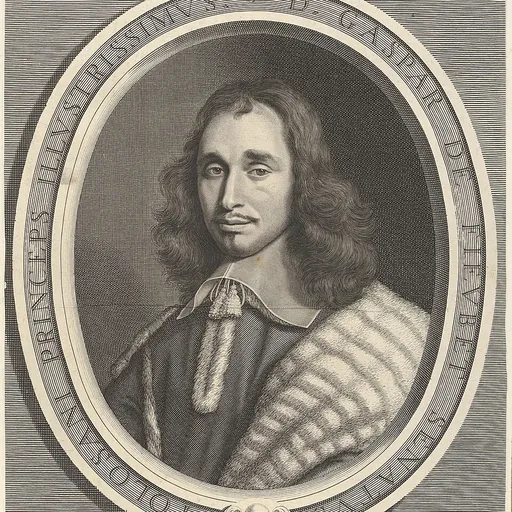
About Gaspard de Fieubet
Lived 1622 – 1686 (aged 63–64). Gaspard de Fieubet was a French magistrate.
Gaspard de Fieubet (December 3, 1622, in Toulouse - November 8, 1686, Château de Caumont) was a French magistrate. He served as president of the Parlement of Toulouse from 1653 to 1686, hailing from a prominent family in the legal and financial spheres. The Fieubet family had two branches: one in Paris and one in Toulouse; Gaspard de Fieubet was a distinguished member of the Toulouse branch.
As the first president of the Parlement of Toulouse, a significant court of law appointed by the king, Fieubet played a role in Louis XIV's policies in the South of France, particularly in curbing the rights of Protestants. In Toulouse, he purchased the Hôtel d'Ulmo on Ninau Street, seeking to exert control over the municipality by appointing the capitouls himself.
Though sometimes thought to be sympathetic to the Jansenists, Fieubet was an influential figure in Toulouse's cultural life, endeavoring to promote sciences, arts, and cultural institutions. He was the dedicatee of books on law, medicine, history, and poetry. Fieubet protected the Academy of Lanternists and the Institute of Girls' Education. He initiated the Salle des Illustres at the Capitole de Toulouse and supported Emmanuel Maignan while opposing Pierre de Fermat.
Family and marriages Gaspard de Fieubet was the son of Guillaume de Fieubet, a magistrate in the Parlement of Toulouse and the first president of the Parlement of Provence, and his wife Marguerite de Saint-Pol, daughter of Jacques de Saint-Pol, a master of requests.
He was the eldest son and had a younger brother and sisters:
Bernard de Fieubet, secretary of the commands of Queen Anne of Austria and superintendent of finances. Isabelle, who died on September 12, 1671, married: in 1646, Jean d'Olive, lord of Mesnil, counselor at the Parlement of Toulouse, on February 7, 1654, Jean de Cassaigneau, lord of Saussans, counselor at the Parlement of Toulouse.
Gaspard de Fieubet was married twice: first, on March 3, 1648, to Marguerite de Gameville (who died on January 30, 1671), daughter of Philippe de Gameville, lord of Montpapou, and Anne de Paulo. The couple had six daughters, and one son:
Marie-Marguerite de Fieubet, married to Jean-Guy de Maniban, a magistrate in the Parlement of Toulouse. Their son, Joseph-Gaspard de Maniban, became the first president of the Parlement of Toulouse. Gabrielle de Fieubet, married to M. de Mauriac, counselor at the Parlement of Toulouse. Marguerite de Fieubet, married to François, Marquis of Ossun. Jeanne de Fieubet, married on August 7, 1678, to Octavin de Cassaigneau de Saint-Félix (1650-1740). Catherine de Fieubet, married on September 14, 1690, to Pierre-Paul de Lombrail, lord of Rochemontès and Dauz, counselor at the Parlement of Toulouse. Paule-Thérèse de Fieubet, born on May 23, 1669, became a nun at the Visitation. Gaspard de Fieubet, counselor at the Parlement of Toulouse, dean of requests in 1709, died in 1711 without offspring, marking the end of this branch of the Fieubet family. On March 5, 1680, Fieubet married Gabrielle-Éléonore de Nogaret de La Valette (d. December 2, 1708), daughter of Jean de Nogaret de La Valette, general of the Venetian troops, and Gabrielle d'Aimar. This second marriage was childless. From the second half of the 17th century, the Fieubets also became part of a dense network of allied families holding positions in the Parlement of Paris.
Royal Authority Relay in Toulouse At the Parlement of Toulouse, Gaspard de Fieubet was appointed as president of requests in November 1643, attorney general on April 26, 1645, and first president on June 21, 1653. During Fieubet's tenure as the first president, the Parlement of Toulouse was a significant court, consisting of over a hundred officers, including a dozen presidents and about a hundred counselors. This high number was due to the monarchy creating many lucrative offices within the framework of the sale of offices system. Consequently, the Parlement held considerable weight in the city: the Parlementarians, their families, and their servants accounted for approximately 4,000 people, representing over 13% of the intra-mural population. 1659. Louis XIV swears on the Gospels to respect the municipal liberties of Toulouse before the kneeling capitouls. Painting by Antoine Durand (circa 1662). Municipal Archives of Toulouse. As early as 1654, through two rulings, Gaspard de Fieubet contested the jurisdiction of the Parlement of Paris, which had sentenced François-Jacques d'Amboise d'Aubijoux to death in absentia for participating in a forbidden duel where his lieutenant was killed. Aubijoux was completely pardoned in 1656. Serving as the first president of the Parlement of Toulouse for over thirty years, Fieubet enforced royal authority in Languedoc and, if necessary, tempered his Parlement's tendencies towards independence. From the king's perspective, he was a reliable man. Fieubet continued this trend by placing his agents within the municipality of Toulouse, such as Germain de Lafaille, whom he appointed as syndic. In 1659, Fieubet had the king approve the appointment of several of his friends as capitouls. By 1661, he was directly appointing them himself, thus reducing the city's autonomy. President Fieubet ensured that individuals "zealous for the king's service" were appointed to various positions, as he himself stated. In 1659, he had the opportunity to receive Louis XIV in person on behalf of the Parlement during the royal visit to Toulouse. The king expressed regret upon learning of his death.
In 1685, two rulings from the Parlement of Toulouse condemned a group of Portuguese merchants, accused of Judaizing, to be burned alive in public. However, they were actually burned in effigy, with the aim of confiscating their assets for the royal treasury.
Wealth Hôtel d'Ulmo, residence of Gaspard de Fieubet, Ninau Street in Toulouse.
The first president of the Parlement of Toulouse received an annual salary of just over 800 livres (not always paid regularly
Law, sciences, and literature It was logical for Toulouse legal scholars to dedicate their collections to Gaspard de Fieubet, the first president of the Parlement. Notable examples include "Abrégé du Recueil des arrests notables de la Cour de Parlement de Tolose" by Géraud de Maynard (1666), "Clarissimi viri Guilielmi Marani antecessoris Tolosani civilium operum" by Bernard Médon (1677), and "Questions notables du droit, décidées par divers arrests de la Cour de parlement de Toulouse" by Simon d'Olive du Mesnil (1682). Fieubet was also the dedicatee of other legal works such as "Eclaircissement nouveau, sur le prêt et les intérêts" by Bernard du Puy (1687). Dedication page of "Annales de la ville de Toulouse" by Germain de Lafaille (1687), BNF (Bibliothèque nationale de France). From the late 16th century onwards, Toulouse Parlementarians began to dominate the municipality (the capitouls) in controlling Toulouse's cultural life. The first president of the Parlement, Gaspard de Fieubet, followed this model and, like his Parisian cousin Gaspard III de Fieubet, surrounded himself with men of letters, organizing religious and scientific debates often led by theologian and physicist Emmanuel Maignan, whom he protected. It was Maignan who introduced Fieubet to astronomy and the use of the microscope.
Books dedicated to Fieubet on topics other than law include philosophical reflections such as "Cursus philosophicus, in quo totius scholae quaestiones" by the Christian doctrine priest Jean Vincent (1658), as well as medical treatises such as "Tractatus de vulneribus capitis" by Louis de Queyrats (1657) or "Doctrine nouvelle de la poudre vitriolique de sympathie" by Mathias Hyar (1677).
Fieubet supported the Toulouse historian Germain de Lafaille, who dedicated his "Annales de la ville de Toulouse" to his memory, published just after Fieubet's death in 1687, devoting the first fifteen pages to praising the Fieubet family.
Fieubet was also the initiator of the Salle des Illustres at the Capitole de Toulouse. Due to serious disputes with the mathematician Pierre de Fermat, the representation of the latter was absent from this gallery for a long time. It stemmed from a different interpretation of a legal case. In January 1658, a priest named Jean Montralon, with Jansenist leanings, was sentenced and hanged at Fieubet's instigation. This decision angered Fermat, who, as a counselor at the Parlement of Toulouse, was the rapporteur and examining judge in this case. His investigation had convinced him of Montralon's innocence.
Promotion of cultural institutions In 1680, Fieubet arranged for the city to provide an apartment, located in a house near Pont-Neuf Square, for the budding Toulouse academy, called the Academy of Lanternists, to hold meetings there, led by Abbé Maury. Thus, the Academy of Lanternists, which had disappeared a few years prior, was restored under his patronage. However, it struggled to survive because scholars were drawn to the capital.
The Fieubet mansion on Rue Ninau was sometimes described as a center of Jansenism. In a ruling from the Parlement of Toulouse that he himself signed in 1663, Gaspard de Fieubet protected the Institute of the Daughters of Childhood, founded in 1662 in Toulouse by Madame de Mondonville and Abbé de Ciron, who were linked to the Toulouse Parlementary milieu. The young girls entering this congregation came from Parlementary families. This institute, reputed to be close to Jansenism, was dismantled by order of Louis XIV in 1686, This ailment plagued him for much of his life, as over twenty years later, in March 1681, he complained in a letter of "the gout which has afflicted me for a month".
After drafting his will on February 13, 1686, he died on November 8, 1686, at the Château de Caumont.
Don’t just read it —
keep it.
Full-length biographies made to live with: read them, listen on the way to work, watch them tonight.
- E-book
- Audio
- Video
Instant download · yours to keep · every purchase keeps this site free
Important facts
People in Gaspard de Fieubet's life
Named in this biography and alive at the same time



Related people
Same field, nearest in time



Contemporaries
People whose lives overlapped Gaspard de Fieubet's





Frequently asked questions
Who was Gaspard de Fieubet?
French Magistrate
When was Gaspard de Fieubet born?
Gaspard de Fieubet was born on 3 December 1622 in Toulouse.
When did Gaspard de Fieubet die?
Gaspard de Fieubet died in 1686 in Yerres.
What was Gaspard de Fieubet's occupation?
Gaspard de Fieubet was a magistrate.
What nationality was Gaspard de Fieubet?
Gaspard de Fieubet was French.
Sources & further reading
· Wikipedia: Gaspard de Fieubet
Cite this page
APA: Biography.guide. (2026). Gaspard de Fieubet. https://biography.guide/gaspard-de-fieubet/
MLA: "Gaspard de Fieubet." Biography.guide, https://biography.guide/gaspard-de-fieubet/.
Chicago: "Gaspard de Fieubet." Biography.guide. https://biography.guide/gaspard-de-fieubet/.
Data last updated: 2026-09-22 · Spot an error? Report a correction.
Portrait: Wikimedia Commons · author & licence
Page generated 2026-09-27 05:02 UTC