
About Gaspar Frutuoso
Lived 1522 – 1591 (aged 68–69). Gaspar Frutuoso was a catholic priest, historian and humanist.
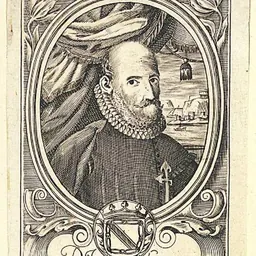
Gaspar Frutuoso ( 1522 – 1591) was a Portuguese priest, historian and humanist from the island of São Miguel, in the Portuguese archipelago of the Azores. His major contribution to Portuguese history was his detailed descriptions of the history and geography of the Azores, Madeira, Canary Islands and references to Cape Verde, which he published in his six-part tome Saudades da Terra, as well as Saudades do Céu.
Biography Gaspar Frutuoso was born in 1522, on the island of São Miguel, son of Frutuoso Dias, a merchant and rural property-owner, and his wife Isabel Fernandes. Little is known of his childhood, apart from references to him working his father's lands during this period.
The first trustworthy record about Frutuoso was his admission to the University of Salamanca (in 1548) where he later obtained an Arts certification.
By decree on the 20 May 1565, he was nominated to be the vicar and orator at the parochial Church of Nossa Senhora da Estrela (Our Lady of the Star), in the municipality of Ribeira Grande, a position he held for the next 26 years (until his death). During this time, he was dedicated to the parish, as well as charitable works he contributed towards on and off-island, but still had time writing his 16 manuscripts that included Saudades da Terra, and Saudades do Ceu.
In 1566, during the French assault on Funchal, he collected funds and wheat for the people of Madeira.
He died on 24 August 1591 and was buried in the Church of Nossa Senhora da Estrela, in Ribeira Grande.
Saudades da Terra
Saudades da Terra, literally Nostalgic-longing for the Land, is a six-volume tome that contains observations by the author, of the history and geography of the Atlantic territories of the Kingdom of Portugal, as well as the Canary Islands (lands at one time attributed to Portugal). It is a referential work for the understanding of the islands of Macaronesia at the end of the 16th Century. The work is not limited to geography and history, but also covers daily life, customs and traditions, genealogy, the origins of place names, flora and fauna, and affirms Frutuoso's humanist nature, typical of the Renaissance.
His detailed descriptions are so detailed that they were published into separate volumes which cover: Book I – Cape Verde and Canary Islands; Book II – Madeira; Book III – Santa Maria (Azores); Book IV – São Miguel (Azores); Book V – Poem Book VI – Terceira, Faial, Pico, Flores, Graciosa, São Jorge (Azores).
The fifth volume is an elaborate poem, from the perspective of a fictional character, writing in a pastoral style, about the history of two friends that are separated and forced to live far from home. Some biographers have cited this as a deliberate autobiography of Frutuoso and his university friend, the Micalense medic, Gaspar Gonçalves.
Gaspar Frutuoso apparently attempted to publish his work, going so far as to rework and edit his manuscript (the original has many edits in his hand). For reasons that are never clear, although the Spanish occupation of the island (during the Iberian Union) may have influenced his decision, he never published the work. The manuscript, along with documents from his library, were sent to the Jesuit College in Ponta Delgada and preserved until 1760 (when the Society of Jesus was expelled from Portugal). The manuscript fell into the hands of people who restricted access to the document, until it was donated to the General Committee of Ponta Delgada, and incorporated into the holdings of the Public Library and Archive (where it now resides). The work was finally published in 1873, with thirty notes by Álvaro Rodrigues de Azevedo, and a prologue by the Dicionário Universal de Português Ilustrado (Illustrated Universal Dictionary of Portugal), written by Fernandes Costa. Many partial editions of Saudades da Terra have been re-published by the Instituto Cultural de Ponta Delgada since 1966.
Don’t just read it —
keep it.
Full-length biographies made to live with: read them, listen on the way to work, watch them tonight.
- E-book
- Audio
- Video
Instant download · yours to keep · every purchase keeps this site free
Important facts
Related people
Same field, nearest in time



Contemporaries
People whose lives overlapped Gaspar Frutuoso's



Frequently asked questions
Who was Gaspar Frutuoso?
Portuguese historian
When was Gaspar Frutuoso born?
Gaspar Frutuoso was born in 1522 in Ponta Delgada.
When did Gaspar Frutuoso die?
Gaspar Frutuoso died in 1591 in Ribeira Grande.
What was Gaspar Frutuoso's occupation?
Gaspar Frutuoso was a catholic priest, historian and humanist.
What nationality was Gaspar Frutuoso?
Gaspar Frutuoso's recorded nationality: Kingdom of Portugal.
Sources & further reading
Cite this page
APA: Biography.guide. (2026). Gaspar Frutuoso. https://biography.guide/gaspar-frutuoso/
MLA: "Gaspar Frutuoso." Biography.guide, https://biography.guide/gaspar-frutuoso/.
Chicago: "Gaspar Frutuoso." Biography.guide. https://biography.guide/gaspar-frutuoso/.
Data last updated: 2026-09-20 · Spot an error? Report a correction.
Page generated 2026-09-27 05:30 UTC