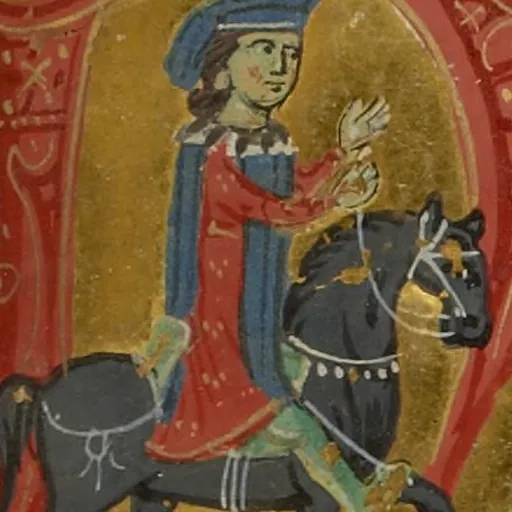
About Garin lo Brun
Lived 1150 – 1156 (aged 5–6). Garin lo Brun was a French troubadour and composer.
Garin lo Brun or le Brun (; died 1156/1162) was an early Auvergnat troubadour.
Life Garin lived in the Diocese of Le Puy-en-Velay, where his family owned castles. He was himself lord of Châteauneuf-de-Randon in the Gévaudan and a vassal of Ermengarde of Narbonne and of Eleanor of Aquitaine. His origins were either in the Diocese of Mende If he was of Randon, then his father was Garin (Guérin) de Randon, a vassal of Raymond Berengar III, Count of Barcelona, of whom Guérin and his brother Odilon held the castle of Randon. This is likely, as a Garin paid homage to the count of Barcelona for this castle in 1150. In 1162, Garin lo Brun appears to have died, as in that year his brother William (Guillaume), called Randon protecteur des troubadours ("Randon, Protector of Troubadours"), arranged a requiem mass for him and granted Grosvialla (Groviala) to the Knights Templar for the rest of his soul. This tenso was dedicated to one Eblon de Saignes.
Ensenhamen The author of Garin's vida (biography) comments that "he went to the trouble of telling the ladies how they should behave themselves."
Garin wrote the earliest known example of an ensenhamen or didactic (teaching) poem to have survived, which has the title El termini d'estiu. This is written in isometric rhymed hexameter and has been dated to 1155.
Garin's work has over a hundred verses on the beauty of nature and the sorry state of contemporary mores, but its main theme is the courtly behaviour of women. It is therefore sometimes called Ensenhamen de la donzela ("Ensenhamen of the girl") or L'ensegnamen alla dama ("The ensenhamen to woman"). It is part of the medieval "conduct literature" which urges women to adapt themselves to their husbands, to be merry or sad as their men are merry or sad. Garin counsels also that women should sing and recite poetry for their guests.
An excerpt from the Ensenhamen says: Joglars e chantadors, que paraulan d'amors e canton sons e lais, per que l'om es plus gais, e meton in corage de tot prez vassallage, retenez amoros.Joglars and singers, who speak of love and sing melodies and lais, which gladden people, and who inspire courage to undertake all feats of bravery, you should honor with your affection.
Another passage of the Ensenhamen which is sometimes quoted advises women to "welcome entertainers and poets who chatter of love and sing verses and melodies. At least, show them a good face, for if you give them nothing, they will make your name known far and wide."
Don’t just read it —
keep it.
Full-length biographies made to live with: read them, listen on the way to work, watch them tonight.
- E-book
- Audio
- Video
Instant download · yours to keep · every purchase keeps this site free
Important facts
People in Garin lo Brun's life
Named in this biography and alive at the same time

Related people
Same field, nearest in time



Frequently asked questions
Who was Garin lo Brun?
troubadour
When was Garin lo Brun born?
Garin lo Brun was born in 1150.
When did Garin lo Brun die?
Garin lo Brun died in 1156.
What was Garin lo Brun's occupation?
Garin lo Brun was a troubadour and composer.
What nationality was Garin lo Brun?
Garin lo Brun was French.
Sources & further reading
Cite this page
APA: Biography.guide. (2026). Garin lo Brun. https://biography.guide/garin-lo-brun/
MLA: "Garin lo Brun." Biography.guide, https://biography.guide/garin-lo-brun/.
Chicago: "Garin lo Brun." Biography.guide. https://biography.guide/garin-lo-brun/.
Data last updated: 2026-09-22 · Spot an error? Report a correction.
Portrait: Wikimedia Commons · author & licence
Page generated 2026-09-27 05:03 UTC