
About Bernard de Ventadour
Lived 1140 – 1190 (aged 49–50). Bernard de Ventadour was a French troubadour, composer and poet.
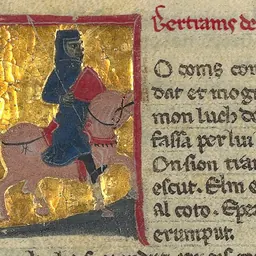
Depiction of Bernart from fol. 15v of the Chansonnier BnF ms. 12473
Bernart de Ventadorn (also Bernard de Ventadour or Bernat del Ventadorn; – ) was an Occitan poet-composer troubadour of the classical age of troubadour poetry. Generally regarded as the most important troubadour in both poetry and music, his 18 extant melodies of 45 known poems in total is the most to survive from any 12th-century troubadour. He is remembered for his mastery as well as popularization of the trobar leu style, and for his prolific cançons, which helped define the genre and establish the "classical" form of courtly love poetry, to be imitated and reproduced throughout the remaining century and a half of troubadour activity.
Now thought of as "the Master Singer," he developed the cançons into a more formalized style which allowed for sudden turns. Bernart was known for being able to portray his women as divine agents in one moment and then, in a sudden twist, as Eve – the cause of man's initial sin. This dichotomy in his work is portrayed in a "graceful, witty, and polished" medium.
Life and career According to the troubadour Uc de Saint Circ, Bernart was possibly the son of a baker at the castle of Ventadour (Ventadorn), in today's Corrèze (France). Yet another source, a satirical poem written by a younger contemporary, Peire d'Alvernha, indicates that he was the son of either a servant, a soldier, or a baker, and his mother was also either a servant or a baker. From evidence given in Bernart's early poem Lo temps vai e ven e vire, he most likely learned the art of singing and writing from his protector, viscount Eble III of Ventadorn. He composed his first poems to his patron's wife, Marguerite de Turenne.
Forced to leave Ventadour after falling in love with Margerite, he traveled to Montluçon and Toulouse, and eventually followed Eleanor of Aquitaine to England and the Plantagenet court; evidence for this association and these travels comes mainly from his poems themselves. Later Bernart returned to Toulouse, where he was employed by Raimon V, Count of Toulouse; later still he went to Dordogne, where he entered a monastery. Most likely he died there.
Works Bernart is unique among secular composers of the twelfth century in the amount of music which has survived: of his forty-five poems, eighteen have music intact, an unusual circumstance for a troubadour composer (music of the trouvères has a higher survival rate, usually attributed to them surviving the Albigensian Crusade, which scattered the troubadours and destroyed many sources). His work probably dates between 1147 and 1180. Bernart is often credited with being the most important influence on the development of the trouvère tradition in northern France, since he was well known there, his melodies were widely circulated, and the early composers of trouvère music seem to have imitated him. Bernart's influence also extended to Latin literature. In 1215 the Bolognese professor Boncompagno wrote in his Antiqua rhetorica that "How much fame attaches to the name of Bernard de Ventadorn, and how gloriously he made cansos and sweetly invented melodies, the world of Provence very much recognises."
Cultural references On screen, Bernart was portrayed by actor Paul Blake in the BBC TV drama series The Devil's Crown (1978).
In the final fragment (Canto CXX) of his epic poem The Cantos, American expatriate poet Ezra Pound, who had a lifelong fascination with the trouveres and troubadours of Provence and southern France, quotes from Bernart's Can vei la lauzeta mover twice.
Don’t just read it —
keep it.
Full-length biographies made to live with: read them, listen on the way to work, watch them tonight.
- E-book
- Audio
- Video
Instant download · yours to keep · every purchase keeps this site free
Important facts
People in Bernard de Ventadour's life
Named in this biography and alive at the same time

Related people
Same field, nearest in time



Contemporaries
People whose lives overlapped Bernard de Ventadour's



Frequently asked questions
Who was Bernard de Ventadour?
12th-century troubador
When was Bernard de Ventadour born?
Bernard de Ventadour was born in 1140 in Moustier-Ventadour.
When did Bernard de Ventadour die?
Bernard de Ventadour died in 1190 in Sainte-Trie.
What was Bernard de Ventadour's occupation?
Bernard de Ventadour was a troubadour, composer and poet.
What nationality was Bernard de Ventadour?
Bernard de Ventadour was French.
Sources & further reading
· Wikipedia: Bernard de Ventadour
· DBpedia: Bernart de Ventadorn
Cite this page
APA: Biography.guide. (2026). Bernard de Ventadour. https://biography.guide/bernard-de-ventadour/
MLA: "Bernard de Ventadour." Biography.guide, https://biography.guide/bernard-de-ventadour/.
Chicago: "Bernard de Ventadour." Biography.guide. https://biography.guide/bernard-de-ventadour/.
Data last updated: 2026-09-24 · Spot an error? Report a correction.
Page generated 2026-09-27 04:59 UTC