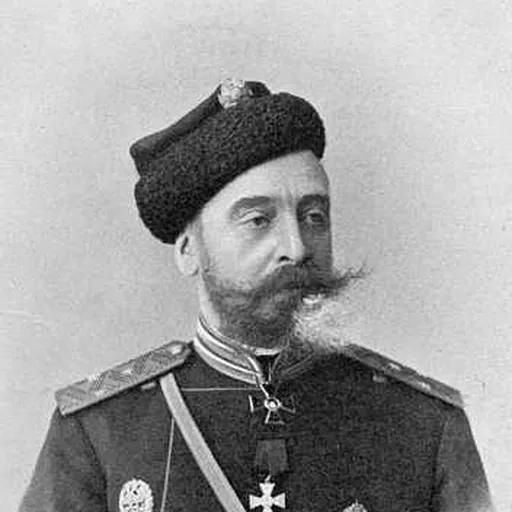
About Fyodor Keller
Lived 1850 – 1904 (aged 53–54). Fyodor Keller was a Russian military personnel.
Theodor Eduard Graf von Keller (, Fyodor Eduardovich Keller; 15 August 1850 – 31 July 1904), better known as Fyodor Keller, was a general in the Imperial Russian Army, noted for his role in the Battle of Motien Pass during the Russo-Japanese War.
Biography Theodor von Keller was from German nobility, and had the title of a Prussian count. His father was Eduard Graf von Keller (1819–1903), who would become an Imperial Russian chamberlain, privy councilor, and senator. His grandfather Theodor Ludwig Wilhelm Graf von Keller (1791–1860), who would become a colonel of the Imperial Russian army, was born in Stedten and had moved to Russia, where his father Dorotheus Ludwig Christoph Graf von Keller (1757–1827), like so many Germans, had been offered a high position and wealth from Catherine the Great.
Young Theodor, who the Russians called Fyodor/Fedor, attended the prestigious Corps of Pages, the military school for the Russian aristocracy. After graduation in 1866, he was commissioned as an ensign in the premier cavalry regiment of the Imperial Russian Army, the Chevalier Guard Regiment. He then attended the Nicholas General Staff Academy and was promoted to captain on his graduation in 1876. His cousin Theodor Alexander Graf von Keller (1857–1918) would later become a famous General der Kavallerie of the Imperial Russian Army.
The Balkan campaigns Also in 1876, Keller volunteered for service with the Serbian Army during the Serbian-Turkish Wars (1876-1878) and was promoted to the rank of lieutenant colonel and distinguished himself in a number of combat operations. In September of the same year, he became a member of the staff of Major-General Mikhail Chernyayev (nicknamed the 'Russian General Custer'), and was assigned as aide-de-camp to the tsarevich Alexander Alexandrovich (the future Tsar Alexander III) and the Field Marshal Prince Aleksandr Baryatinsky, both of whom were in Serbia serving with the Russian volunteer expeditionary force.
The forces of Ottoman Empire defeated the Russian-backed Serbians, thus leading to the subsequent Russo-Turkish War, 1877–1878. During this war, Keller served as the Chief-of-Staff to the Russian-led Bulgarian militia, and later as chief-of-staff for Russian Major-General Mikhail Skobelev, where he replaced the wounded Colonel Alexei Kuropatkin. After the war, Keller was promoted to colonel and served in various staff positions. At the conclusion of the war in 1879, he was promoted to colonel and designated an official emissary to Constantinople for the negotiations which determined the borders of the Kingdom of Bulgaria.
Don’t just read it —
keep it.
Full-length biographies made to live with: read them, listen on the way to work, watch them tonight.
- E-book
- Audio
- Video
Instant download · yours to keep · every purchase keeps this site free
Important facts
People in Fyodor Keller's life
Named in this biography and alive at the same time

Related people
Same field, nearest in time



Contemporaries
People whose lives overlapped Fyodor Keller's


Frequently asked questions
Who was Fyodor Keller?
Russian general (1850–1904)
When was Fyodor Keller born?
Fyodor Keller was born in 1850 in Moscow.
When did Fyodor Keller die?
Fyodor Keller died on 18 July 1904 in Gaizhou.
What was Fyodor Keller's occupation?
Fyodor Keller was a military personnel.
What nationality was Fyodor Keller?
Fyodor Keller was Russian.
Sources & further reading
· DBpedia: Fyodor Eduardovich Keller
Cite this page
APA: Biography.guide. (2026). Fyodor Keller. https://biography.guide/fyodor-keller-military-personnel/
MLA: "Fyodor Keller." Biography.guide, https://biography.guide/fyodor-keller-military-personnel/.
Chicago: "Fyodor Keller." Biography.guide. https://biography.guide/fyodor-keller-military-personnel/.
Data last updated: 2026-09-21 · Spot an error? Report a correction.
Portrait: Wikimedia Commons · author & licence
Page generated 2026-09-27 04:59 UTC