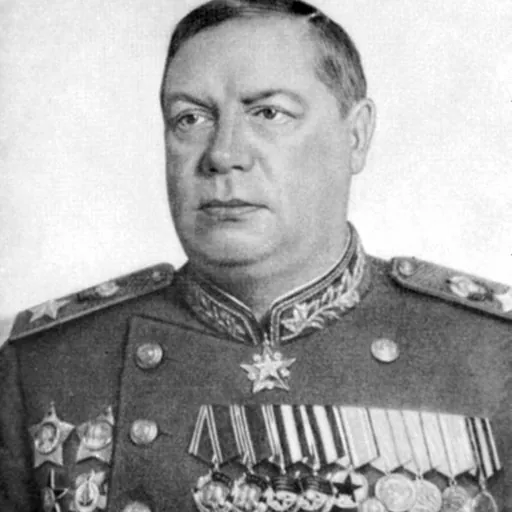
Fyodor Ivanovich Tolbukhin
Soviet military commander and Marshal of the Soviet Union
About Fyodor Ivanovich Tolbukhin
Lived 1894 – 1949 (aged 55). Fyodor Ivanovich Tolbukhin was a Russian military officer, politician, soldier and marshal.
Fyodor Ivanovich Tolbukhin (; 16 June 1894 – 17 October 1949) was a Soviet military commander and Marshal of the Soviet Union. He is regarded as one of the finest Soviet generals of World War II.
Born into a peasant family in Yaroslavl, Tolbukhin volunteered for the Imperial Russian Army during the First World War and served with distinction. He joined the Red Army in 1918 and fought in the Russian Civil War. After graduating from the Frunze Military Academy, he held a succession of commands, rising to the post of chief of staff of the Transcaucasian Military District by 1938. Tolbukhin rose further through the ranks following the German invasion of the Soviet Union, and was involved in the Battle of Stalingrad. As commander of the 4th Ukrainian Front, he assisted Rodion Malinovsky in the Lower Dnieper and Dnieper–Carpathian offensives. He then contributed to the Soviet drive into the Balkans and forced Romania's defection to the Allies, for which he was named a Marshal of the Soviet Union. Afterwards, Tolbukhin took part in the occupation of Bulgaria and liberated much of Yugoslavia after the Belgrade offensive. He commanded the Vienna offensive in May 1945 and helped set up the new Austrian government under Karl Renner.
After the war, Tolbukhin received command of the Southern Group of Forces in the Balkans before returning to the Transcaucasus. He held the post until his death in October 1949 from diabetes.
Early life and military career Tolbukhin was born into a peasant family in the province of Androniki, near Moscow. After the death of his father in 1907 his family moved to St. Petersburg.
He volunteered for the Imperial Army in 1914 at the outbreak of World War I. The following year he completed an officer training program and became the commander of an infantry regiment. He was seriously wounded during 1917, and was demobilized as a result of his injuries in 1918. which renders the latter an important role in the foundation of a new Austrian republic that had been integrated into the Third Reich (1938–1945). Tolbukhin gave the go-ahead at the location, for this important step towards an independent Austria in the formation of the Second Republic (1945–present).
After the war, Tolbukhin was commander-in-chief of the Southern Group of Forces, which comprised the Balkan region. In January 1947, Tolbukhin was made the commander of the Transcaucasus Military District, a post he held until his death on October 17, 1949, due to complication from diabetes.
Tolbukhin is generally regarded as one of the finest Soviet generals of World War II. Meticulous, careful, and not overly ambitious like some Soviet commanders, Tolbukhin was well respected by fellow commanders and also his men, especially since he had a dedication to keeping casualty rates low. Tolbukhin was the recipient of numerous awards and medals including the highest Soviet medal and rank, the Order of Victory and Hero of the Soviet Union, respectively. Tolbukhin was also People's Hero of Yugoslavia, whose capital Belgrade he liberated. The urn containing his ashes is buried in the Kremlin Wall Necropolis, and there is a monument to him in his native Yaroslavl. The city of Dobrich in Bulgaria was renamed to Tolbukhin in his honor in 1949.
Honours and awards Hero of the Soviet Union (7 May 1965, posthumously) Order of Victory (№ 9–26 April 1945) Two Orders of Lenin (incl. 19 March 1944, 21 February 1945) Order of Red Banner, three times (18 October 1922, 3 November 1944) Order of Suvorov, 1st class, twice (28 January 1943, 16 May 1944) Order of Kutuzov, 1st class (17 September 1943) Order of the Red Star (22 February 1938) Order of St. Anna, 3rd class Order of St. Stanislaus, 3rd class Order of the People's Hero (Yugoslavia, 31 May 1945) Hero of the People's Republic of Bulgaria (1979, posthumous) Order of Bravery (Bulgaria) Order of Georgi Dimitrov (Bulgaria) Legion of Merit Grade of Commander (United States) Order of the "Hungarian freedom" Grand Cross of the Order of "The Republic of Hungary" Grand Officer of the Legion of Honour (France) Honorary Citizen of Sofia and Belgrade To the Valiant Soldier of the Karelian Front Medal "For the Defence of Stalingrad" Medal "For the Victory over Germany in the Great Patriotic War 1941–1945" Medal "For the Capture of Budapest" Medal "For the Capture of Vienna" Medal "In Commemoration of the 800th Anniversary of Moscow" Jubilee Medal "XX Years of the Workers' and Peasants' Red Army" Medal "For the Liberation of Belgrade" Jubilee Medal "30 Years of the Soviet Army and Navy"
Memorials The Bulgarian city of Dobrich was renamed Tolbukhin, a name it held until the fall of communism in 1989.
In Ukraine a Prospect (street) in Odesa holds his name. In December 2022 the Fyodor Tolbukhin street in Kyiv was renamed to street and the Fyodor Tolbukhin lane was renamed to Mykhailo Yalovy lane.
One of the main streets in Belgrade, the capital of Serbia, was named Marshal Tolbukhin Street (in Serbian: Улица маршала Толбухина / Ulica maršala Tolbuhina). The street was originally named Макензијева / Makenzijeva, after Scottish missionary Francis Mackenzie who purchased and developed this part of the city in the late 19th century. After the fall of Communism in Serbia and democratic changes in 2000, the name of the street was reverted to its original name. Instead, Goce Delčeva Street, in the new section of the city (New Belgrade) was renamed Boulevard of Marshal Tolbukhin (Булевар маршала Толбухина / Bulevar maršala Tolbuhina) in 2016.
The Laxenburger Straße in Vienna was named as Tolbuchinstraße between 1946 and 1956,
Budapest, the capital of Hungary also had one of its streets named after Tolbukhin, as he was one of the major Soviet commanders in the Hungarian war theatre. The previous Mészáros utca (Butchers' Street) was renamed Vámház körút (Custom House Boulevard) during the (re)construction of the area in 1875. The road was renamed after the Tsar of Bulgaria, Ferdinand in 1915, when Bulgaria joined the Central Powers in the First World War. In 1919 the road got back its old name, Vámház körút, which it bore until 1942, when it was once more renamed, this time after son of Regent of Hungary, Admiral Miklós Horthy, István Horthy. In 1945, the road was named after Marshal Tolbukhin (Tolbuhin Boulevard), and it held this name until 1990 with the fall of communism.
A Monument to Fyodor Tolbukhin was installed in 1960 in Moscow in the square on Samotychnaya Street. The authors of the monument are the sculptor L. E. Kerbel and the architect G. A. Zakharov.
Don’t just read it —
keep it.
Full-length biographies made to live with: read them, listen on the way to work, watch them tonight.
- E-book
- Audio
- Video
Instant download · yours to keep · every purchase keeps this site free
Important facts
People in Fyodor Ivanovich Tolbukhin's life
Named in this biography and alive at the same time



Related people
Same field, nearest in time


Contemporaries
People whose lives overlapped Fyodor Ivanovich Tolbukhin's


Frequently asked questions
Who was Fyodor Ivanovich Tolbukhin?
Soviet military commander and Marshal of the Soviet Union (1894-1949)
When was Fyodor Ivanovich Tolbukhin born?
Fyodor Ivanovich Tolbukhin was born on 4 June 1894.
When did Fyodor Ivanovich Tolbukhin die?
Fyodor Ivanovich Tolbukhin died on 17 October 1949 in Moscow.
What was Fyodor Ivanovich Tolbukhin's occupation?
Fyodor Ivanovich Tolbukhin was a military officer, politician, soldier and marshal.
What nationality was Fyodor Ivanovich Tolbukhin?
Fyodor Ivanovich Tolbukhin was Russian.
Sources & further reading
· Wikipedia: Fyodor Ivanovich Tolbukhin
Cite this page
APA: Biography.guide. (2026). Fyodor Ivanovich Tolbukhin. https://biography.guide/fyodor-ivanovich-tolbukhin/
MLA: "Fyodor Ivanovich Tolbukhin." Biography.guide, https://biography.guide/fyodor-ivanovich-tolbukhin/.
Chicago: "Fyodor Ivanovich Tolbukhin." Biography.guide. https://biography.guide/fyodor-ivanovich-tolbukhin/.
Data last updated: 2026-09-20 · Spot an error? Report a correction.
Portrait: Wikimedia Commons · author & licence
Page generated 2026-09-27 04:58 UTC