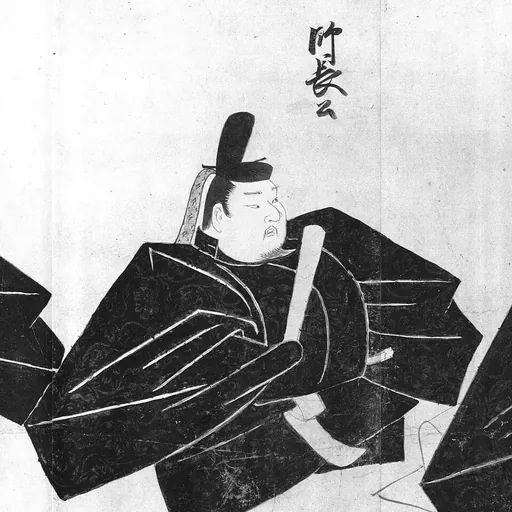
About Fujiwara no Moronaga
Lived 1138 – 1192 (aged 53–54). Fujiwara no Moronaga was a Japanese musician and kugyō.
Fujiwara no Moronaga was a Japanese politician, noble and musician during the Heian era. He was also known as Myo-On-In Daishokoku (Grand chancellor of Myo-On-In).
Life Moronaga was born into the northern branch of Fujiwara clan. He was the second son of Fujiwara no Yorinaga. He also retained a special relationship of "Quasi-son" with his grandfather Fujiwara no Tadajitsu. Thanks to this relationship with the ōdono Tadajistsu, Moronaga's political security was guaranteed and he was seen as one of the potential successor of the position of supreme chancellor Kanpaku.
In 1151, Moronaga was entered into the noble rank of Kugyo at the age of 14. In 1154, he was appointed the acting-middle counsellor. In 1156, Moronaga's father Yorinaga planned a rebellion against Emperor Go-Shirakawa and Fujiwara no Tadamichi. Historically, the rebellion was known as the Hōgen rebellion. The result of Yorinaga's rebellion was disastrous, he died during the rebellion while Moronaga was seen as a potential threat to the Japanese monarch. Consequently, Moronaga was exiled to Tosa province.
In 1164, Moronaga was allowed to return to Kyoto. Soon after his return, his noble rank was also restored. In 1177, Moronaga was promoted to the position of Daijō-daijin (chancellor). Quite unfortunately for Moronaga, he became a political enemy of the military strongman Taira no Kiyomori who initiated a coup d'état in 1179 and took over the power in Japan. He was dismissed together with Kanpaku Matsudono Motofusa and once more exiled. Later, he forfeited all his titles and became a Buddhist monk in Owari province. He died in Kyoto in 1192 when he was 55 years old.
Music Moronaga was a prominent musician of the Heian era. He was especially skillful at playing the koto and biwa. Sometime between 1179 and 1192 he wrote two large-scale musical treatises: Jinchi Yōroku『仁智要録』and Sango Yōroku『三五要録』, each of which contains numerous scores for instrumental and vocal works of Chinese and Korean origin dating back to the Tang Dynasty. In addition, he was a devoted worshiper of Benzaiten, the patron deity of musicians in Japanese Buddhism.
According to sinologist Rao Zongyi, Sango Yōroku contains some of the oldest surviving musical scores for the biwa.
Family Moronaga gave birth to three sons, one daughter and adopted one son from Fujiwara no Narichika. Fujiwara no Morotae Fujiwara no Moroyoshi Fujiwara no Narimune Chokaku A daughter whose name is unknown.
Don’t just read it —
keep it.
Full-length biographies made to live with: read them, listen on the way to work, watch them tonight.
- E-book
- Audio
- Video
Instant download · yours to keep · every purchase keeps this site free
Important facts
People in Fujiwara no Moronaga's life
Named in this biography and alive at the same time

Related people
Same field, nearest in time




Contemporaries
People whose lives overlapped Fujiwara no Moronaga's





Frequently asked questions
Who was Fujiwara no Moronaga?
12th Century Japanese Noble
When was Fujiwara no Moronaga born?
Fujiwara no Moronaga was born in 1138.
When did Fujiwara no Moronaga die?
Fujiwara no Moronaga died on 28 August 1192.
What was Fujiwara no Moronaga's occupation?
Fujiwara no Moronaga was a musician and kugyō.
What nationality was Fujiwara no Moronaga?
Fujiwara no Moronaga was Japanese.
Sources & further reading
· Wikipedia: Fujiwara no Moronaga
· DBpedia: Fujiwara no Moronaga
Cite this page
APA: Biography.guide. (2026). Fujiwara no Moronaga. https://biography.guide/fujiwara-no-moronaga/
MLA: "Fujiwara no Moronaga." Biography.guide, https://biography.guide/fujiwara-no-moronaga/.
Chicago: "Fujiwara no Moronaga." Biography.guide. https://biography.guide/fujiwara-no-moronaga/.
Data last updated: 2026-09-22 · Spot an error? Report a correction.
Portrait: Wikimedia Commons · author & licence
Page generated 2026-09-27 05:03 UTC