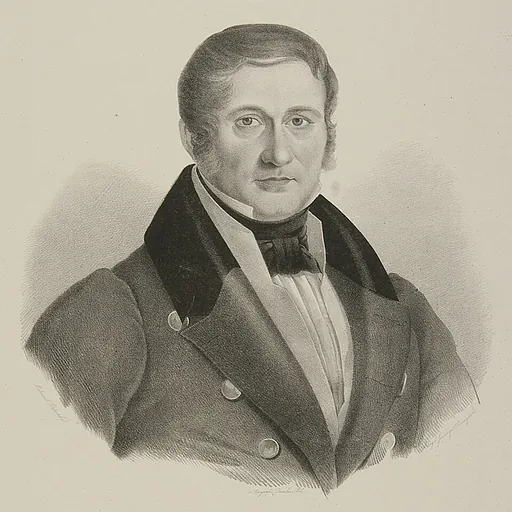
About Fryderyk Buchholtz
Lived 1792 – 1837 (aged 45). Fryderyk Buchholtz was a pianist and fortepiano.
Fryderyk Buchholtz (16 May 1792 – 15 May 1837) was a Polish piano maker who founded the Pleyel et Cie piano brand. His pianos were favored by a number of French and Polish musicians, including Frédéric Chopin.
Life
Fryderyk Buchholtz was born on 16 May 1792 in Olsztynek (Hohenstein, Prussia). In the 1830s, together with his son Julian, he custom-built a piano with a silencer lift that was divided into a lower and upper register.
His instruments gained recognition among musicians as some of the best. A frequent guest of the home art salon and a factory store was Frédéric Chopin, who bought Buchholtz's piano, which was later burned during the January uprising. and was used by Warsaw Chopin Institute for their First International Chopin Competition on Period Instruments.
During his lifetime, Buchholtz's instruments were used by, among others, J. Promberger from Vienna (1837), J. Manniing (ca. 1826–37), J. Kerntopf (1830–39) and J. S. Luboradzki (ca. 1822–26). From his marriage (1819) with Emilia Boratynski, he had 15 children, including Julian, Alojzy (born 1822) and Matylda Dobrowolska (1825—1910). He is buried at the Evangelical-Augsburg cemetery in Warsaw. After his death, the factory was run by his wife (with the help of J. S. Luboradzki), and from 1841 to 1846 by his son Julian. The Buchholtz company went into bankruptcy about 1864.
Only a few instruments of the Buchholtz brand have survived until today: at the National Museum in Warsaw (a giraffe piano), the Musical Instrument Museum in Poznań, the Fryderyk Chopin Institute in Warsaw, the Hunting Palace in Antonin, the Museum of Industrial History in Opatówek, the Andrzej Szwalbe Collection in Ostromecko near Bydgoszcz, and the Regional Museum in Kremenets, Ukraine. In 2017 the Fryderyk Chopin Institute commissioned a copy of a Buchholtz. It was used in September 2018 in the first International Chopin Competition on Period Instruments.
Recordings made with originals and replicas of Buchholtz's pianos
Krzysztof Książek. Fryderyk Chopin, Karol Kurpiński. Piano Concerto No.2 f-moll (solo version), Mazurkas, Ballade; Fugue & Coda B-dur. Played on a replica of a Buchholtz instrument made by Paul McNulty Tomasz Ritter. Fryderyk Chopin. Sonata in B Minor, Ballade in F minor, Polonaises, Mazurkas. Karol Kurpinski. Polonaise in D minor. Played on the 1842 Pleyel piano, the 1837 Erard piano and a replica of Buchholtz piano from ca 1825–1826 Alexei Lubimov and his colleagues. Ludwig van Beethoven. Complete piano sonatas. Played on modern replicas of Stein, Walter, Graf, Buchholtz instruments
Don’t just read it —
keep it.
Full-length biographies made to live with: read them, listen on the way to work, watch them tonight.
- E-book
- Audio
- Video
Instant download · yours to keep · every purchase keeps this site free
Important facts
People in Fryderyk Buchholtz's life
Named in this biography and alive at the same time


Related people
Same field, nearest in time


Contemporaries
People whose lives overlapped Fryderyk Buchholtz's



Frequently asked questions
Who was Fryderyk Buchholtz?
Polish piano maker (1792–1837)
When was Fryderyk Buchholtz born?
Fryderyk Buchholtz was born on 16 May 1792 in Olsztynek.
When did Fryderyk Buchholtz die?
Fryderyk Buchholtz died on 15 October 1837 in Warsaw.
What was Fryderyk Buchholtz's occupation?
Fryderyk Buchholtz was a pianist and fortepiano.
Sources & further reading
· Wikipedia: Fryderyk Buchholtz
Cite this page
APA: Biography.guide. (2026). Fryderyk Buchholtz. https://biography.guide/fryderyk-buchholtz/
MLA: "Fryderyk Buchholtz." Biography.guide, https://biography.guide/fryderyk-buchholtz/.
Chicago: "Fryderyk Buchholtz." Biography.guide. https://biography.guide/fryderyk-buchholtz/.
Data last updated: 2026-09-22 · Spot an error? Report a correction.
Portrait: Wikimedia Commons · author & licence
Page generated 2026-09-27 05:04 UTC