
About Fritz Johann Hansgirg
Lived 1891 – 1949 (aged 57–58). Fritz Johann Hansgirg was a chemist.
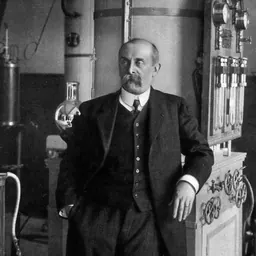
Fritz Johann Hansgirg (18911949) was an Austrian electrochemist and metallurgist who in 1928 invented a carbothermic magnesium reduction process. In 1934, he left Austria for the Empire of Japan where he worked with industrialist Shitagau Noguchi to set up a magnesium plant, and then helped build a pilot plant to produce heavy water using a combined electrolysis catalytic exchange process he had invented. He moved to the United States in 1940, where he worked with industrialist Henry J. Kaiser to design a magnesium plant in California. In 1941, Hansgirg was arrested by the FBI on a presidential warrant and interned for "the duration of the war". After the war, the Soviet Union captured Hansgirg's plants in northern Korea, using the plants' processes and equipment for their atomic bomb project.
Early life
Hansgirg was born in Graz, Austria in 1891 and received a PhD degree in chemistry from the University of Graz. Heller's son from her first marriage, Peter Robert Hofstätter, graduated from the University of Vienna, and served as a military psychologist in the German army during World War II. a carbothermic magnesium reduction process urged Hansgirg to sell the patent rights to the highest bidder. This he did in 1934, and then left Austria for the Empire of Japan. The pilot plant never worked at full strengthit took a lot of accessories, and working with magnesium requires sophisticated equipment and increased caution due to the reactivity of magnesium dust.
Empire of Japan
In 1934, Hansgirg arrived in the Empire of Japan where he worked with industrialist Shitagau Noguchi in what is now the northern Korean city of Hungnam. Noguchi (through his company Nichitsu) and Winter (American Magnesium Metals corporation) established a subsidiary Japanese magnesium company. Hansgirg took the post of vice president of both American and Japanese magnesium companies, but there were problems with financing. Hansgirg's work was not limited to magnesium. In 1936, he founded a new firm Nitehiuu gemstones, because of the increased demand for jewel bearings for military purposes. It is thought that Hansgirg helped the Japanese to produce heavy water in Hungnam, and was suspected by the United States of aiding the Japanese nuclear weapon program. By 1941, the first unit at Kaiser's plant was producing about of magnesium per day. However, instead of modifying the approach, PMC chemists found a new use for the magnesium dust. They invented a new incendiary mixture of "goop" – a paste of magnesium dust gelled with gasoline and additives, which could be used as a bomb. Government controls allowed PMC to price the "goop" in competition with napalm, and avoid large financial losses. By September 1943, only 10% of the dust was being used to produce magnesium as ingots. For the entire war period, PMC issued 20 million lbs. of magnesium and 86 million lbs. of "goop". The proportion of incendiary bombs with "goop" constituted about 8% of the total tonnage of incendiary devices used in the bombing of Japan and Germany. After the war, the Permanente plant was halted, and at the end of 1945 Kaiser repaid his credits.
After arrest, Hansgirg was first held in jail in Santa Clara County, California, and later at U.S. alien internment camps in San Antonio, Texas and Stringtown, Oklahoma. This resulted in Hansgirg being released under parole to Theodore Dreier, the treasurer of Black Mountain College, a progressive experimental educational community in North Carolina. Hansgirg was appointed as chemistry professor to replace Charles Lindsley, who took a position with the US department of defense doing research for the war department in 1942. This decision was taken on the advice of Austrian scientist Karl Terzaghi. Hansgirg's parolee sponsorship was transferred in 1943 to Dr. W. R. Wunsch, another employee at Black Mountain College, and then to Isaac Van Horn in July 1944. Later in the same year, he developed a modified method of magnesium production that used calcium carbide as a reducing agent. Hansgirg created and applied for patents under the name of the North Carolina Magnesium Development Corporation, and gave 20% of the shares of this business to the college.
Although many of his colleagues had fled Europe during the rise of fascism, Hansgirg was the only Black Mountain College community member with "enemy alien" status. He was known for letting the college community use his grand piano, his organ, his photographic equipment and his extensive collection of opera recordings. He was also one of the few faculty with personal wealth, and provided champagne and strawberries for special celebrations.
In September 1948, the building that housed Hansgirg's equipment and experiments burned down in a fire rumored to have been the result of a fellow faculty member's vodka still.
Death After Black Mountain College, Hansgirg moved to New York. There he worked as chief engineer for the Electro-Metal Corporation and the Bach Corporation, and provided consulting services to the Standard Oil Company of New Jersey. but is suspected to be related to his decades of ingestion of magnesium, resulting in hypermagnesemia. Many aspects of the postwar history related to both the U.S. and Soviet (now Russian) use of Hansgirg's processes remain classified.
Don’t just read it —
keep it.
Full-length biographies made to live with: read them, listen on the way to work, watch them tonight.
- E-book
- Audio
- Video
Instant download · yours to keep · every purchase keeps this site free
Important facts
People in Fritz Johann Hansgirg's life
Named in this biography and alive at the same time

Related people
Same field, nearest in time



Contemporaries
People whose lives overlapped Fritz Johann Hansgirg's




Frequently asked questions
Who was Fritz Johann Hansgirg?
Austrian electrochemist and metallurgist
When was Fritz Johann Hansgirg born?
Fritz Johann Hansgirg was born in 1891 in Graz.
When did Fritz Johann Hansgirg die?
Fritz Johann Hansgirg died on 23 July 1949 in New York City.
What was Fritz Johann Hansgirg's occupation?
Fritz Johann Hansgirg was a chemist.
Sources & further reading
· Wikipedia: Fritz Johann Hansgirg
· DBpedia: Fritz Johann Hansgirg
Cite this page
APA: Biography.guide. (2026). Fritz Johann Hansgirg. https://biography.guide/fritz-johann-hansgirg/
MLA: "Fritz Johann Hansgirg." Biography.guide, https://biography.guide/fritz-johann-hansgirg/.
Chicago: "Fritz Johann Hansgirg." Biography.guide. https://biography.guide/fritz-johann-hansgirg/.
Data last updated: 2026-09-20 · Spot an error? Report a correction.
Page generated 2026-09-27 05:01 UTC