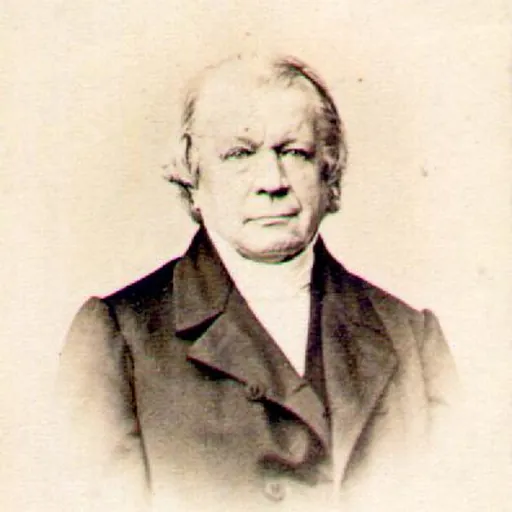
About Friedrich Wilhelm Krummacher
Lived 1796 – 1868 (aged 71–72). Friedrich Wilhelm Krummacher was a German court chaplain, parson and protestant theologian.
Friedrich Wilhelm Krummacher (born in Moers, France (now Germany), 28 January 1796; died in Potsdam, Prussia (now Germany), 10 December 1868) was a German Reformed clergyman.
Biography His father, Friedrich Adolf Krummacher, was a noted German theologian and writer, and his uncle, also a German theologian, was Gottfried Daniel Krummacher. The son, after attending the gymnasiums in Duisburg and Bernburg, studied theology at Halle and Jena, and became pastor successively at Frankfurt am Main (1819), Ruhrort (1823), Gemarke, near Barmen (1825), and Elberfeld (1834). He came to New York in 1843, declined a theological professorship in Mercersburg, Pennsylvania, and afterward returned to Germany, eventually settling in Berlin, Prussia. In 1847, the Evangelical State Church in Prussia appointed him to the Trinity Church in Berlin, and in 1853 he became court chaplain at Potsdam. He was an influential promoter of the Evangelical Alliance. Although a minister of the Reformed Church, he was a zealous advocate of the older Lutheranism, and gave great offence by his denunciation of rationalists. He was a regular participant of the Evangelical Church Conferences.
His sermons on the prophet Elijah inspired the composer Felix Mendelssohn to write his 1846 choral work Elijah (oratorio).
Literary works Among his numerous works, many of which have been translated into English and Dutch, are: Salomo und Sulamith (1827, 9th ed. 1875) Flying Roll of Free Grace Displayed (New York, 1841) Elijah the Tishbite (; 1828-1833; 6th ed. 1874; Eng. trans. 1838) The Martyr Lamb (1849) The Last Days of Elisha (; 1852) The Risen Redeemer (1863) The Suffering Saviour (; 1854, Eng. trans. 1870) Bunsen and Stahl (Berlin, 1856) The Dew of Israel and the Lily of God, Or, A Glimpse of the Kingdom of Grace Christ in the Wilderness The Beheading of John the Baptist The Church's Voice of Instruction
Among his later devotional works are: Gottes Wort (Berlin, 1865) David, der König von Israel (1866; English translation, 1870)
His sermons were published (Berlin, 1868), and his autobiography (1869) edited by his daughter, which was translated into English (London, 1871).
Don’t just read it —
keep it.
Full-length biographies made to live with: read them, listen on the way to work, watch them tonight.
- E-book
- Audio
- Video
Instant download · yours to keep · every purchase keeps this site free
Important facts
People in Friedrich Wilhelm Krummacher's life
Named in this biography and alive at the same time


Related people
Same field, nearest in time



Contemporaries
People whose lives overlapped Friedrich Wilhelm Krummacher's






Frequently asked questions
Who was Friedrich Wilhelm Krummacher?
German clergyman (1796–1868)
When was Friedrich Wilhelm Krummacher born?
Friedrich Wilhelm Krummacher was born in 1796 in Moers.
When did Friedrich Wilhelm Krummacher die?
Friedrich Wilhelm Krummacher died on 10 December 1868 in Potsdam.
What was Friedrich Wilhelm Krummacher's occupation?
Friedrich Wilhelm Krummacher was a court chaplain, parson and protestant theologian.
What nationality was Friedrich Wilhelm Krummacher?
Friedrich Wilhelm Krummacher was German.
Sources & further reading
· Wikipedia: Friedrich Wilhelm Krummacher
· DBpedia: Friedrich Wilhelm Krummacher
Cite this page
APA: Biography.guide. (2026). Friedrich Wilhelm Krummacher. https://biography.guide/friedrich-wilhelm-krummacher/
MLA: "Friedrich Wilhelm Krummacher." Biography.guide, https://biography.guide/friedrich-wilhelm-krummacher/.
Chicago: "Friedrich Wilhelm Krummacher." Biography.guide. https://biography.guide/friedrich-wilhelm-krummacher/.
Data last updated: 2026-09-23 · Spot an error? Report a correction.
Portrait: Wikimedia Commons · author & licence
Page generated 2026-09-27 05:07 UTC