
Friedrich Ludwig Jahn
German educator, writer and politician
About Friedrich Ludwig Jahn
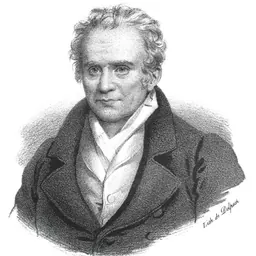
Lived 1778 – 1853 (aged 75). Friedrich Ludwig Jahn was a German pedagogue, teacher, politician, gymnast, writer and opinion journalist.
(; 11August 177815October 1852) was a German gymnastics educator and nationalist whose writing is credited with the founding of the German gymnastics (Turner) movement, first realized at Volkspark Hasenheide in Berlin, the origin of modern sports clubs, as well as influencing the German Campaign of 1813, during which a coalition of German states effectively ended the occupation by Napoleon's First French Empire. His admirers know him as , roughly meaning "Father of Gymnastics ". Jahn invented the parallel bars, rings, high bar, the pommel horse and the vault horse.
Life was born in the village of in Brandenburg, Prussia. He studied theology and philology from 1796 to 1802 at the universities in , , and . After the Battle of Jena–Auerstedt in 1806, he joined the Prussian army. In 1809, he went to Berlin where he became a teacher at the and at the Plamann School.
Brooding upon what he saw as the humiliation of his native land by Napoleon, conceived the idea of restoring the spirits of his countrymen by the development of their physical and moral powers through the practice of gymnastics. in 1811, and the (gymnastics association) movement spread rapidly. The conflict resulted in the closing of the in 1819 and arrest. Kept in semi-confinement successively at , and at the fortress in Kolberg until 1824, Follen opened the first college gymnasium and the first public gymnasium in the US in Massachusetts in 1826 at Harvard College and in nearby Boston, respectively.
A memorial to exists in St. Louis, Missouri, within its Forest Park. It features a large bust of in the center of an arc of stone, with statues of a male and female gymnast, one on each end of the arc. The monument is on the edge of Art Hill next to the path running north and south along the western edge of Post-Dispatch Lake. It is directly north of the St. Louis Zoo. On the plaque below his bronze bust, is given credit as "The Father of Systematic Physical Culture".
Other memorials to are located in , Germany; Vienna; and Cincinnati, Ohio's Inwood Park in the Mount Auburn Historic District. An elementary school in Chicago, is named after .
Criticism
In his own time was seen by both supporters and opponents as a liberal figure. He advocated that the German states should unite after the withdrawal of Napoleon's occupying armies and establish a democratic constitution under the monarchy, which would include the right to free speech. As a German nationalist, advocated maintaining German language and culture against foreign influence. In 1810 he wrote, "Poles, French, priests, aristocrats and Jews are Germany's misfortune." At the time wrote this, the German states were occupied by foreign armies under the leadership of Napoleon. Also, was "the guiding spirit" of the fanatic book burning episode carried out by revolutionary students at the Wartburg festival in 1817.
Scholarly focus on the of thought started in the 1920s with a new generation of interpreters like and . explicitly linked with National Socialism. The equation by the National Socialists of ideas with their world view was more or less complete by the mid-1930s. in which he characterized invention of gymnastics as an explicitly political project, designed to create the ultimate citizen by educating his body. claimed was the spiritual founder of Nazism who inspired early German romantics with anti-Semitic and authoritarian doctrines, influencing and finally, the Nazis. In a review of Viereck's book observed that portrait of cultural trends supposedly leading to Nazism was "a caricature without resemblance" relying on "misleading shortcuts." response in the same issue points out that it is clear from remarks that did not read far into the book.
Don’t just read it —
keep it.
Full-length biographies made to live with: read them, listen on the way to work, watch them tonight.
- E-book
- Audio
- Video
Instant download · yours to keep · every purchase keeps this site free
Important facts
People in Friedrich Ludwig Jahn's life
Named in this biography and alive at the same time
Related people
Same field, nearest in time



Contemporaries
People whose lives overlapped Friedrich Ludwig Jahn's



Frequently asked questions
Who was Friedrich Ludwig Jahn?
German educator, writer and politician (1778-1852)
When was Friedrich Ludwig Jahn born?
Friedrich Ludwig Jahn was born on 11 August 1778 in Lanz.
When did Friedrich Ludwig Jahn die?
Friedrich Ludwig Jahn died on 15 October 1853 in Freyburg.
What was Friedrich Ludwig Jahn's occupation?
Friedrich Ludwig Jahn was a pedagogue, teacher, politician, gymnast, writer and opinion journalist.
What nationality was Friedrich Ludwig Jahn?
Friedrich Ludwig Jahn was German.
Sources & further reading
· Wikipedia: Friedrich Ludwig Jahn
· DBpedia: Friedrich Ludwig Jahn
Cite this page
APA: Biography.guide. (2026). Friedrich Ludwig Jahn. https://biography.guide/friedrich-ludwig-jahn/
MLA: "Friedrich Ludwig Jahn." Biography.guide, https://biography.guide/friedrich-ludwig-jahn/.
Chicago: "Friedrich Ludwig Jahn." Biography.guide. https://biography.guide/friedrich-ludwig-jahn/.
Data last updated: 2026-09-20 · Spot an error? Report a correction.
Page generated 2026-09-27 05:17 UTC