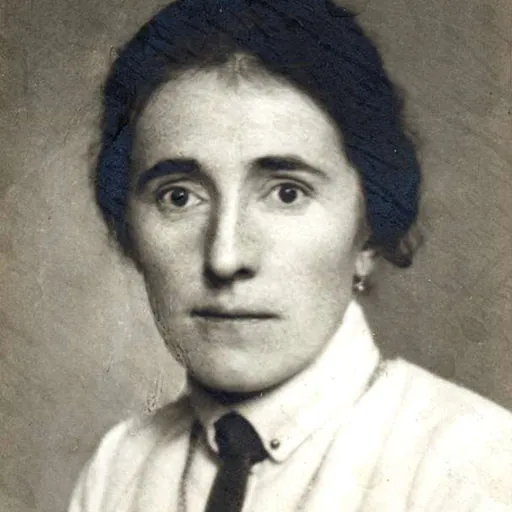
About Frieda Unger
Lived 1888 – 1975 (aged 86). Frieda Unger was a German politician and resistance fighter.
Frieda Unger (born Frieda Eckert; 9 July 1888 – 12 April 1975) was a German activist and politician (SPD, USPD, KPD) who served as a member of the Parliament ("Landtag") of Baden. Her candidacy for the national parliament ("Reichstag") was not successful, however.
Life Frieda Eckert was born in Schopfheim in the south-west of Germany. Her father is described variously as a smallholder Karl Eckert died when Frieda was three after which she grew up in Schopfheim with her grandparents. The High Court in Leipzig found her guilty and sentenced her to a two and a half jail term on account of her part in the political unrest two and a half years earlier. Vorwärts, the party newspaper of the SPD (party), commented that it was a harsh sentence, which was to be expected in the case of a communist. She was sent to the Bruchsal penitentiary to serve out her sentence. Her early release on 1 October 1927 resulted from a presidential amnesty as the authorities attempted to reintegrate political activists who had been arrested during the troubled first half of the 1920s back into the political mainstream. However, there was no longer any role made available to her within the local Communist Party.
In July 1925 Frieda Unger's marriage to Karl Hauser had ended in divorce, and on 20 November 1926 she had married Max Haas, who had also been a participant in the failed 1923 uprising. He was from Lahr, and for the next few years the two of them ran a kiosk in the town. In 1930 they moved to Berlin. There she worked in the city centre as a district leader for the "National Association of Workplace Invalidity Victims" ("Zentralverband der Arbeitsinvaliden"). The political context changed abruptly after January 1933 when the Nazis took power and lost no time in transforming Germany into a one-party dictatorship. After the Reichstag fire at the end of February 1933, those with a political past involving the (now banned) Communist Party found themselves at the top of the government's target list. Many were arrested (or worse) or fled abroad. Frieda Haas nevertheless continued to associate with politically like minded comrades: specifically, her apartment became a meeting point for Communist resistance members. Nevertheless, other sources, apparently based on information provided by Frieda Haas herself at the end of her life, indicate a conscious decision on her part to keep out of politics during the Nazi years.
In 1937 the resistance group with which she was associated was broken up and Frieda Haas spent eight months in detention, arrested by the Gestapo and held in "protective detention" by the police for two or three months before transferred to the large investigatory penitentiary at Berlin-Moabit. before being released. Around this time Max Haas was conscripted into the army. According to one source she was arrested again, possibly more than once, and incarcerated by the Gestapo for terms of several months.
War and the Nazi regime ended in May 1945, with the western two thirds of Germany divided into four military areas of occupation. A large region surrounding Berlin, including the eastern part of the city itself, was now administered as the Soviet occupation zone. It was here that Frieda Haas now made her home. Edwin Hoernle found her work as an instructor with the National Administration for Agriculture and Forestry, where she worked between 1945 and 1948 or 1950, becoming a department head. With the reform of land ownership high on the political agenda, there was much to be done. She was also a member of the National Executive ("Zentralvorstand") of what is sometimes translated as the Peasants Mutual Aid Association ("Vereinigung der gegenseitigen Bauernhilfe" / VdgB).
As a pensioner, from 1950 she served for several years on the national executive of the Democratic Women's League ("Demokratischer Frauenbund Deutschlands" / DFD). She also led a National Front district residents' group in Berlin-Johannisthal until 1968. However, on reaching her seventieth birthday she withdrew completely from public life in 1968 on health grounds.
Frieda Haas died in East Berlin on 13 April 1975.
Awards and honours 1968 Patriotic Order of Merit in silver.
At the instigation of the Women's advisory board the municipal council in Lahr passed a resolution on 18 December 2006 as a result of which a memorial tablet commemorating Frieda Unger was set up at the Luisenschule (primary school). The decision was contentious, supported by the votes of 16 councillors, with 12 opposing it and one abstention.
Don’t just read it —
keep it.
Full-length biographies made to live with: read them, listen on the way to work, watch them tonight.
- E-book
- Audio
- Video
Instant download · yours to keep · every purchase keeps this site free
Important facts
People in Frieda Unger's life
Named in this biography and alive at the same time

Related people
Same field, nearest in time






Contemporaries
People whose lives overlapped Frieda Unger's


Frequently asked questions
Who was Frieda Unger?
German politician (1888-1975)
When was Frieda Unger born?
Frieda Unger was born on 9 July 1888 in Schopfheim.
When did Frieda Unger die?
Frieda Unger died on 12 April 1975 in Berlin.
What was Frieda Unger's occupation?
Frieda Unger was a politician and resistance fighter.
What nationality was Frieda Unger?
Frieda Unger was German.
Sources & further reading
Cite this page
APA: Biography.guide. (2026). Frieda Unger. https://biography.guide/frieda-unger/
MLA: "Frieda Unger." Biography.guide, https://biography.guide/frieda-unger/.
Chicago: "Frieda Unger." Biography.guide. https://biography.guide/frieda-unger/.
Data last updated: 2026-09-23 · Spot an error? Report a correction.
Portrait: Wikimedia Commons · author & licence
Page generated 2026-09-27 05:07 UTC