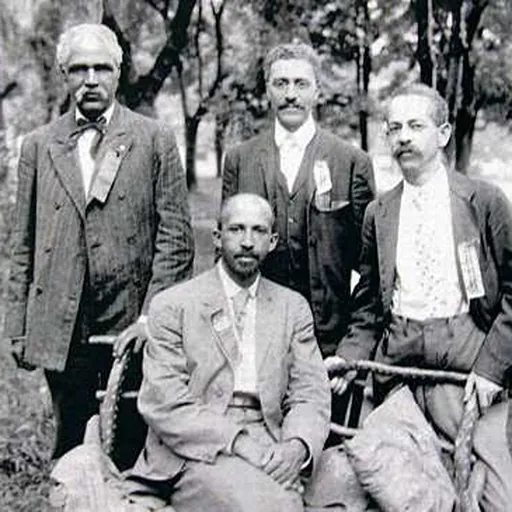
Freeman H. M. Murray
Civil rights activist, and journalist in Washington D.C
About Freeman H. M. Murray
Lived 1859 – 1950 (aged 90). Freeman H. M. Murray was an American publisher, journalist, activist and book printer.
Freeman H. M. Murray (September 22, 1859 - February 20, 1950) was an intellectual, civil rights activist, and journalist in Washington D.C. and Alexandria, Virginia. He was active in promoting black home-ownership, opposing Jim Crow laws and lynching, and supporting positive representation of African Americans in public art. He was a founding member of the Niagara Movement and was an editor of its journal, the Horizon, along with W. E. B. Du Bois and Lafayette M. Hershaw. Alongside his other work, Murray was an important intellectual leader and wrote an influential book of art criticism. In this, Murray was one of the first historians of African American art. His work expressed a desire that art take seriously the representation of African Americans and that slavery not be overlooked in favor of representation of heroes and glory in public art.
Personal life Freeman Henry Morris Murray was born September 22, 1859, in Cleveland, Ohio. His father was John M. Murray and was of Scottish descent and was disowned by his family for marrying a black woman. His mother was Martha Bently, whose father was Irish and mother was Native American and African American. The couple owned a tailoring business in Cleveland. After his father died, his mother moved the family to Cincinnati, Ohio. After primary school, Murray attended Mount Pleasant Academy to train to be a teacher, one of three black students. He graduated from the academy in 1875. Murray was a bibliophile and learned French and Latin while continuing to work with his mother's father, Daniel Bentley in his whitewashing and painting business. Soon, Murray moved to Covington, Kentucky, to take a job teaching. He also took an apprenticeship for the Cincinnati Enquirer where he gained editing and publishing experience.
Women at the 1906 Niagara Movement Conference at Harpers Ferry: Mrs. Gertrude Wright Morgan (seated) and (left to right) Mrs. O.M. Waller, Mrs. F.H.M. Murray, Mrs. Mollie Lewis Kelan, Mrs. Ida D. Bailey, Miss Sadie Shorter, and Mrs. Charlotte Hershaw. In 1883, Murray married Laura Hamilton. They had five children. One daughter, Kathleen Paige Murray, worked for the Niagara Movement. In 1898 his daughter, Mary Vivian, and his wife died of tuberculosis. On September 1, 1898, Murray married his live-in nanny and mistress, Delilah and died two days later on February 20, 1950, in Washington, DC. In December 1891, Murray, Rev. H. H. Warring and Rev. Porter were elected by a group of Alexandria blacks to oppose segregated coach laws before the Virginia Legislature in Richmond.
Murray ran a newspaper called the Home News and was Washington correspondent for Trotter's Boston Guardian, as well as writing for many other newspapers and journals. Murray's position at the Guardian begane in January 1909. In the 1910s, Murray was an officer for the American Negro Academy. He also founded another paper, the Washington Tribune. He was a prominent member of the movement, giving the opening address at the second national meeting of the group in August 1906 at Harpers Ferry. The Niagara Movement was a forerunner of the N.A.A.C.P.
In 1907 Murray and others were rallying opposition to Booker T. Washington's Tuskegee Institute and Theodore Roosevelt in the black press. Washington sent his assistant, New York Customs Agent Charles W. Anderson to suggest action against the radicals to Roosevelt. Anderson opposed the idea of Niagara movement members holding federal jobs and succeeded at convincing President Roosevelt that Murray should be demoted.
The Horizon In order to publicize the views of the Niagara Movement, Du Bois, Hershaw, and F. H. M. Murray began publication of the magazine, "The Horizon". Hershaw's most frequent contribution to Horizon was a column called "The Out-Look", a view of the black experience from the perspective of the white world, while Murray contributed "The In-Look" about the black experience from the view of black and the black press and Du Bois wrote "The Over-Look" about any issue in the black experience he felt necessary. Murray's "the In-Look" often criticized less radical positions of Booker T. Washington and his followers. The paper was not always in perfect harmony, and Hershaw and Murray frequently fought over material to be included in the "Horizon". and Trotter left the journal and the movement. Seeking greater radicalism, Trotter created the Negro American Political League. He wrote an influential book, Emancipation and the Freed American in Sculpture in 1916 where he discussed the role of African Americans in sculpture. Murray advocated advances in African American culture and art.
Later in life
Later in his life he organized and directed the Alexandria Dramatic Club. He also was a religious leader and educator in Alexandria. He was the head of the primary Sunday School of Roberts Chapel Methodist Church, where he also taught.
Don’t just read it —
keep it.
Full-length biographies made to live with: read them, listen on the way to work, watch them tonight.
- E-book
- Audio
- Video
Instant download · yours to keep · every purchase keeps this site free
Important facts
People in Freeman H. M. Murray's life
Named in this biography and alive at the same time




Related people
Same field, nearest in time
Contemporaries
People whose lives overlapped Freeman H. M. Murray's

Frequently asked questions
Who was Freeman H. M. Murray?
civil rights activist, and journalist in Washington D.C
When was Freeman H. M. Murray born?
Freeman H. M. Murray was born on 22 September 1859 in Cleveland.
When did Freeman H. M. Murray die?
Freeman H. M. Murray died on 20 February 1950 in Washington, D.C..
What was Freeman H. M. Murray's occupation?
Freeman H. M. Murray was a publisher, journalist, activist and book printer.
What nationality was Freeman H. M. Murray?
Freeman H. M. Murray was American.
Sources & further reading
· Wikipedia: Freeman H. M. Murray
· DBpedia: Freeman H. M. Murray
Cite this page
APA: Biography.guide. (2026). Freeman H. M. Murray. https://biography.guide/freeman-h-m-murray/
MLA: "Freeman H. M. Murray." Biography.guide, https://biography.guide/freeman-h-m-murray/.
Chicago: "Freeman H. M. Murray." Biography.guide. https://biography.guide/freeman-h-m-murray/.
Data last updated: 2026-09-24 · Spot an error? Report a correction.
Portrait: Wikimedia Commons · author & licence
Page generated 2026-09-27 05:09 UTC