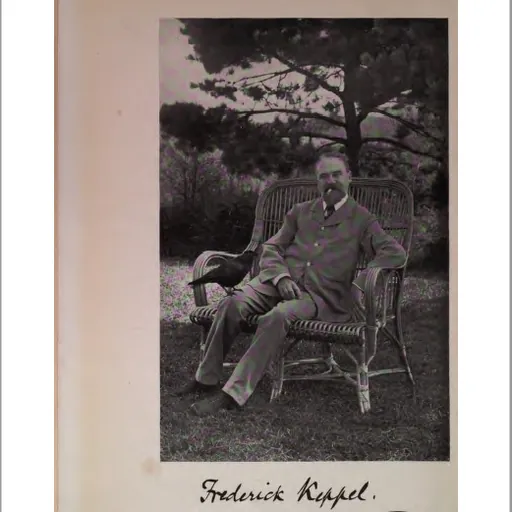
About Frederick Keppel
Lived 1845 – 1912 (aged 66–67). Frederick Keppel was an American art dealer.
Frederick Keppel (1845–1912) was an American art dealer, scholar, writer, owner and founder of Frederick Keppel & Company. Keppel came to America in 1864 and became a print dealer in 1868. He was a patron and promoter of the Etching Revival and etchers including Whistler, Zorn, Buhot and Pennell. He gave Félix-Hilaire Buhot his first one-man show in 1888, and about the same time started to buy and sell a large number of Whistler's prints.
Early life Keppel was born in Tullow in County Carlow in Ireland in 1845. Keppel was educated at Wesley College in Dublin. His family left Ireland when he was a teenager, going first to Ontario, ultimately settling in New York in 1864. He began his career as a bookseller. He became interested in prints after being introduced to John S. Philips, a major Philadelphia collector of European prints and drawings.
Frederick Keppel & Company Keppel established his firm, Frederick Keppel & Company at 20 E 16th Street in 1868. There he sold etchings and engravings by the Old Masters and works by Modern artists, such as Jean-François Millet, Félix Buhot, James McNeil Whistler, Edith Loring Getchell and Joseph Pennell. In 1905, Keppel & Company moved uptown to 4 E. 39th Street. The firm moved again in the 1920s to 16 E. 57th Street. Keppel was known throughout his career for his personal relationships with artists. His friendships with artists such as James McNeil Whistler and Jean-François Millet. Keppel sold prints to major New York collectors such as Samuel P. Avery, Atherton Curtis and Mary Jane Morgan. After his death in 1912, Keppel's son David Keppel (1877–1956) inherited the business, acting as its president until 1940. In 1940, Keppel & Co. merged with Arthur Harlow & Co. to form Harlow, Keppel & Co. located at 670 5th Avenue.
Legacy William Macbeth started his career at Frederick Keppel & Co., eventually becoming a partner. He left in 1892 to establish the Macbeth Gallery, which specialized in American Art. Carl Zigrosser, who became the Philadelphia Museum of Art Curator of Drawings, was first employed by Frederick Keppel & Co. He wrote articles and pamphlets to accompany exhibitions at his gallery, and often gave lectures on subjects related to prints. Keppel co-founded the Print Collector’s Quarterly in 1911, a publication devoted entirely to the subject of print collecting. He was involved in the Etching Revival movement.
Don’t just read it —
keep it.
Full-length biographies made to live with: read them, listen on the way to work, watch them tonight.
- E-book
- Audio
- Video
Instant download · yours to keep · every purchase keeps this site free
Important facts
People in Frederick Keppel's life
Named in this biography and alive at the same time




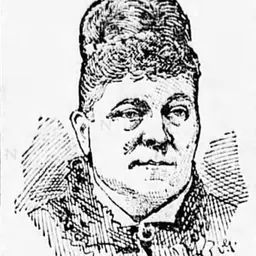
Related people
Same field, nearest in time

Contemporaries
People whose lives overlapped Frederick Keppel's


Frequently asked questions
Who was Frederick Keppel?
art dealer
When was Frederick Keppel born?
Frederick Keppel was born in 1845 in Tullow.
When did Frederick Keppel die?
Frederick Keppel died in 1912 in New York City.
What was Frederick Keppel's occupation?
Frederick Keppel was an art dealer.
What nationality was Frederick Keppel?
Frederick Keppel was American.
Sources & further reading
· DBpedia: Frederick Keppel (art dealer)
Cite this page
APA: Biography.guide. (2026). Frederick Keppel. https://biography.guide/frederick-keppel-art-dealer/
MLA: "Frederick Keppel." Biography.guide, https://biography.guide/frederick-keppel-art-dealer/.
Chicago: "Frederick Keppel." Biography.guide. https://biography.guide/frederick-keppel-art-dealer/.
Data last updated: 2026-09-23 · Spot an error? Report a correction.
Portrait: Wikimedia Commons · author & licence
Page generated 2026-09-27 05:07 UTC