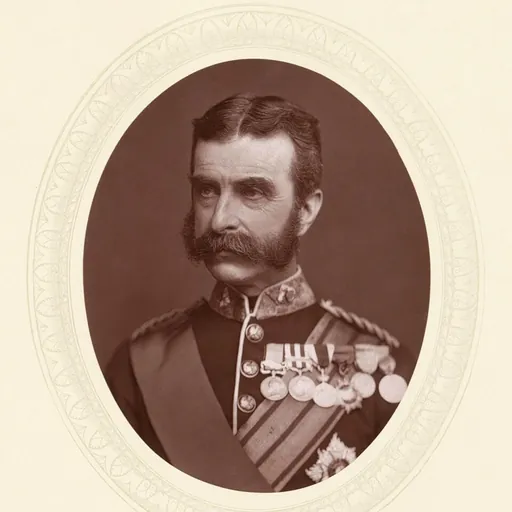
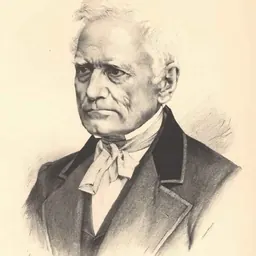
Frederic Thesiger, 2nd Baron Chelmsford
British Army general
About Frederic Thesiger, 2nd Baron Chelmsford
Lived 1827 – 1905 (aged 77). Frederic Thesiger, 2nd Baron Chelmsford was a British politician, military officer, soldier, colonel and lieutenant of the Tower of London.
General Frederic Augustus Thesiger, 2nd Baron Chelmsford, (31 May 18279 April 1905) was a British Army officer who rose to prominence during the Anglo-Zulu War, when an expeditionary force under his command suffered a decisive defeat at the hands of a Zulu force at the Battle of Isandlwana in 1879. Despite this defeat, he was able to score several victories against the Zulus, culminating in the decisive British victory at the Battle of Ulundi, which ended the war and partly restored his reputation in Britain.
Early life Frederic Augustus Thesiger was born 31 May 1827, the eldest child of Frederic Thesiger, a lawyer who later became Lord Chancellor and was created Baron Chelmsford. Thesiger was educated at Eton College. His invasion plans changed, with two columns being held in defensive positions, and a British expeditionary force under the command of Chelmsford invaded the Zulu Kingdom, heading in three columns towards the Zulu capital, Ulundi. The force was attacked by a Zulu force at Isandlwana, during which the Zulus overran and destroyed the central column of Chelmsford's separated forces which had been left under the command of Lieutenant Colonel Pulleine. The engagement was an unexpected victory for the Zulus, which threw British war plans into disarray. The total number killed was: 1,300+ killed: · 52 officers · 690 British regulars · 476 others including: · 343 African Natal Native Contingent troops · 133 European Colonial troops. The portion of the column which had left Isandlwana prior to the attack under Chelmsfod's command reached the scene of the defeat after dark. They observed the glowing of fire from Rorke's Drift, where another battle was taking place, but Chelmsford ordered the column to get what sleep they could. The next day, Chelmsford and his tropps marched back to Rorke's Drift, where they learned that the garrison there had held out successfully. Following the defeat at Isandlwana, Chelmsford's command retreated across the border, with Chelmsford sending a despatch to Colonel Charles Pearson to inform him that his number 1 column could not expect support and that an attack by the full force of the Zulu army could come at any time. When he reached Pietermaritzburg, Chelmsford sent a message to inform the government of the defeat at Isandlwana and to request reinforcements for a new invasion into Zululand. Many more reinforcements than he had requested were sent, and they began to arrive in Durban in March.
Afterwards, the British government, anxious to avoid the Zulus threatening Natal, issued orders for the hasty relief of Chelmsford of his command and for him to be replaced with Sir Garnet Wolseley. However, this order could not be implemented until the arrival of Wolseley, and in the meantime, Chelmsford ignored diplomatic overtures from King Cetshwayo and made plans to capture Ulundi, aiming to defeat them in a decisive engagement and salvage his reputation before Wolseley's arrival. The advance to relieve the Siege of Eshowe was hampered by bad weather conditions which had particularly negative effects on the troops as Chelmsford had ordered, intending to reduce the size of the wagon train, that no tents be brought along for the men and that they should instead sleep underneath the wagons. In late May, hoping to draw Zulu forces and to prevent them from attacking the right flank of the 2nd Division when it began its advance, Chelmsford ordered all forces along the border to launch raids into Zululand. The Battle of Ulundi took place on 4 July 1879, being the last major battle of the Anglo-Zulu War. After a half-hour bombardment by the Royal Artillery, of which there were 12 guns, Chelmsford attacked a Zulu army massed at Ulundi, making full use of concentrated small arms fire from Gatling guns and rifles, leading to the destruction of the Zulu force. The British Army's casualties, after the sharp but brief engagement was ten killed and eighty-seven wounded, in exchange for nearly sixty times that number of Zulu dead. quotes the London Standard reporting 473 counted dead and another 1000 or more wounded. Chelmsford ordered Ulundi to be burnt, after which he handed over command to Wolseley on 15 July at the fort at St. Paul's and left South Africa by ship for England two days later. The defeat of the Zulus at Ulundi allowed Chelmsford to partially recover his military prestige after the disaster at Isandlwana, and he was honoured as a Knight Grand Cross of the Order of the Bath. However, he was severely criticised by a subsequent enquiry launched by the British Army into the events that had led to the Isandlwana debacle, and did not serve in the field again.
Later career Lord Chelmsford became lieutenant general in 1882, lieutenant of the Tower of London (1884 until 1889), colonel of the 4th (West London) Rifle Volunteer Corps (1887), full general (1888), and colonel of the Derbyshire Regiment (1889). He exchanged the colonelcy of the Derbyshires for that of the 2nd Life Guards (1900), and as such was Gold Stick in Waiting during ceremonial events at Court. King Edward VII appointed him Knight Grand Cross of the Royal Victorian Order (GCVO) in the November 1902 Birthday Honours list, and he was invested with the insignia by the King at Buckingham Palace on 18 December 1902. He was the inaugural Governor and Commandant of the Church Lads' Brigade, a post he retained until his death.
In popular culture Peter O'Toole portrayed Chelmsford in the film Zulu Dawn (1979), which depicted the events at the Battle of Isandlwana.
Don’t just read it —
keep it.
Full-length biographies made to live with: read them, listen on the way to work, watch them tonight.
- E-book
- Audio
- Video
Instant download · yours to keep · every purchase keeps this site free
Important facts
People in Frederic Thesiger, 2nd Baron Chelmsford's life
Named in this biography and alive at the same time

Related people
Same field, nearest in time



Contemporaries
People whose lives overlapped Frederic Thesiger, 2nd Baron Chelmsford's




Frequently asked questions
Who was Frederic Thesiger, 2nd Baron Chelmsford?
British Army general (1827-1905)
When was Frederic Thesiger, 2nd Baron Chelmsford born?
Frederic Thesiger, 2nd Baron Chelmsford was born on 31 May 1827 in Derby.
When did Frederic Thesiger, 2nd Baron Chelmsford die?
Frederic Thesiger, 2nd Baron Chelmsford died on 9 April 1905 in Westminster.
What was Frederic Thesiger, 2nd Baron Chelmsford's occupation?
Frederic Thesiger, 2nd Baron Chelmsford was a politician, military officer, soldier, colonel and lieutenant of the Tower of London.
What nationality was Frederic Thesiger, 2nd Baron Chelmsford?
Frederic Thesiger, 2nd Baron Chelmsford was British.
Sources & further reading
· Wikipedia: Frederic Thesiger, 2nd Baron Chelmsford
· DBpedia: Frederic Thesiger, 2nd Baron Chelmsford
Cite this page
APA: Biography.guide. (2026). Frederic Thesiger, 2nd Baron Chelmsford. https://biography.guide/frederic-thesiger-2nd-baron-chelmsford/
MLA: "Frederic Thesiger, 2nd Baron Chelmsford." Biography.guide, https://biography.guide/frederic-thesiger-2nd-baron-chelmsford/.
Chicago: "Frederic Thesiger, 2nd Baron Chelmsford." Biography.guide. https://biography.guide/frederic-thesiger-2nd-baron-chelmsford/.
Data last updated: 2026-09-21 · Spot an error? Report a correction.
Portrait: Wikimedia Commons · author & licence
Page generated 2026-09-27 05:00 UTC