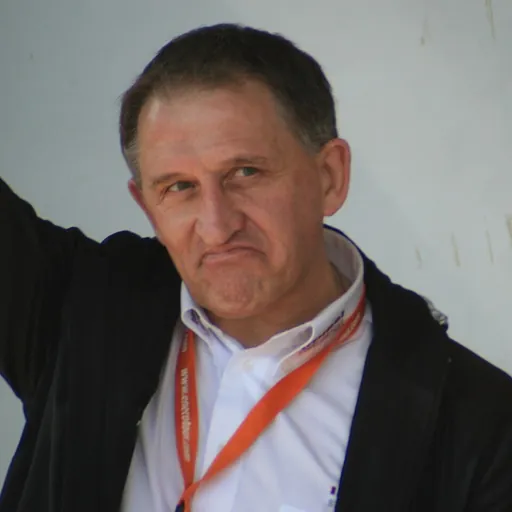
About Freddy Maertens
Born 1952. Freddy Maertens is a Belgian sport cyclist.
Freddy Maertens (born 13 February 1952) is a Belgian former professional racing cyclist who was twice world road race champion. Maertens' career swung between winning more than 50 races in a season to winning almost none and then back again. His life has been marked by debt and alcoholism.
Personal life Maertens was the son of what his wife, Carine, described as a hard-working middle-class couple:
Amateur career
Maertens rode his first race at Westhoek when he was 14, in 1966. The field included riders of 17 and 18, including some from France. The race was open to riders who did not have a licence from the Belgian federation, the BWB. He had trouble riding in a group. His second race went better. Among the riders he beat was Michel Pollentier, later a friend and a team colleague as a professional.
Maertens continued to ride unlicensed races in 1967. In 1968 he took his first licence from the BWB, riding in the nieuweling or beginners' class. He won 21 times and came second 19 times to a rider named Vandromme. His wife described him as trusting and vulnerable, that he needed care because otherwise he would be "like a bird waiting for a cat". He turned professional in 1972. The frame-maker Ernest Colnago and the former champion Ercole Baldini came to his house with an offer to join their SCIC team. They offered to support him in his last year as an amateur and then take him as a professional.
Gilbert Maertens was more impressed by the Belgian businessman, Paul Claeys, who had inherited the Flandria bicycle company. Flandria already sponsored Maertens' club, SWC Torhout, and Maertens rode a Flandria bike. Claeys came to the Maertens house with his team manager, Briek Schotte, a legend in Belgian cycling. Claeys offered Gilbert Maertens a concession for Flandria bikes, allowing him to sell them without first buying them. Maertens pushed his son to sign a contract for 40,000 francs a month as an amateur and then double in his first full year as a professional. The family needed the bike concession because Silonne Maertens had fallen ill and closed her shop.
Maertens said: "I would have preferred to go to SCIC and Colnago but my father said, 'You have to do something for us too.'" He suffered what he called the poor organisation and penny-pinching attitude of Claeys and his Flandria company. It was the start of financial troubles with tax officials (see below).
Rik Vanwalleghem says Maertens was naïve as a new professional. Belgian racing was dominated by Eddy Merckx and Roger De Vlaeminck. Maertens did not observe an unwritten rule that new professionals establish themselves gradually and not try to humiliate established riders. Instead, Maertens, just 21, charged in and upset everyone by demanding they make room for him and make room quickly".
Merckx broke clear on a hill. Maertens said none of the others took up the chase and so he chased by himself. Merckx was angry that Maertens, in his view, had sabotaged his chances of winning. Maertens was the better sprinter.
The two were unable to cooperate and were caught by Luis Ocaña and Felice Gimondi. Maertens agreed to lead Merckx in the sprint and allow him to win. He would be well paid, he understood – "a fantastic offer." The historian Olivier Dazat said Merckx had dropped Driessens as manager of his teams and that Driessens had never forgiven him. Driessens had directed his Romeo-Smith team to ride all year against Rik Van Looy in similar circumstances and now he wanted his revenge against Merckx.
Maertens said: "I enjoyed working with Driessens. There were no problems. When you work with Driessens there are no problems. A lot of people complained about Driessens, saying he took the racers' money, that he did this, he did that. But in the morning, he was the first to wake you, he prepared your food. He was a fabulous organiser".
Equipment war The world championship at Barcelona was complicated by commercial interests. Professional cycling had been dominated by an Italian component maker, Campagnolo. A Japanese rival, Shimano, had recently entered the market. It supplied the Flandria team and designed a range of components specifically for it.
Maertens said Gimondi won because he pushed him into the barriers at the finish. When he demanded Belgian officials protest, he said, they answered: "We can't do that to our Italian friends". Merckx won.
Naessens, now dead, was also Tom Simpson's soigneur when he died in the Tour de France of 1967. The following year he was banned from working in cycling for two years.
1976 world championship
Maertens started favourite for the 1976 world championship, held at Ostuni, in Italy. He came to the race in good form and with the Belgian team lined in his support. Journalists called them the Three Musketeers.
In 1976 he won eight stages of the Tour de France. He won the points classification in 1976 and again in 1978 and 1981.
1977 Vuelta
Maertens won the 1977 Vuelta a España by winning 13 stages, half the total. He imposed his will "like a South American dictator", according to the writer Olivier Dazat.
Wilderness years
There followed a wilderness period in which he did little of note. He started big races but often stopped after 100 km, or was dropped on unremarkable hills.
It made his performance in the 1981 Tour de France and victory in the 1981 world championship in Prague the more remarkable and was regarded as one of the greatest comebacks in cycling history. In the Tour he won the points classification as well as five stages including the final stage into Paris. In the world championship he finished in front of Giuseppe Saronni and Bernard Hinault, two short and stocky riders like himself. Journalists wondered whether the era of tall, lean riders such as Merckx, Gimondi, and De Vlaeminck was over.
A year later his record faded again. He rarely finished races and shone only in round-the-houses races, where his contract fees were needed to pay his tax debts. He did not defend his title in the 1982 world championship at Goodwood, saying he had injured his knee on a gate. He became fatter and rode for small teams for equally small salaries.
Olivier Dazat said: "His employers sacked him and others stepped in to benefit from the publicity. Freddy often forgot to go to races and was fired again. The press and those around him begged him to stop". Rumours intensified when Maertens' successes became erratic.
Maertens was caught in drugs tests. He was first found positive after Professor Michel Debackere perfected a test in 1974 for pemoline, a drug in the amphetamine family that riders believed to be undetectable.
He was disqualified in the Flèche Wallonne of 1977 and found guilty the same year in the Tour de France, the Tour of Belgium and the Tour of Flanders. He also had a positive finding for cortisone in 1986.
Michel Pollentier is quoted as saying: "I told him I could see only one way out for him: to see a psychiatrist, advice he considered stupid. I’ve never hesitated to confess that I spent three weeks under the surveillance of Dr Dejonckheere at the St-Joseph clinic at Ostend and that after treatment I stayed under his control for another two years. Why hide it? It's impossible to come out of a situation like that without the help of a doctor."
Alcohol
Maertens drank champagne during races. He worked as a salesman after retiring, including in Belgium and Luxembourg for Assos, a Swiss clothing company. He left Assos, he said, when supplies became erratic. He kept a distance from the sport. His weight rose to 100 kg. In 2000 he began to work in the Belgian National Cycling Museum ('Nationaal Wielermuseum') in his hometown Roeselare. Many visitors of the museum liked the presence of a real world champion during their visit. In 2008 he moved to the Centrum Ronde van Vlaanderen (Tour of Flanders Center) in Oudenaarde. In 2017, after health problems, he retired. He works when possible as a volunteer or special guest in both museums. The museum in Roeselare is now renamed to 'KOERS. Museum of Cycle Racing'. The bicycle shop "Maertens Sport" in Evergem on the outskirts of Ghent is owned by Freddy's brother Mario.
Career achievements
Road
Amateur 1971
1972 1st GP Roeselare 1st Omloop Het Volk U23 (nl) 1st Omloop van de Westhoek 2nd Ronde Van Vlaanderen Beloften 4th Circuit des Frontières 5th Flèche Ardennaise
Professional 1973
1st Stage 5b (ITT) 1st Scheldeprijs 1st Bruxelles–Meulebeke 1st Leeuwse Pijl 1st Omloop van de Westkust 1st Tour du Condroz 1st GP Roeselare
2nd Tour of Flanders 2nd Kuurne–Brussels–Kuurne 2nd Elfstedenronde 2nd Tour of the Flemish Ardennes 2nd Omloop van de Westkust 3rd Dwars door België 3rd Rund um den Henninger Turm 3rd Omloop van de Grensstreek 3rd Omloop van Oost-Vlaanderen 3rd Liedekerkse Pijl (fr) 4th E3 Prijs Vlaanderen 4th Boucles de l'Aulne 5th Paris–Roubaix 5th Gent–Wevelgem 8th Road race, National Road Championships 8th Amstel Gold Race 9th Grand Prix de Wallonie 1974
1st Prologue a & b, Stages 1, 2, 4, 5 & 6
1st Stages 1 & 2 1st Tour of Leuven
1st Omloop van Midden-Vlaanderen 1st Nokere Koerse 1st Elfstedenronde Tour of Belgium
1st Stages 2, 3 & 4 1st Bruxelles–Meulebeke 1st Izegem Koers (nl) 2nd E3 Prijs Vlaanderen 2nd Grand Prix de Wallonie 2nd Critérium des As 3rd Overall Four Days of Dunkirk 1st Stage 3b (ITT) 3rd Brabantse Pijl 3rd Omloop van Oost-Vlaanderen 4th Overall Grand Prix du Midi Libre 4th Amstel Gold Race 4th Coppa Ugo Agostoni 4th Rund um den Henninger Turm 5th Paris–Tours 5th Overall GP du Midi Libre 5th Boucles de l'Aulne 5th GP Roeselare 6th Overall Tirreno–Adriatico 6th Gent–Wevelgem 6th La Flèche Wallonne 6th Kuurne–Brussels–Kuurne 6th GP Union Dortmund 7th Paris–Roubaix 8th Omloop Het Volk 9th Milan–San Remo 9th Liège–Bastogne–Liège 9th Gran Piemonte 1975
1st Stages 1a, 1b, 5, 6 & 7b
1st Stages 1a (ITT), 1b & 2
1st Stage 3b (ITT) 1st Gent–Wevelgem 1st Paris–Tours 1st Paris–Brussels 1st Tour of Leuven Critérium du Dauphiné Libéré
1st Prologue, Stages 1, 2a, 2b, 3, 4 & 7b (ITT) 1st Bruxelles–Meulebeke 1st GP Roeselare 2nd Amstel Gold Race 2nd E3 Prijs Vlaanderen 2nd Coppa Ugo Agostoni 2nd Trofeo Baracchi (with Michel Pollentier) 2nd Hyon-Mons 3rd Scheldeprijs 3rd Kuurne–Brussels–Kuurne 3rd Gran Premio di Lugano 3rd Critérium des As 4th La Flèche Wallonne 4th Milano–Torino 4th Kampioenschap van Vlaanderen 4th Rund um den Henninger Turm 5th Giro di Lombardia 5th Overall Paris–Nice
1st Stage 2 6th Paris–Roubaix 8th Tour of Flanders 9th Milan–San Remo 1976
1st Stage 2b (ITT) 1st Super Prestige Pernod International 1st Gent–Wevelgem 1st Amstel Gold Race 1st Rund um den Henninger Turm 1st Züri-Metzgete 1st Grand Prix des Nations 1st Brabantse Pijl
1st Trofeo Baracchi (with Michel Pollentier) 1st Critérium des As 1st Stage 1b Escalada a Montjuïc 1st Stage 2 & 3 Tour of Corsica 1st Liedekerkse Pijl (fr) 1st Heusden Koers 2nd Liège–Bastogne–Liège 2nd Grand Prix de Wallonie 2nd Tour de Wallonie 2nd Omloop van de Grensstreek 2nd G.P Betekom 3rd Overall Tour of Belgium 1st Stage 1a (ITT) 3rd La Flèche Wallonne 4th Overall Paris–Nice
1st Prologue, Stages 2, 3, 4, 6a & 6b 4th Paris–Brussels 4th Tour du Condroz 5th Tour of Flanders 5th GP Roeselare 6th Grand Prix of Aargau Canton 7th Overall Tour de Suisse
1st Prologue & Stage 1 8th Overall Tour de France
1st Prologue, Stages 1, 3 (ITT), 7, 18a, 18b, 21 & 22a (ITT)
8th Overall Ronde van Nederland
1st Stages 5a & 5b (ITT) 1977
1st Prologue, Stages 1, 2, 5, 6, 7, 8, 9, 11a (ITT), 11b, 13, 16 & 19
1st Prologue, Stages 1a, 1b, 2 & 7b (ITT)
1st Prologue, Stages 1, 3b, 4b & 7a (ITT)
1st Stages 1b, 4, 5a & 5b (ITT)
1st Stage 1 1st Omloop Het Volk 1st Trofeo Laigueglia Giro d'Italia 1st Prologue, Stages 1, 4, 6a, 6b, 7 & 8a
1st Stage 1 Tour de Suisse 1st Stage 3 Ronde van Nederland 1st Delta Profronde 1st G.P Malderen 1st Super Prestige Pernod International 2nd Tour of Flanders 2nd Trofeo Baracchi (with Joop Zoetemelk) 2nd Giro del Mendrisiotto 3rd Paris–Roubaix 5th Milan–San Remo 5th Liège–Bastogne–Liège 5th Amstel Gold Race 8th Overall Escalada a Montjuïc 8th Paris–Brussels 8th Grand Prix de Wallonie 9th Overall Tour of Belgium 1978
1st Stages 2a & 2b 1st Omloop Het Volk 1st E3 Prijs Vlaanderen 1st Tour du Haut Var 1st Châteauroux Classic Tour de France
1st Stages 5 & 7 1st Stage 7a Critérium du Dauphiné Libéré 1st Stage 5 Tour de Suisse 1st Heusden Koers 2nd Overall Tour of Belgium
2nd Overall Vuelta a Mallorca 1st Stage 2b 2nd De Kustpijl 2nd Bruxelles–Meulebeke 4th Paris–Roubaix 4th Amstel Gold Race 5th Grand Prix of Aargau Canton 6th Trofeo Laigueglia 8th Tour of Flanders 9th Liège–Bastogne–Liège 9th Gent–Wevelgem 1979 9th Primus Classic 1980 1st Stage 1 Cronostafetta 3rd Omloop van West-Brabant 6th Tour of Flanders 6th Giro di Campania 6th Trofeo Pantalica 1981
Tour de France
1st Intermediate sprints classification 1st Stages 1a, 3, 12a, 13, & 22 Vuelta a Andalucía
1st Stage 4 3rd Omloop van West-Brabant 7th Milan–San Remo 10th Dwars door West-Vlaanderen 1982 1st Hyon-Mons 9th Overall Three Days of De Panne 1983 1st G.P du Printemps à Hannut (fr) 7th Grand Prix Pino Cerami
Track
1975 2nd Six Days of Grenoble, Madison
1976 1st Six Days of Dortmund (with Patrick Sercu) 2nd Six Days of Antwerp (with Dieter Kemper) 3rd National Track Championships (fr), Madison (with Marc Demeyer) 1977
1st Six Days of Antwerp (with Patrick Sercu) 2nd Six Days of Ghent (with Danny Clark) 2nd Six Days of Milan (with Marc Demeyer)
1978 1st Six Days of Antwerp (with Danny Clark)
Grand Tour general classification results timeline
Classics & Monuments results timeline
Major championship results timeline
+ Legend — Did not compete DNF Did not finish DNS Did not start DSQ Disqualified
Records
Most stage wins in 1 Tour de France: 8 in 1976 (record shared with Charles Pélissier and Eddy Merckx) Most stage wins in 1 Vuelta a España: 13 in 1977 Most Grand Tour stage wins in 1 season: 20 in 1977 (13 stages in the Vuelta a España and 7 in the Giro d'Italia) Most wins in Four Days of Dunkirk: 4 in 1973, 1975, 1976, 1978 Most wins in Bruxelles–Meulebeke: 3 in 1973, 1974, 1975
Awards and honours
Ruban Jaune: From 1975 to 1997 (record) Gan Challenge: 1976, 1977 Swiss Mendrisio d'Or: 1976 Belgian Sportsman of the Year: 1981, Runner-up: 1976 Introduced in the UCI Hall of Fame: 2002 Memoire du Cyclisme – 20th Greatest Cyclist of all Time: 2002 Honorary Citizen of Middelkerke: 2004 Bust in Lombardsijde: 2005 CyclingNews 5th Best Sprinter of All Time: 2023 UCI Top 100 of All Time: 3,955 points Procyclingstats.com – All Time Wins Ranking: 10th place (147 wins)
Don’t just read it —
keep it.
Full-length biographies made to live with: read them, listen on the way to work, watch them tonight.
- E-book
- Audio
- Video
Instant download · yours to keep · every purchase keeps this site free
Important facts
People in Freddy Maertens's life
Named in this biography and alive at the same time


Related people
Same field, nearest in time



Contemporaries
People whose lives overlapped Freddy Maertens's

Frequently asked questions
Who is Freddy Maertens?
Belgian cyclist
When was Freddy Maertens born?
Freddy Maertens was born on 13 February 1952 in Nieuwpoort.
What is Freddy Maertens's occupation?
Freddy Maertens is a sport cyclist.
What nationality is Freddy Maertens?
Freddy Maertens is Belgian.
Sources & further reading
Cite this page
APA: Biography.guide. (2026). Freddy Maertens. https://biography.guide/freddy-maertens/
MLA: "Freddy Maertens." Biography.guide, https://biography.guide/freddy-maertens/.
Chicago: "Freddy Maertens." Biography.guide. https://biography.guide/freddy-maertens/.
Data last updated: 2026-09-20 · Spot an error? Report a correction.
Page generated 2026-09-27 05:09 UTC