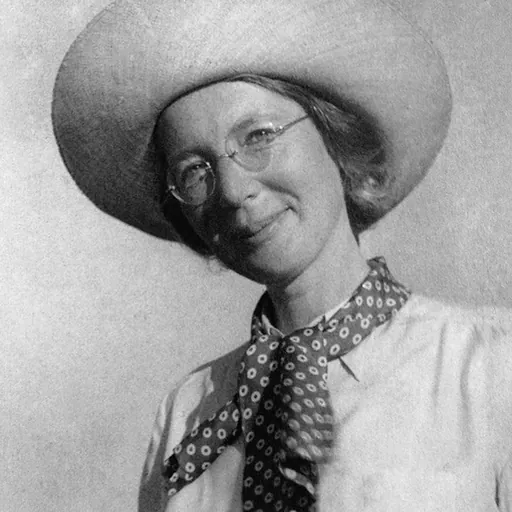
Franzisca Baruch
German-Israeli calligrapher and font designer
About Franzisca Baruch
Lived 1901 – 1989 (aged 87). Franzisca Baruch was an Israeli and German designer, graphic designer, typesetter and calligrapher.
Franzisca Baruch (; 21 November 1901 – 3 September 1989) was a German–Israeli graphic designer. She is known for designing Hebrew fonts, the cover of the first Israeli passport, the emblem of Jerusalem, and the logo of the Ha'aretz newspaper.
Biography Early life and career in Germany
Franzisca Baruch was born in Hamburg, Germany in 1901. Her father died when she was four; she and her sister Anna then lived with their grandmother; their mother studied in the State Academy of Music in Berlin at that time. At the age of 17 she was admitted to the (State School of Arts and Crafts). Baruch studied decoration, illustration, graphics, and lettering. she also took private courses in handwriting with Else Marcks-Penzig. In 1920 she won the first prize for designing Christmas plates for the porcelain manufacturer of the Prussian Royal house. To prepare for that work she studied the medieval Jewish manuscripts and the in the library of the Jewish community in Berlin. The Book of Jonah was published in 1953, and the Book of Ruth in 1957, both with lettering done by Baruch and illustrated by Steinhardt. Baruch also created covers for books by famous Jewish writers and artists, including Hayim Nahman Bialik, Shmuel Yosef Agnon, and Shaul Tchernichovsky. One of the notable works was the design of the cover and letters of Bialik's book from 1923, Ketina Kol-Bo, inspired by a manuscript of the Bible copied in Spain in the 15th century by Moshe Ibn Zabara and the Yosef Ibn Chaim. She also created a thinner version of this script for the orientalist Leo A. Mayer, who taught at the Hebrew University of Jerusalem. A new cut of this typeface was later offered as "Mayer-Baruch" by Moshe Spitzer's Jerusalem Type Foundry. She also participated in the design of first Israeli banknotes, probably under the supervision of Otte Wallish, but was not credited. Several sketches were found in her archive after her death.
As Ha'aretz put it:
Her acquaintance told Ha'aretz, that Baruch "belonged to a group of artists who would meet on Fridays at Cafe Tamon in front of the old Knesset. They all spoke German. She herself did not know a word of Hebrew. The letters she designed were graphic forms with no program meaning".
Baruch recalled the story of the design of the Israeli passport in an interview in 1984:
Passports with Baruch's design were used until 1980.
Family and personal life Baruch's father died when she was a child. Her mother, Augusta, and her sister, Anna, were murdered in Theresienstadt concentration camp in 1943; Baruch only found out about this nine years later through the Red Cross.
An acquaintance of Baruch, who stayed anonymous, described her to Ha'aretz as "a childless woman, dressed in masculine clothes, tall, walking like a camel. The walls of her small apartment were white and bare, empty of any decoration. With such a view she did not need decorations, she would say, and indeed her balcony overlooked the Old City".
She lived alone in Jerusalem, on Shmuel Hanagid street. Baruch died in Jerusalem in 1989. She never married and had no children. After her death, her will was taken care of by her close friend and her investment advisor, Ilsa Rosenthal, who donated her archive to the Israel Museum.
Recognition
Designers Henri Friedlaender and Gideon Stern wrote about Baruch's design that it combines natural, unsophisticated pureness of form with an instinctive feeling for the reach and limits of graphic possibilities. The completed design looks as if it could not be different, inspired by a sober yet imaginative sense for the right form. Her own personality is hidden behind her absolute dedication to the task before her, the job always came first. She barely made a living from her work, yet she contributed unmeasurably to the renaissance of the modern Hebrew letter and graphic design in Israel.
Oded Ezer, a Bezalel Academy graduate who teaches in the Department of Visual Communication at the Institute of Technology said of Baruch: I always call her 'the first lady of Hebrew typography' for historical reasons. She was the first woman and she remains the most significant woman in this field. There is no typographer, font designer or graphic designer who studied at one of the institutions in the country who does not know her name.
Gil Weissblai, an archivist at the National Library of Israel and researcher of the history of the Hebrew book, said that "Francesca Baruch was... unique as an artist, one of the greatest and most talented graphic artists who worked in Israel. She belongs to a different generation, of artists who had not signed their works and had not received credit for them."
Exhibitions
2015–2016: New Types. Three Pioneers of Hebrew Graphic Design. Palevsky Design Pavilion, Israel Museum in Jerusalem 2017: New Types, Museum für Druckkunst in Leipzig
Don’t just read it —
keep it.
Full-length biographies made to live with: read them, listen on the way to work, watch them tonight.
- E-book
- Audio
- Video
Instant download · yours to keep · every purchase keeps this site free
Important facts
People in Franzisca Baruch's life
Named in this biography and alive at the same time


Related people
Same field, nearest in time

Contemporaries
People whose lives overlapped Franzisca Baruch's


Frequently asked questions
Who was Franzisca Baruch?
German-Israeli calligrapher and font designer (1901–1989)
When was Franzisca Baruch born?
Franzisca Baruch was born on 21 November 1901 in Hamburg.
When did Franzisca Baruch die?
Franzisca Baruch died on 3 September 1989 in Jerusalem.
What was Franzisca Baruch's occupation?
Franzisca Baruch was a designer, graphic designer, typesetter and calligrapher.
What nationality was Franzisca Baruch?
Franzisca Baruch was Israeli and German.
Sources & further reading
Cite this page
APA: Biography.guide. (2026). Franzisca Baruch. https://biography.guide/franzisca-baruch/
MLA: "Franzisca Baruch." Biography.guide, https://biography.guide/franzisca-baruch/.
Chicago: "Franzisca Baruch." Biography.guide. https://biography.guide/franzisca-baruch/.
Data last updated: 2026-09-22 · Spot an error? Report a correction.
Portrait: Wikimedia Commons · author & licence
Page generated 2026-09-27 05:04 UTC