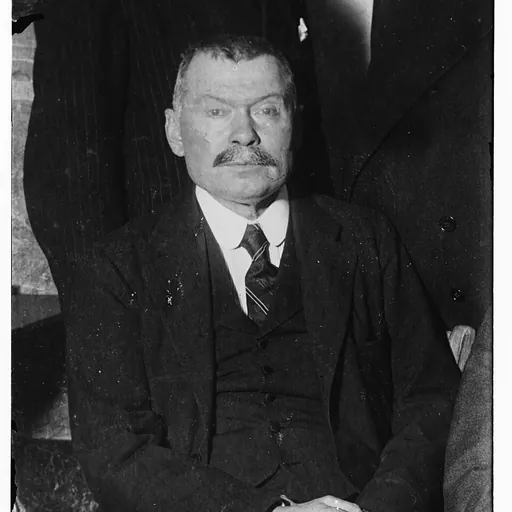
About Franz Urbig
Lived 1864 – 1944 (aged 80). Franz Urbig was a banker, scribe, chairman of the supervisory board and supervisory board.
Franz Urbig (23 January 1864 – 28 September 1944) was a German banker. He joined the Disconto-Gesellschaft as a trainee on 15 July 1884 and built much of his career and reputation within this bank in Southeast Asia during the final part of the nineteenth century. Between 1902 and 1929, when the bank merged with the larger Deutsche Bank, he was a partner in the Disconto-Gesellschaft. Between 1930 and his death in 1944 he was chairman of the supervisory board at the enlarged Deutsche Bank. His long career was not without controversy.
After he died the Villa Urbig, the large family home on the western edge of Berlin which he had commissioned in 1915 and which had been designed by Ludwig Mies van der Rohe, brought Urbig enhanced posthumous publicity in the English-speaking world of a kind he cannot have anticipated. It became the setting for some of the most carefully staged and widely viewed press photographs of the post-war period. During the first part of 1945 surviving family members were forcibly ushered out by Soviet troops: three months later British Prime Minister Churchill moved in with a large retinue of staff. The plan was for Churchill to use the residence for the duration of the Potsdam Conference, but in the event, following a United Kingdom national election in July 1945, Churchill moved out and Prime Minister Attlee moved in for the conference's later stages.
Life Provenance and early years Franz Urbig was born in Luckenwalde, a small town south of Berlin along the main railway line towards Halle and Leipzig: Urbig himself would later describe Luckenwalde as a "typical manufacturing town of its time". His father worked in the cloth trade, in the end becoming a factory foreman in a textiles company.
Disconto-Gesellschaft (bank) After joining the bank Urbig mastered the theory and practice of banking with what several sources refer to as "iron energy". Most of the parts of the world in which the bank saw the greatest opportunities for expansion were component territories of the British or French empires. He used his spare time to master English and French.
Shanghai years In 1894 he was sent to Shanghai which was where the recently established Deutsch-Asiatische Bank (DAB / 德華銀) had its main office. The bank had been set up and funded in 1889 by a consortium of thirteen major and private German banks, of which the Disconto-Gesellschaft was one. Appointed "Prokurist", Urbig enjoyed authority to make commitments on behalf of the bank. In 1895 he took on the leadership of the DAB's subsidiary in Tianjin. Back in Shanghai, in 1896 Urbig had been appointed to membership of the bank's board of directors. In 1896 and again in 1898 it was Urbig who led the negotiations in respect of two very large DAB bank loans to the Chinese government. Although China had never been incorporated into the British Empire, there was by this time intensifying jostling between the British, French and German governments for the inclusion of China in their respective spheres of imperial influence: providing German capital to a government that till now had accepted western capital investment almost exclusively from the British raised political sensitivities which made Urbig's negotiations particularly difficult. Recalled to Shanghai, following a brief visit home to Germany, in 1898 he was mandated to work on setting up the bank's Hong Kong operation. In 1900 he was moved to London where he was briefly involved in setting up the local branch of Disconto-Gesellschaft, of which he became deputy chairman. On 23 November 1902, having returned to Berlin, he became a "Geschräftsinhaber",
War and postwar period The onset of the First World War destroyed a large part of Franz Urbig's life's work. The globalisation of world trade which up till 1914 had underpinned more than three decades of rapidly growing prosperity - especially for western Europe and the United States - was thrown into reverse for more than a generation. Urbig resigned his mandate as a member of the German delegation, with the parting advice that the conditions proposed (and subsequently imposed) by the war's military victors could never provide the basis for a lasting peace. In 1924 Franz Urbig was one of seven German nationals appointed to the newly formed General Council of the Reichsbank (German central bank)
Bank merger As part of the 1929 merger of the Disconto-Gesellschaft with the larger (but conspicuously less well capitalised) Deutsche Bank Franz Urbig, who was reaching what many would have seen as a conventional retirement age, became a member of the oversight board of the merged entity. Nevertheless, more recent sources state that both Oscar Wassermann and Theodor Frank were "driven" to resign from the Deutsche Bank board in 1933. Georg Solmssen, a Jew by birth who had subsequently been baptised a Christian, managed to hang on as a board member till 1934 and then switched to the supervisory board, from which he was forced to resign only in 1936. There is no sign that Franz Urbig was a particular supporter of the National Socialists (nor of any other political party), but there is also no sign that he saw it as part of his role to stand out against the tide of government antisemitism. According to at least one source, as early as 1933 the supervisory board of the bank included at least one member who had been planted there by the government. It was here that the Urbigs' children grew up.
Between 16 July and 25 July 1945 the Villa Ubrig was briefly home to Winston Churchill, who was attending the Potsdam Conference nearby. He was accompanied by his 21-year-old daughter (who stayed on for an extra week after her father returned to England) and a substantial retinue of support staff. but had up till this point been relegated to more modest accommodation in the town. (In England the party led by Attlee had already won the 1945 General Election even before Churchill's party set sail for the Potsdam conference, but it took several weeks before all the votes could be counted and the results confirmed and declared. )
After the war the Villa Urbig found itself in Berlin's Soviet occupation zone (relaunched in October 1949 as the Soviet sponsored German Democratic Republic (East Germany). It was used for many years as a guest house for the "Walter Ulbricht" [East] German Academy for political and legal studies ("Deutsche Akademie für Staats- und Rechtswissenschaft "Walter Ulbricht" "). It was also used for more directly educational purposes, including the training of East German diplomats.
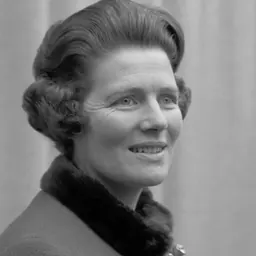
Following 1990 the Villa Urbig reverted to private ownership. In 2005 it was acquired by Theodor Semmelhaack, a successful businessman and property developer who comprehensively restored it. Semmelhaack attracted criticism in English newspapers in 2006 when he refused to allow a plaque to be placed on his "private residence" celebrating its Churchill connections. Under pressure he nevertheless agreed that Mary Soames, who by this point was Winston Churchill's only surviving child, was very welcome to visit and look around: "It's empty at the moment. But I can get someone from my office to let her in".
By 2009 the villa had become home to an icon of German capitalism almost as iconic as Franz Urbig himself. Having for some time lived in the villa as a tenant, that year the software entrepreneur Hasso Plattner purchased it.
Don’t just read it —
keep it.
Full-length biographies made to live with: read them, listen on the way to work, watch them tonight.
- E-book
- Audio
- Video
Instant download · yours to keep · every purchase keeps this site free
Important facts
People in Franz Urbig's life
Named in this biography and alive at the same time
Related people
Same field, nearest in time



Contemporaries
People whose lives overlapped Franz Urbig's




Frequently asked questions
Who was Franz Urbig?
German banker (1864–1944)
When was Franz Urbig born?
Franz Urbig was born on 23 January 1864 in Luckenwalde.
When did Franz Urbig die?
Franz Urbig died on 28 September 1944 in Babelsberg.
What was Franz Urbig's occupation?
Franz Urbig was a banker, scribe, chairman of the supervisory board and supervisory board.
What nationality was Franz Urbig?
Franz Urbig's recorded nationality: German Reich.
Sources & further reading
Cite this page
APA: Biography.guide. (2026). Franz Urbig. https://biography.guide/franz-urbig/
MLA: "Franz Urbig." Biography.guide, https://biography.guide/franz-urbig/.
Chicago: "Franz Urbig." Biography.guide. https://biography.guide/franz-urbig/.
Data last updated: 2026-09-22 · Spot an error? Report a correction.
Portrait: Wikimedia Commons · author & licence
Page generated 2026-09-27 05:02 UTC